

Israel and Spain: Mediterranean leaders in water management
In Southern Europe, 30 per cent of the population lives in areas experiencing permanent water stress. With temperatures such as those we are currently seeing, this figure could rise to 70 per cent. The NextMed report assesses the countries bordering the basin. The ranking sees Tel Aviv and Spanish cities at the top. Malta performs well. Italia and Spain show mixed results. The best water cycle? New infrastructure, but also balancing demand, reducing leaks and promoting reuse.
by 24Ore NextMed
 Aggiungi Il Sole 24 Ore
ai preferiti su Google
Key points
Water is not merely a resource, but a technological and social objective. The EEA, the European Environment Agency, reports that in 2023 water scarcity affected 28 per cent of the territory and 32 per cent of the population of the European Union. In southern Europe, around 30 per cent of the population lives in areas under permanent water stress, and this figure can rise to 70 per cent during the summer. Cyprus and Malta face particularly severe conditions. Turkey is identified as the most vulnerable country among those covered by the EEA. Improving resilience depends not only on new infrastructure, but also on demand management, ecosystem restoration, reduced water losses and water reuse. The Mediterranean basin is one of the world’s main climate hotspots. MedECC, the Mediterranean Expert Centre on Climate and Environmental Change, has found that, whilst the global average temperature has risen by around 1 degree compared with the pre-industrial era, the Mediterranean had already warmed by around 1.5 degrees, with even higher summer values. Summer rainfall could decrease by between 10 per cent and 30 per cent in various areas of the basin in the coming years. This simultaneously leads to: reduced groundwater recharge; increased evaporation from reservoirs; rising urban demand; deterioration in water quality; saltwater intrusion; and damage to water networks and treatment plants. But also more intense storms. Water scarcity and excess thus become two sides of the same crisis. In other words, Mediterranean countries that currently demonstrate the best water cycle management are not necessarily those with the greatest water resources, but those that have succeeded in transforming water availability into a well-governed, technologically equipped and resilient system.
NextMed’s report on water
A report produced as part of the NextMed Observatory, building on the premises set out by the EEA, analysed the water cycle management capacity of the main Mediterranean cities with the aim of drawing up a country-level ranking. The ranking does not simply reward the abundance of resources, but rather the ability to organise supply, distribution, reuse, treatment, leakage control and response to climate crises. From this perspective, the most advanced cases in the Mediterranean are primarily Israel and Spain, followed by Malta and, in the second tier, Cyprus. Greece, France and Italia show more mixed results, whilst in North African countries the picture appears, on average, more fragile or less well-established.
Israel and Spain: the best systems
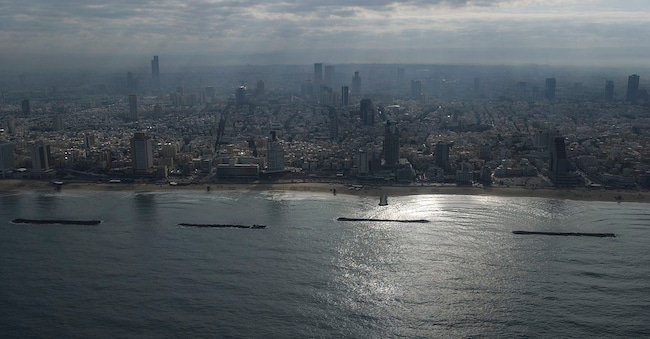
The report identifies Israel as the leader, represented by the urban system Tel Aviv-Gush Dan, described as the ‘overall capital of water and water resilience in the Mediterranean’. This is due to a combination of factors: large-scale seawater desalination, an interconnected national network, the systematic reuse of wastewater, widespread metering, and the integration of drinking water, agriculture and treatment, as well as strong technological and organisational capacity. The report notes in particular that Israel reuses over 80 per cent of its treated wastewater for agriculture, and that a very significant proportion of its drinking water now comes from desalination. In other words, Israel is presented as the most advanced Mediterranean model for transforming water from an uncertain natural resource into a programmable, stable and resilient service.
The second major example is Spain, which does not dominate through a single city, but through a truly widespread urban network of centres of excellence. Indeed, the list of the fifteen finalists identified by the report includes Madrid, Barcelona, Valencia, Alicante and Murcia, a sign of broad and structural managerial quality. Madrid is ranked second overall and is cited as a leader in network efficiency and catchment area governance, thanks to integrated management, robust planning, financial capacity and the minimisation of losses. Barcelona is recognised for its efficiency in demand management, urban resilience and the growing diversification of its water sources. Valencia is a city that strikes a good balance between water reuse, demand management, innovation, water availability and integration with the agricultural system. It must be said that the Catalan crisis of 2023–2024 demonstrated that even an advanced region can approach a critical threshold when the entire catchment system is affected by drought. Overall, the report indicates that Spain is now the most advanced Mediterranean nation in terms of water cycle management – that is, in its ability to coordinate networks, consumption, reuse, planning and climate adaptation.
Island models
A third example of best practice is Malta. Its situation is particularly significant because it is an island nation, with few natural resources and highly vulnerable to water stress. It is precisely for this reason that the report considers it a model of adaptation: the integration of reverse osmosis, aquifers, leakage control and water treatment, with a highly rational and continuous management approach. Cyprus also ranks highly. The Nicosia-Limassol system is listed amongst the finalists and is described as a heavily desalinated system with a good capacity to respond to water scarcity. Although it does not reach the level of the Israeli and Spanish leaders, Cyprus is nevertheless considered a country that has managed to build a degree of water security through infrastructure and management.

