
Israel-Iran, from Erbil to Lebanon: Italian bases on alert
On 24 June, the new commander of Unifil will take office, who this time will be Italian, General Diodato Abagnara

4' min read
Key points
4' min read
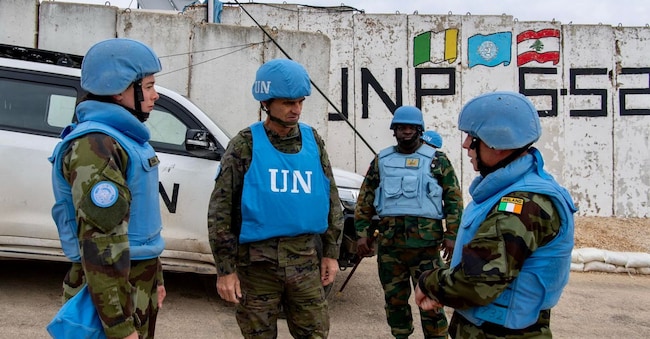
The escalation in the clash between Israel and Iran has resulted in an increased level of alertness in neighbouring countries. These include Lebanon, which borders Israel to the south. Here, in the southern part of the country, Unifil (United Nations Interim Force in Lebanon), a UN mission, has been active since March 1978, i.e. since Israel's invasion of the cedar country. Established by UN Security Council Resolution 425, the mission's duration has been extended by successive resolutions every six months. About 10,000 soldiers participate, 47 nations are involved.
Since the Israeli military withdrawal in 2000, the mission has been responsible, among other things, for demarcating the blue line that effectively separates Lebanon from Israel. After the 2006 war, the mission was reinforced with a new mandate drawn up by Resolution 1701. After the latest conflict between Hezbollah and Israel, which was interrupted by the ceasefire last November, Resolution No.1701 was reinforced with a series of measures on the ground. Among the functions carried out by the Blue Helmets are monitoring the (permanent) cessation of hostilities, accompanying and supporting the Lebanese Armed Forces (LAF) in their redeployment in the south of the country, including the Blue Line, and coordinating the withdrawal of the IDF, i.e. the Israeli Defence Forces, from the occupied Lebanese territories and the redeployment of the LAF in the same territories once they have been vacated by the Israelis. Unifil's military must also prevent the resumption of hostilities by maintaining a buffer area between the Blue Line and the Litani River that is free of armed personnel, assets and weapons other than those of the Lebanese government and the UN mission itself.
To what extent Italy participates in Unifil
.The Italian participation in the Unifil mission began in July 1979, with an Army helicopter squadron, equipped with 4 aircraft and consisting of about 50 soldiers, with reconnaissance, search and rescue, medical transport and liaison tasks. Currently, the maximum annual number authorised by Italy for the national contingent deployed in the mission is 1,256 military personnel, 374 land vehicles and 6 air vehicles. In fact, 1,100 Italian military personnel are deployed. In the national context, the operation is called 'Leonte'. The Pozzuoli del Friuli Brigade, commanded by Brigadier General Nicola Mandolesi, took over the baton from the Sassari and last February assumed responsibility for Sector-West, with the Bilateral Mission for Lebanon (MIBIL) and the Military Technical Committee for Lebanon (MTC4L).
Not only Unifil: Italian soldiers in the Middle East
More generally, in the Middle East, Italian contingents are deployed in Erbil, in northern Iraq, in Rafah - with the presence of the Carabinieri - and in Lebanon, as an integral part of Unifil. From Erbil to Lebanon, to Rafah, the men and women of the Italian armed forces continue their commitment in the operational theatres unabated, even though - as Defence Minister Guido Crosetto himself stressed - "there should be no specific problems for our bases". The tension, however, is increasing by the hour, while the skies over Iraq - as well as over Lebanon - are being furrowed by the trails of Iranian and Israeli missiles in a war that shows no sign of abating. An increase in the level of attention is inevitable, as ordered by the Chief of Defence Staff, General Luciano Portolano. "In a multidimensional and multinational domain, the elements on the table are the success, or failure, of a nuclear agreement with Iran, the geopolitical contiguity of states, actors, interests, resources, alliances and rivalries," he explained in an interview with Corriere della Sera. "Up to hypotheses of greater amplitude and seriousness, with the risk of deflagration and extension of the open conflict to neighbouring countries. "There is a level of attention that has increased," Minister Crosetto added from Montecitorio, "as in all times when, unfortunately, there are events of this type and security conditions worsen.
Unifil: new Italian commander takes office on 24 June
Meanwhile, however, there is also expectation for the installation ceremony of the new Unifil commander, who this time will be Italian, General Diodato Abagnara. He takes the place of the Spanish General Aroldo Lazaro. The handover will take place on 24 June, precisely at one of the worst moments of the crisis between Beirut and Tel Aviv. At the end of May, the UN mission reported that over the past six months it had identified more than 225 weapons depots in the area from the Litani river to the Blue Line. This is also the reason why there have been numerous episodes of tension and clashes between the local population and the Blue Helmets since December.


