
Green light from the House for international missions for 2025: here are what they are and how much they cost
The measure provides for expenditure of approximately EUR 1.5 billion for 2025, earmarked for the continuation of interventions aimed at peace, cooperation and human rights objectives

7' min read
Key points
- High and Very High Operational Readiness Force
- Country training of personnel of the Ukrainian Armed Forces
- Lebanon and the training of Palestinian security forces
- West Africa: the mission in Niger
- Police and Gdf missions
- Safe Streets
- The critical issues highlighted by the International Research Institute Archivio Disarmo
7' min read
First green light from the Chamber of Deputies for the extension of international missions and new operations for 2025. A total of 39 international operations and missions are underway (17 extended against 36 in the previous year), with an average size of 7,750 units, a maximum authorised contingent of 12,100 units and a total financial burden of 1.48 billion, with a breakdown over two years: 980 million in 2025 and 500 million in 2026.
Here are some of the approved missions, including extended and new ones.
The contingent of high and very high operational readiness forces
.The Government - and this is a novelty - has requested authorisation to set up a contingent of forces with high and very high operational readiness, to be deployed, under an accelerated procedure, when crises or emergencies occur. Once the identification of these forces has been authorised by Parliament, their actual deployment, at the time of the occurrence of the crisis or emergency, must in any case be deliberated by the Council of Ministers, after notifying the President of the Republic. The resolution is forwarded to the Houses of Parliament, which, within five days, either authorise their use or deny their authorisation by means of specific policies, in accordance with their respective regulations. Within 90 days of the approval of the authorisation guidelines, the Government reports to Parliament on the continuation of the crisis or emergency situations that led to the actual deployment of the forces. This contingent can also be used to feed the national contingent within the NATO Allied Reaction Forces (ARF). The latter are a highly reactive and versatile multinational force, ready to intervene at any time to protect allied interests and ensure stability in the Euro-Atlantic region. "The scenario," recalled the Chief of the General Staff, General Luciano Portolano, in a hearing at the end of March before the Foreign and Defence Committees of the House and Senate, "has suddenly returned centrality to defence and to readiness and deterrence. Our armed forces must be able to defend Italy, peace and democracy, and the Euro-Mediterranean spaces at all times. We need a military instrument that is a credible bulwark of agile and adaptive defence. Our intention is to pursue this in a choral manner'.
Country training of Ukrainian Armed Forces personnel
.The extension of the military training mission EUMAM Ukraine (European Union Military Assistance Mission) until 31 December 2025 gets the first green light. The mission was established by the EU Council on 17 October 2022, responding to the Ukrainian authorities' request for support in the area of military training. The aim is to contribute to the strengthening of the military capacity of the armed forces, to enable Ukraine to defend its territorial integrity and protect civilians. In order to achieve its objectives, the mission provides individual and collective training to the personnel of the Ukrainian armed forces, at basic, advanced and specialised levels; specialised training to the personnel of the Ukrainian armed forces; training to the territorial defence forces; coordination of the training activities of the Ukrainian armed forces conducted bilaterally by the Member States. Italy contributes to the mission through specific training modules conducted on its territory for the benefit of Ukrainian Armed Forces personnel. The mission is currently set to expire on 15 November 2026.
Lebanon and the training of Palestinian security forces
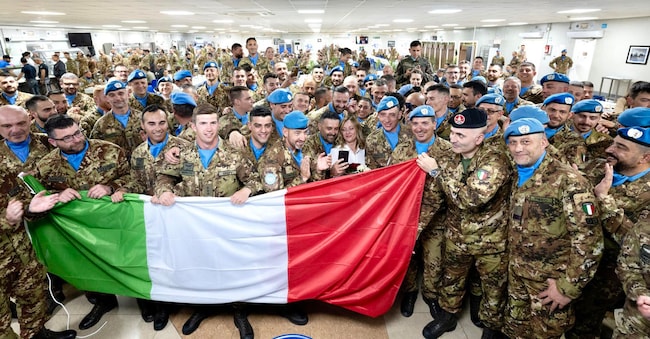
The escalation of the conflict between Israel and Hezbollah threatens to fully involve Lebanon, already destabilised by a serious economic, social and political crisis. The extension of the hostilities that have spread from the 'Blue Line' to large areas of Lebanese territory risk aggravating the already complex situation. The picture is further complicated by the difficult management and the risk of radicalisation of Syrian refugees, a significant factor of regional and international instability, with repercussions on migration and the security of European countries themselves. The Chamber approved the extension of the deployment of military equipment in the area of Lebanon and the Eastern Mediterranean. It concerns the 'United Nations Interim Force in Lebanon (UNIFIL)' operation and the 'Lebanese Armed Forces Bilateral Training Mission (MIBIL)' operation. There is also a third mission that is being extended: the 'Operation Bilateral Training Mission for Palestinian Security Forces (MIADIT)'. The maximum size of the total national contingent deployed in the three missions is 1,650, 376 land vehicles, 1 naval vehicle and 5 air vehicles. The financial requirement for the period from 1 January to 31 December 2025 is €177,640,912 of which €46,289,000 is for obligations due in 2026. It must be remembered that in 2024, Italy participated in Unifil with a maximum size of the national contingent employed set at 1,292 units, 375 land vehicles, 7 air vehicles and 1 naval vehicle; for Mibil, instead, the maximum size of the national contingent employed in the mission was set at 105 units. Finally, for Miadit, a maximum contingent of 39 was planned.


