Space

Iss crew returned early: what are the health risks in space

This time it went well, because solving these problems in orbit is complicated. How has it gone so far and what are the most likely cases?

by Leopoldo Benacchio

Rientrata la missione Crew 11, i quattro membri dell'equipaggio escono dalla navetta

4' min read

Translated by AI
Versione italiana

4' min read

Translated by AI
Versione italiana

Oleg Platonov, Mike Fincke, Zena Cardman and Kimiya Yui returned safely to Earth. The four astronauts of Crew 11 of the International Space Station, ISS, ditch landed at 03:41 EST on 15 January 2026, or 09:41 Italian time, CET, on 15 January, off the coast of California.

Everything went well then and the concern over re-entry has passed; as is well known, they were pulled back a month before the scheduled end of their mission because at least one of the participants had a health condition described as 'serious' that did not allow him to stay in orbit.

Loading...

Nothing is known of any of the four, for obvious reasons of privacy, but all appeared to be in acceptable condition, at least at first glance. Now they will all be taken for the usual medical examination in hospital at the end of a long mission, we are talking about six months.
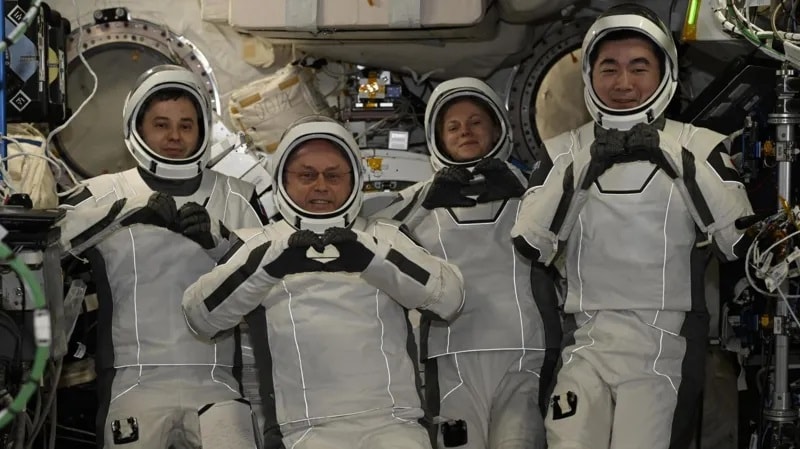
A bordo della Crew 11

Equipaggio

It is the first time that astronauts have been evacuated for health problems since the station was put into Earth orbit in 1998. Jared Isaacman, recently confirmed as Nasa administrator after a stormy process due to President Trump's second thoughts, confirmed that the ailing astronaut "is fine right now" and is "in good spirits". However, the crew that ditched today had been in the ISS since 1 August; thus, 85 per cent of the mission was completed.

On the Iss, Russian cosmonaut Sergey Kud-Sverchkov currently remains in command, along with two other members
The ISS is the largest artefact ever built to orbit the Earth, the size of a football field, travelling at an average speed of 27600 km/h and performing almost 16 orbits in one solar day at an altitude of between 330 and 410 kilometres. It is operated by five space agencies, including of course the European space agency Esa, and also carries out scientific research into the effects of life in microgravity on humans, animals and plants.

It is worth remembering that50% of the walkable surface of the ISS was built by Italian companies, Thales Alenia Space in the lead.

Rientrata la missione Crew 11, ammaraggio al largo della California

The ISS, given the long shifts the crews are used to, carries medicines and medical equipment for minor problems. Although the astronauts are selected and trained people and only leave if they are in excellent health, an emergency can happen.

All in all, at the end of the day, we can say that the rescue procedure worked perfectly, not least because the, or the, astronaut in need of 'terrestrial' care coped very well with the short period of time required for re-entry. Of course, had it been more serious or more urgent, who knows how it would have gone.

For the rest, astronauts when in orbit have problems that are very common even to ordinary mortals: cconcussions from minor bumps, nausea, dizziness, headaches, skin irritations and the list would be as long as it is trivial.

The medical risk models used by NASA, Integrated Medical Model, estimate that for low-orbit missions of weeks the probability of having to evacuate the ISS is 1%, so this time we got there, for missions of years on the other hand, the probability increases dramatically, and this is quite a problem for a trip to, say, Mars, which requires many weeks and months of travel and stay.

The Moon is a case a little in the middle and with a noticeable difference depending on whether the crew is on lunar soil or in orbit around our satellite. This is the next case study to be solved in the best possible way, given the restart in the coming weeks of the Artemis Programme for the stable return to the Moon.

The most serious accidents in space

The overwhelming majority of accidents, from the 1960s to the present day, have in any case occurred on Earth or in launch stages.

Without rehashing the sad list, let us recall that on the Moon there is a plaque carried by NASA with the names of the astronauts who perished in the attempt to go into space.

It is only worth rememberingthe three Apollo 1 astronauts who burnt to the ground due to a trivial electrical circuit.

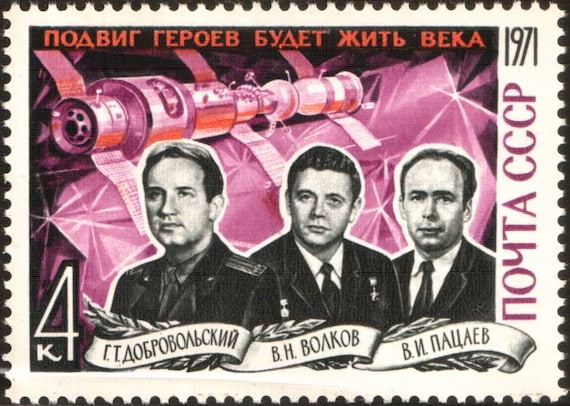
Francobollo

In ricordo dei tre astronauti sovietici della Sojuz 11 morti nel 1971 mentre tornavano dalla stazione spaziale sovietica Saljut

Francobollo commemorativo dei tre astronauti sovietici morti nel 1971 mentre tornavano dalla stazione spaziale sovietica Saljut

The only ones to die while in space, however, were the three Soviet cosmonauts of the crew of the Soyuz 11 as they returned from the Soviet space station Saljut on 29 June 1971. The pressurisation of the spacecraft blew, the spacecraft reached Earth automatically but the three died immediately, within seconds from asphyxiation.

Today there is a great focus on safety in human flights, both during take-off and during the stay in orbit, but of course true medical emergencies are difficult to solve, this time it went very well.

Just as well went the Chinese in December 2025 for a non-medical emergency, but these worse.

A piece of space debris, one of the hundreds of thousands orbiting the Earth, literallycracked a window of the Shenzhou-20, which was then declared unfit for service as the shuttle that was to bring the 3 taikonauts, the Chinese astronauts (from the Chinese "taikong" (太空) meaning "space, ndr)

It was therefore necessary to wait for the arrival of a new crew with a new spacecraft to bring the three taikonauts from the previous mission back to Earth. No problems then, except for an enforced stay of a few extra days.

Brand connect

Loading...

Newsletter

Notizie e approfondimenti sugli avvenimenti politici, economici e finanziari.

Iscriviti