Dfb hearings

Giorgetti: Budget slippage is not the solution for duties and defence

The Minister of the Economy reiterated the government's intention to 'sterilise the three-month increase on the 67 years and seniority retirement age

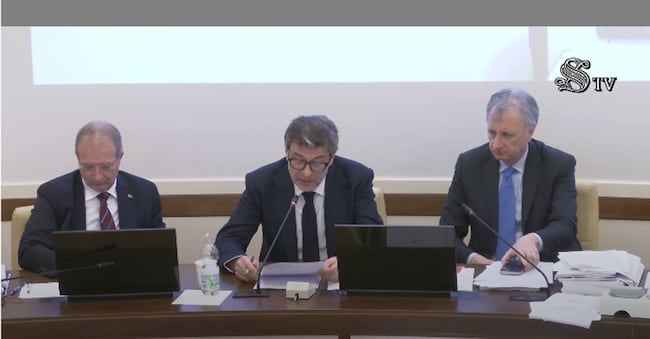
Il ministron dell’Economia Giancarlo Giorgetti è intervenuto in audizione sul Documento di finanza pubblica

10' min read

10' min read

"I had the deviation put in the Constitution, that possibility is due to me. But it must not be the easy solution. Before providing for additional expenditure, even for defence or duties, I want to know where that expenditure is going and why I have to do it'. Economy Minister Giancarlo Giorgetti said this during a hearing on the Dfp. 'This,' he added, 'is a criterion not of prudence or rigour, but of the good father of the family, and it is the criterion with which as long as I remain minister I will continue to manage the Ministry of Economy and Finance''.

"With reference to defence spending and, more generally, to the country's security, the reconnaissance work according to Nato methodology, carried out with particular care, suggests that already by this year we will be able to reach the target of 2 per cent of GDP assumed in 2024," Giorgetti explained. And he pointed out: 'We are acutely aware, also in light of the current tensions, of the need to increase this expenditure in the coming years'. The minister spoke of an 'extremely uncertain overall picture' and stressed that 'the scenario is constantly evolving. Italy will continue to operate in a credible manner and will know how best to deal with the difficult context, continuing to defend the solidity of its accounts and provide the necessary support to the economic and social system'.

Loading...

Giorgetti: now we will not use derogation from Pact for defence spending

"I have been asked if the waiver to the Stability Pact is used for military spending, my opinion is that at this moment the Italian government will not use it. We believe it is correct and fair to wait for the NATO summit in June 2025 to see the general orientation. And then calibrating military spending means making choices,' the economy minister added, replying in a hearing on the Dfp

Giorgetti: from Crosetto I received defence spending list

On defence spending, there was a knock-down-drag-out between the owner of the Mef and Defence Minister Guido Crosetto. 'I was after Crosetto for a month, saying "send me this shopping list". He didn't have the courage to send it. ... The day before yesterday he said to me "I have sent it, maybe I didn't send it to you"... it arrived the day before yesterday evening, I didn't have the courage to look at it, but I'm afraid it's long". Thus the Minister of the Economy, Giancarlo Giorgetti, on defence spending where the European Union has 'put up this whole scaffolding of more or less clear, confused instruments, saying "autonomously but in a coordinated manner you have to ask for an exception to the Stability Pact and spend more on defence we don't know what on'". Giorgetti, using jocular tones on the sudden decision to release the constraints on defence spending, said 'for the major states it's their time, all the dreams of a lifetime that you couldn't buy put there, it's like Christmas'.

Crosetto to Giorgetti: shopping list? Let's talk weapons

Closely followed Crosetto's reply on X. 'Unfortunately it is not Christmas, there is nothing to celebrate, there are no shopping lists but we live in dramatic times. I am pleased that Giancarlo has not lost his sense of humour, which I often struggle to find because I work thinking about the scenarios that the women and men of Defence, that is, the people who have promised to defend me, him, and all other Italian citizens, might have to face. They know better than anyone that we are not talking about toys for fun, but weapons with which to protect their nation".

"We will sterilise the increase in the retirement age"

.

Giorgetti in the hearing also reiterated the government's intention to 'sterilise the three-month increase on the 67 years and seniority retirement age, we consider the system in Europe to be one of the best performing'. To parliamentarians who urged him to do it quickly, the minister replied: 'For now there is still no decree to increase it, so until there is, there is no hurry. Magni rest assured,' he said addressing the Avs senator.

"Framework also subject to positive risks"

.

All of the simulations contained in the Dfp, Giorgetti recalled in his speech, 'are based on worst-case assumptions and therefore provide indications of a deterioration in growth and public finance. Nonetheless, a less adverse scenario seems to be envisaged than the one taken into account in the official forecasts; more favourable in terms of both the possible final outcome of the international tariff structure and the exogenous variables (such as energy prices and interest rates) that condition growth. The macroeconomic picture is therefore also subject to upside risks'.

"Improving solid accounts for uncertainties"

.

According to the Lega Nord member, 'the significant improvement in public finance in 2024 described in the document I presented today is a solid basis against the uncertain economic outlook. We have before us increasingly complex challenges that require prudence, well-considered decisions and shared strategies at the European level. Italy,' he said, 'will continue to operate in a credible manner and will know how best to deal with the difficult context, continuing to defend the solidity of its accounts and provide the necessary support to the economic and social system'.

"Italy stands out, markets recognise it"

.

The head of the Mef placed the emphasis on the fact that 'in a much more complex context than only a few months ago, Italy stands out for its management of public finance, which makes it possible to confirm in this document the net spending and deficit and debt reduction targets set out in last October's Plan and to attest to the improvement in the figures for 2024, already acquiring a positive effect in the control account to which I will return shortly. A state of affairs clearly recognised by the financial markets,' Giorgetti added.

Economics Minister: Downward revisions signal government seriousness

According to the head of the Mef, "the document submitted for your attention comes at an international juncture characterised by increasingly abrupt changes, which make it particularly complex to draw up estimates not only in the long term, but also in the short term. In this context, downward revisions, which are only a sign of the government's seriousness with respect to exogenous elements, should not come as a surprise. This transition phase will be closely monitored, with particular reference to the effects on investments and household consumption,' he said.

On the Pnrr: "Physiological expenses accounted for after 2026

As for the NRP, the minister continued, "the monitoring system shows that, as of March 2025, a total expenditure of about EUR 66 billion has been incurred. This amount corresponds to about 34 per cent of the total NRP budget and 54 per cent of the resources received so far from the European Commission. We expect a substantial increase in spending this year and next, as investments are progressively completed and the numerous construction sites opened throughout Italy are closed. We also consider it entirely physiological that, regardless of the achievement of the objectives and targets by the end of 2026, some of the expenditure will also have to be accounted for in subsequent years.

"From Pnrr reprogramming possible aid against duties"

Still on the subject of the NRP, Giorgetti explained: 'We are working on the achievement of the objectives set out in the last three tranches and on an enhanced monitoring of the Plan's implementation status, also in order to identify any adjustments needed to complete the investments on schedule. As also emerged from the discussions with the social partners, in the context of the subsequent reprogramming it will be possible to identify resources to be allocated to the companies, workers, and sectors most affected by the trade war,' he added.

Istat: Tariff assumptions and uncertain two-year period weigh 0.2 points on 2025 growth

Istat conducted an exercise to provide an initial assessment of the impact that a possible continuation of uncertainty and an increase in trade tensions might have on the economy. In particular, it was assumed that: the level of uncertainty would remain at the average level of the first three months of the forecast period; the exchange rate of the euro against the dollar would appreciate by 3% in 2025 compared to the baseline scenario and return to the baseline in 2026; import tariffs in the US (assumed to be 20% on all goods) would be fully reflected in the price of exported final manufactured goods; world trade would decline by about half a percentage point in 2025 and one point in 2026 compared to the baseline scenario. Under these assumptions, GDP growth, according to Istat, would be lower by two tenths of a point in 2025 and three tenths in 2026. The simulation was presented during the hearing on the Dfp.

Positive albeit weak growth signs, record tourism

"For the new year we do not yet have the GDP estimate for the first quarter, which will be released on 30 April. From the data available so far, industrial production, after a rebound in the previous month, grew by 2.5 per cent, construction is doing much better, there is good growth, services also showed positive signs, so basically before scenarios of strong tensions, the economy all in all continues to show positive signs, albeit weak growth. With an important record in tourism'. Thus Stefano Menghinello, director of ISTAT's Department of Economic and Environmental Statistics and National Accounts, at a hearing before the Budget Committees of the House and Senate on the Dfp.

EU and NATO accounting criteria on defence expenditure major differences

The new European economic governance refers for the defence expenditure to the European System of Accounts, which uses a different classification from NATO: this can "result in significant differences". For example, in 2022 the incidence of military expenditure on GDP was 1.5 per cent according to NATO criteria, while according to EU criteria it was 1.2 per cent. A specific focus was presented by Istat at the hearing on the Dfp, considering the need to increase defence spending and the EU rules that consider these investments a relevant factor for deviation of net spending on the path to recovery. The EU accounting system considers both current and capital expenditures that are recorded on an accrual basis and not on a cash basis as NATO does: in particular, investments at the time of the transfer of economic ownership of the asset, i.e. actual delivery (not payment). Expenditure related to military defence and arms procurement are included in these calculations.

Bankitalia: Pnrr implementation crucial for growth

According to the deputy head of the Bank of Italy's Economics and Statistics Department, Andrea Brandolini, 'unstable trade policies, the possibility of prolonged turbulence in the financial markets, and the adoption of possible retaliatory measures by the United States' trading partners may jeopardise export performance and adversely affect investment and consumption spending. In this context, the implementation of the NRP measures is crucial to support growth and the strength of the domestic economy'.

"The identification of discretionary revenues and the quantification of their effects is crucial for compliance with the objectives defined in the Psmbt (Medium-Term Budgetary Structural Plan 2025-2029, ed.). The Dfp contains little detail on this. It is to be hoped that future editions of the monitoring documents will contain more detail on this point, regardless of what is strictly required by EU regulations'.

Upb: duties will weigh 0.3 points on value added, almost all sectors affected

Some simulations by the Parliamentary Budget Office show that the US duties will impact, also taking into account induced effects, almost all sectors of the economy, with an aggregate loss of value added in the order of three-tenths of a percentage point. The sectors most affected would be pharmaceuticals, mining, automotive, chemicals, metals and machinery manufacturing, all of which are on average more exposed to the US as an outlet market or have higher tariffs. Professional services businesses, such as advertising, real estate design and personnel management, would also be affected. The simulation was presented at the hearing on the Dfp. from increased defence spending increased debt, multiplier below 1

An increase in defence spending and related slippage, according to Upb's simulations, would cause debt to increase by 0.7 percentage points to 137.3% in 2028 with a partial utilisation (0.25 percentage points of GDP in 2025 and 0.5 in 2026-28) of flexibility; with a gradual increase in spending up to the maximum allowed flexibility of 1.5% in 2028, debt would rise to 137.7% with worsening dynamics in subsequent years and debt/GDP rising after 2031. The positive economic impact of these expenditure increases depends on the composition of expenditure and the degree to which domestic demand is activated, but the multiplier of these interventions is estimated to be less than one. The forecasts were presented at the Dfp hearing in connection with the EU defence initiatives that allow the activation of the national safeguard clause to deviate from the reduction path by increasing defence spending. Currently, it stands at 1.2 per cent of GDP in 2023 according to the EU classification and 1.5 per cent in 2024 according to the NATO classification.

Court of Auditors: limited indications, lack of elements to assess

.

For an examination of the framework offered by the Dfp "there is a lack not only of programmatic development (affected by the difficulty of defining at the moment a precise reconstruction of the needs at stake), but also (and above all) of decisive information detail on various chapters of the short and medium-term financial policy: there are limited indications on the composition of expenditure by sectors, there are no adequate elements and indications on the changes being worked on for the redesigning of the NRP, and there is a lack of indications on the choices that are proposed to be made on the front of expenditure for the defence sector. Elements that make it difficult to assess the tightness of the overall framework and its consistency with the priorities of government action'. This was stated by the Court of Auditors at a hearing on the Dfp.

Pension trends under control, rules need certainty

"The underlying trends in outlays for pension benefits seem to remain under control, also as a result of the various corrections made in recent years to the rules on early retirement, starting, for outlays with Quota 103, with the introduction of the fully contributory calculation, which has limited the impact on retirement flows," the accounting judges argue. "It is crucial, at a time when the EU's new regulatory framework of economic governance makes the governance of expenditure the main tool for controlling the balance of public accounts, to give certainty to the rules of the social security system, starting from the restart, scheduled from 2027, of the mechanism for adjusting the requirements for access to retirement to life expectancy".

Cnel: drop in household and business confidence risks recession

The expected drop in confidence among households and businesses and the increase in uncertainty caused by the geopolitical framework bring the risk of recession. This was said by Cnel president Renato Brunetta at the hearing before the budget committees of the House and Senate. "The degree of uncertainty is amplified by geopolitical conflicts, technological and environmental changes and weighs like a boulder on the expectations of economic agents, making it difficult for individuals, businesses and governments to act and plan rationally. In the short term,' he explained, 'we should therefore expect a fall in consumer and producer confidence. More uncertainty and less business and household confidence lead to reduced demand for investment and consumer goods. With negative effects on production, employment and incomes. In other words: recession. The mere mention of it causes justified fears for employment and citizens' welfare'.

Copyright reserved ©
Loading...

Brand connect

Loading...

Newsletter

Notizie e approfondimenti sugli avvenimenti politici, economici e finanziari.

Iscriviti