
Has Trump really ended 'seven wars' in 'seven months'?
The US president's words at the UN General Assembly crossed with facts (with a little help from pop culture, numerology and Jewish Kabbalah)

Key points
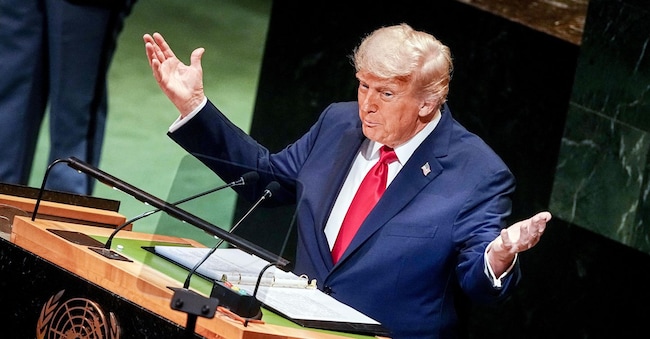
What he said at the United Nations General Assembly we have all heard: "In seven months I have ended seven wars that they said were not terminable. It hasn't happened before, I'm very honoured to have done it,' Donald Trump said, adding: "I've never had a call from the United Nations" and "no one has thanked me" for the work. An effort for which the US president reiterates that he is once again more than worthy of the Nobel Peace Prize. But has Trump really stopped seven wars in seven months? Let us try to match his words with deeds.
Seven in the sense of perfection
.A preliminary remark must be made on the use of the number seven ("In seven months I have ended seven wars") which is certainly not just any number. Biblical rhetoric frequents the number seven with great assiduity: the seven days of Creation, the seven gifts of the Holy Spirit, the seven deadly sins, the seven seals of the Apocalypse, the "seventy times seven" that Christ uses as a synonym for infinity when Peter asks him how many times it is necessary to forgive a brother (Mt 18:21-22). In Hebrew Kabbalah, but also in medieval numerology, seven is a symbol of completeness and perfection, a number so powerful that it has invaded both high and low culture in the last two millennia (Pirates of the Seven Seas, Seven Brides for Seven Brothers, The Magnificent Seven). To biblical rhetoric and pop culture Trump's electorate is fond. And Trump always speaks to his electorate. Whether he is at the United Nations or at a funeral.
The 12-Day War
.The first conflict in which the US president claims a decisive role is the so-called 12-day war between Israel and Iran, which broke out on 13 June this year with Tel Aviv's attack on Tehran's nuclear infrastructure. Trump intervened directly on 22 June with Operation Midnight Hammer to destroy Iranian laboratories with the latest American weapons. Analysts agree that the US intervention hastened the end of the conflict, but with or without US involvement the Israelis had decided to attack. And it is unclear how much Trump influenced the negotiations.
The Congo-Ruanda conflict
.On 27 June, shortly after the end of the so-called 12-Day War, in Washington Congo and Rwanda signed an agreement ending the guerrilla war. Here Trump actually played a mediating role, so much so that the President of the Republic of Congo Félix Tshiseked nominated 'The Donald' for the coveted Nobel Peace Prize. Whatever the outcome in Oslo, the US in this game brought home 'many mineral rights from Congo', as Trump himself pointed out. This is certainly not the first peace attempt between the two African countries. And the resilience of the understanding will have to be tested over time.
The escalation between Cambodia and Thailand
.In July, there was a new escalation between Cambodia and Thailand over ancient territorial issues, even dating back to colonial times. The affair ended in a peace agreement after a handful of days thanks to the mediation of Malaysia. Here too, Trump claimed a role, lending weight to his threats of economic retaliation against the states involved. The understanding reached between Cambodia and Thailand, however, does not resolve the territorial issues underlying the conflict.


