
Italian brainrot: AI-born characters take shape in the real world
Artificial intelligence-generated surreal characters have become successful collectible cards and school gadgets

2' min read
2' min read
The Italian brainrot phenomenon, born on the Internet as a collection of surreal characters created by artificial intelligence and spread initially as memes that later became viral content, has recently shifted more and more to an offline market. It is no coincidence that in recent months their presence has been consolidated through the sale of physical objects ranging from collector's cards to sticker albums and school gadgets such as pencil cases, notebooks, backpacks and gift items.
But probably what simplifies and facilitates their diffusion, beyond their notoriety, is also and above all a legal aspect: brain rot can be freely reproduced since, to date, copyright regulations on what is created by artificial intelligence are still unclear, consequently, companies are not obliged to pay licences or recognise copyright, thus reducing production time and costs and facilitating distribution. In addition, their success has drastically increased with the recent introduction of new figures inspired by Labubu, the puppets distributed by the Chinese chain Pop Mart, and the protagonists of Squid Game.
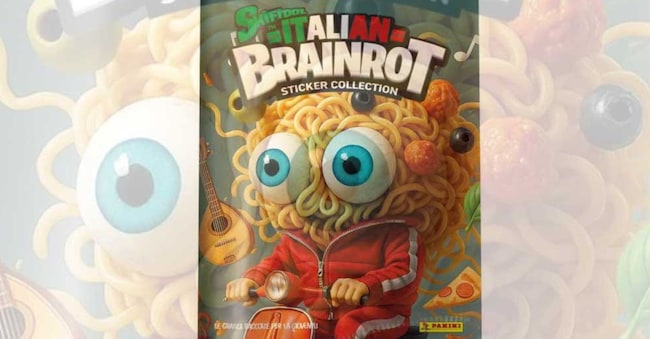
However, an important role in the transition from online to offline was played by Officina Comunicazione, a Modenese company engaged in the entertainment and publishing sector, which last May announced the market launch of the new Skifidol branded collectible card game and subsequently the action figures, dedicated precisely to the Italian brain rot. Only later, however, did the Panini company - already a leader in the figurine and comic book sector - publish a 48-page album with 300 figurines entitled Skifidol Italian Brainrot Sticker Collection, with the intention of extending the product's distribution to other European countries.
The popularity of collectible cards and figurines has therefore generated a parallel phenomenon that has taken shape in a community on social networks: on Facebook, for example, a group called Italian Brainrot Card Game Official was born, which already has over 4.900 members, in which requests are made to exchange cards between members and lists of numbers relating to missing or duplicate cards are reported, recalling dynamics already experienced with Pokémon trading cards or classic football players' cards, although this time the protagonists are imaginary characters generated by the creativity of the AI.
It remains uncertain how long the phenomenon will last because if the current popularity is mainly driven by the novelty and virality of the web, continuity will depend on the ability to update the collections and propose new editions to keep collectors' attention high.

