
Samsung, the smart home will anticipate our habits


3' min read
3' min read
For years now, we have been able to buy washing machines, refrigerators, coffee machines and other household appliances that we can control with an app. But, needless to say, this approach has never worked and the reason was there for all to see, just watch a science fiction film: when in a film set in the future you approach a coffee machine, what do you do? You talk, not use an app. Samsung has launched the AI Home: Future Living, Now initiative: a more effective way to make all household appliances easy to use.
The goal stated by Cheolgi Kim, Executive Vice President and Head of the Digital Appliances business, is to go beyond the logic of the simple smart appliance. The idea is that of technology working in the background, simplifying tasks, anticipating habits and ensuring a more comfortable and safer home environment. A laudable intent that many have already expressed in the past, but this time there is an important detail: Samsung's SmartThings infrastructure has grown and started to collaborate with Google's Gemini, Microsoft's Copilot and Perplexity to communicate with users and analyse their behaviour.
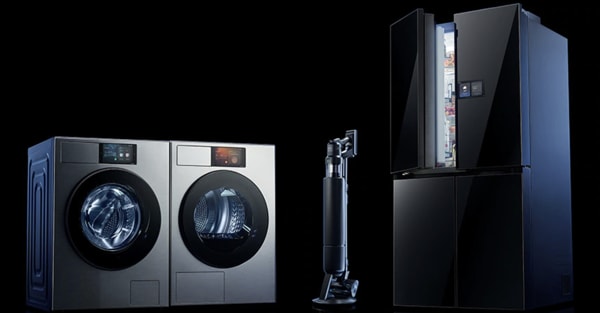
This means that various household appliances have become much smarter. Washing machines analyse the load with AI to work out how much detergent to use and how much water to use; the refrigerator understands what we put in it; the floor-cleaning robot recognises liquids and avoids scattering them all over the house. But it goes further. Now they also answer users' questions. For example, you can go to your BeSpoke AI washing machine and ask her how to wash a garment with a gravy stain and she will answer you, even taking all the necessary actions during the wash if you decide to have her do it. Even better, on-board diagnostics will allow advanced remote assistance from July next year. "In the event of a fault," Matteo Trambaiolo, Head of Marketing & Business Planning - Home Appliances at Samsung Italia, tells us, "the support call centre operator will be able to receive the status of the appliance, possibly exclude some functions to allow partial operation until it is repaired, and send a technician with the necessary spare parts already.
Energy efficiency, but also security
Of course, as convenient as an advanced fault repair system is, the greatest benefits of intensive use of AI come in the everyday. Among the most important ones are the savings related to the intelligent use of energy. With the SmartThings Energy platform, the South Korean giant estimates reductions of up to 70 per cent in washing machine consumption (thanks also to the automatic scheduling of washing at night and agreements to be made with electricity suppliers for intelligent consumption management). The physical and IT security front is also important. Samsung Knox Vault, which safeguards sensitive information at the hardware level, and Knox Matrix, which extends protection to the entire network of connected devices, are there to protect data. "In addition," Trambaiolo continues, "the possibility of monitoring household appliances allows those with elderly parents to understand, while always respecting privacy, if things in the house are working normally or if, for example, no one has been in front of the TV for too many hours or if the fridge doors have been closed for longer than usual, detecting possible problems.
The new Bespoke AI range
.The vision is translated into practice with a new line of household appliances. The Bespoke AI Jet Bot Steam Ultra robot hoover even recognises transparent liquids thanks to its advanced object recognition system. The Bespoke AI Wash+ washing machine promises energy consumption well below class A standards. The dishwasher uses algorithms to automatically choose the most suitable cycle, completing drying with an automatic door opening. Also new for the kitchen is the induction hob that integrates extraction, a solution designed to optimise space in modern homes.

