News

Crisis in Italian industry: 103,000 jobs lost since 2008, boom in redundancies and collapse of the automotive sector

The Fiom report highlights the fall in production of cars and household appliances, which has led to a drop in employment and a sharp increase in the use of redundancy funds. Investments are slowing down, while Italian companies are prey to foreign groups

by Giorgio Pogliotti

(AdobeStock)

4' min read

Translated by AI
Versione italiana

4' min read

Translated by AI
Versione italiana

Between 2008 and 2024, 103,775 jobs were lost in industry, from 2,088,424 to 1,984,649. But the job loss would have been greater if there had not been extensive use of social shock absorbers. By limiting the comparison between 2024 and 2025, a growth of almost 50 million hours in lay-offs emerges; last year, the Inps authorised almost 309 million hours, which corresponds to more than 148,000 jobs left out of production.

The photograph taken by Fiom, in its study on the 'State and trends of the Italian metalworking industry', highlights all the difficulties of the sector, the fall in production in important sectors (cars, household appliances), the structural weaknesses (the small size of companies), which is reflected in the 42 crisis tables opened at Mimit. 'We continue to demand a convocation at the level of the Presidency of the Council to open a discussion with the government on the extraordinary plan for industry,' explains Fiom secretary general Michele De Palma. 'We run the risk of the crisis situation becoming irreversible for our industrial system.

Loading...

The collapse of car and appliance production

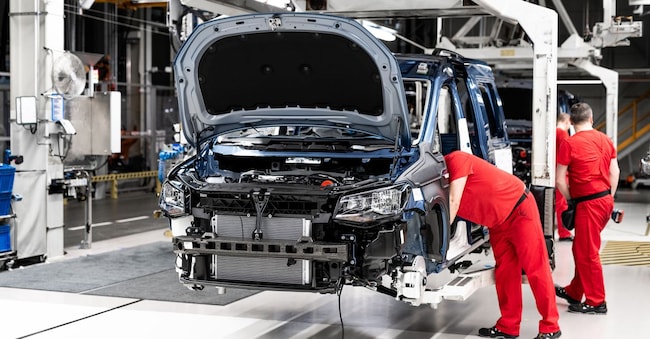
Automotive is the sector that is paying the most for the effects of the industry crisis. In the first nine months of 2000, car production stood at 1,077,995, in the same period of 2025 it dropped to 179,737, with a -83.3% drop in domestic production. Due to the collapse in car production, Italia has to export a substantial part of its components; the main countries to which we export include Germany, France, the USA, Poland and Spain.

Between 2015 and 2024, investments from abroad to Italia in the automotive sector decreased by EUR 9.153 billion: we are witnessing a process of disinvestment. On the contrary, investments from Italia to foreign countries amounted to 8.251 billion euro.

In the decade between 2014 and 2024, the production of household appliances plummeted: refrigerators recorded -662,330 units (-34.41%), dishwashers -186,244 (-21.62%), washing machines -2,325,549 (-60.23%), hoods -3,909,511 (-70.24%), vacuum cleaners -1,092,464 (-64.02%).

Open Crisis Tables

The crisis tables open at Mimit number 42 and involve 43,117 workers. The most affected sectors are evidently the steel industry with 16,307 workers at risk, in the automotive industry there are 12,650, in household appliances 7,740, in telecommunications-informatics 3446, in energy 1330, in aerospace 1102.

The downturn in investments

 Manufacturing companies' investments in relation to GDP have fallen; despite a slight recovery in recent years driven by PNRR and public incentives, we are still more than 6.1 points below the 2000 level. This is the investment of Italian manufacturing companies in machinery/equipment in relation to Italia's GDP. "The drop is particularly worrying because it has occurred despite the PNRR and public incentives (e.g. Transition 4.0 etc.)," Fiom's report points out.

In an international comparison over the period 2006-2023, it emerges that Italia is last with a ratio of investment to production value of 2.65%, after Germany (2.91%), Japan (2.79%), but above all far behind Hungary (4.69%), South Korea (4.31%), Turkey (4.16%), Poland and the Czech Republic (both around 3.75%).

 Fiom also points out that in this scenario over 10 years - i.e. from 2014 to 2023 - the companies' profit per hour worked increased from EUR 13.59 to EUR 23.73 (an increase of more than EUR 10, or 74.6%), in contrast, labour costs per hour worked increased by only EUR 3.34 (+ 12%).

The structural weaknesses of Italian industry

The Italian metalworking industry is characterised by a number of structural weaknesses, starting with the small size of companies: on average in the European Union, a metalworking company has 43.75 employees, compared to 29.88 in Italia. The gap widens when comparing Germany and Italia. In Germany, in the metal sector, 50.8% of companies are micro-enterprises (0-9 employees), while in Italia the figure rises to 63.8%. In the same sector in Germany almost 9% are large companies (over 250 employees), while in Italia this size is just over 2%.

According to Fiom's study, Italia's industrial structure is inadequate, in terms of installed production capacity, to cope with the energy transition: for the production of transformers and power equipment, domestic production covers only 60% and 79% of national requirements respectively, for the remainder (40% and 21%) we depend on imports from abroad. The main countries from which we import power equipment are mainly European (Germany, France, Czech Republic, Hungary) plus China.

Italy's industrial apparatus is also inadequate for the digital transition: domestic production covers only 21.7 per cent of the requirement for telecommunications equipment, and in the case of ICT equipment only 11.7 per cent. The countries from which we import TLC equipment are mainly Asian (China, Vietnam, India).

The loss of industrial sovereignty

Fiom speaks of 'loss of industrial sovereignty', counting that the acquisitions of Italian metalworking companies from abroad during the Meloni government in the period between November 2022 and January 2026 were 255 majority and 60 minority, in addition to 16 capital increases and 3 joint ventures. Among the companies acquired from abroad, the transaction involving Iveco in favour of Tata Motors is nearing completion, while the acquisition of Piaggio Aero by the Turkish company Baykar Makina has been completed.

Copyright reserved ©
Loading...

Brand connect

Loading...

Newsletter

Notizie e approfondimenti sugli avvenimenti politici, economici e finanziari.

Iscriviti