
James Dyson Award 2025: keyboard that monitors Parkinson's and a smart water sensor win
These are the two inventions that won the prestigious international award
Twenty years of history, over 400 inventions supported and more than £1.5 million distributed. The James Dyson Award is not just any competition: it is that rare occasion when young inventors can really get noticed and, more importantly, take their ideas forward without having to sell off their intellectual property. Unlike many other competitions, the James Dyson Award gives participants full intellectual property rights to their inventions. This is no small thing: for inventors, it means being able to freely develop and commercialise their ideas without having to give up rights or shares to third parties. This year, among more than 2,100 entries from 28 countries, two projects that address very different but equally pressing problems stood out.
OnCue: typing becomes possible even with Parkinson's
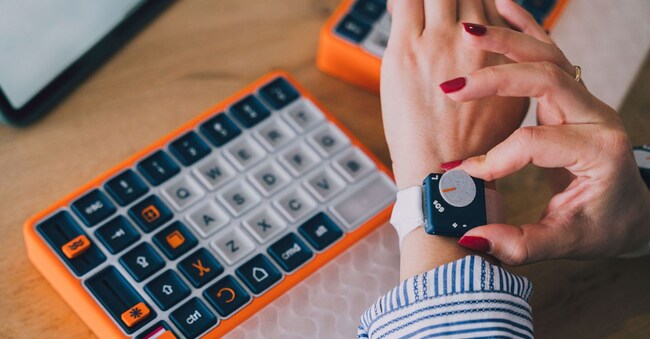
Imagine you want to write an email, but your fingers don't respond the way you want them to. They tremble, they get stuck, they can't keep the rhythm. For the 10 million people in the world living with Parkinson's disease (400,000 in Italy alone), this is a daily frustration. Alessandra Galli, an Italian product designer who graduated from the Delft University of Technology in the Netherlands, decided to do something about it. Her invention, OnCue, is a keyboard that goes beyond the assistive solutions already on the market: it is not limited to larger keys or high-contrast colours, but integrates visual and tactile cues designed specifically for Parkinson's symptoms.
The system is ingenious in its simplicity: the keyboard and matching wristbands send out gentle vibrations each time a key is pressed, helping to maintain a steady rhythm. If you hold a key down too long (a common problem for those suffering from 'freezing'), the vibration gradually intensifies, prompting you to move on to the next key.But there's more: thanks to artificial intelligence, OnCue predicts which letter you are about to type and illuminates it on the keyboard. The compact, split design reduces fatigue, while the raised key edges minimise errors. It connects via Bluetooth and the battery lasts up to a week.
Personalisation is at the heart of the project: symptoms vary from person to person and even throughout the day, so Alessandra is developing software that allows vibrations and lighting to be adapted to the habits and intensity of each person's symptoms. Lecturer Gert Pasman, who has been living with Parkinson's for more than ten years, said: "OnCue offers real hope to change this... Winning this award will allow her to take the project forward, which is great news for the entire Parkinson's community." Alessandra now aims to collaborate with healthcare professionals to refine OnCue and bring it to market, with the ambition of extending its use to other neurological diseases such as Alzheimer's and dystonia.
WaterSense: river water under control 24/7
On the other side of Europe, Filip Budny, a Polish PhD student in nanotechnology at Warsaw University of Technology, was fighting an invisible enemy: inland water pollution. It is a phenomenon that cannot be ignored: over 40% of the world's water is seriously polluted, and rivers and lakes are particularly vulnerable. But here is the paradox: while marine waters are monitored minute by minute with automated buoys, rivers are sampled far less.

