Planet Life Sciences

Johnson & Johnson: the first 50 years in Italia. CEO Murzi: ‘Please allow us to invest further’

This request, particularly in light of the draft budget bill, is supported by a Cerm study which estimates that the payback adjustment required to preserve the competitiveness of businesses amounts to approximately 1.28 billion euros

6' min read

Translated by AI
Versione italiana

6' min read

Translated by AI
Versione italiana

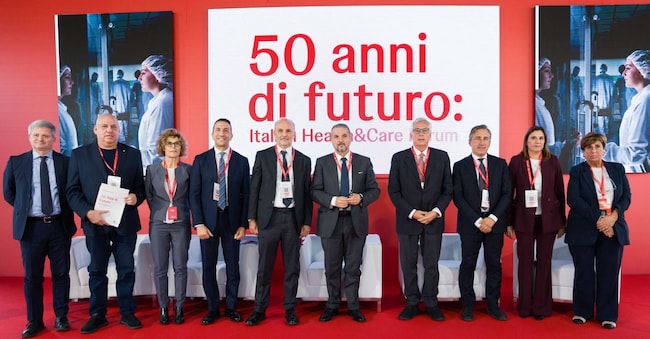
To establish a regulatory framework for the pharmaceutical sector that enables the reconciliation of three objectives: the sustainability of the National Health Service, the capacity to develop and introduce therapeutic innovation, and the competitiveness of one of the country’s most strategic sectors, which generated (2024 figures) €59.9 billion in production value and €15.9 billion in value added, whilst exports in 2025 reached €68.3 billion. This is the challenge outlined in the Cerm Foundation’s study ‘Industrial Policy and Economic Sustainability in the Pharmaceutical Sector’, presented at the event in Latina marking the 50th anniversary of Johnson & Johnson Innovative Medicine’s presence in Italia. The occasion provided CEO Jacopo Murzi with the opportunity to emphasise that ‘Fifty years of presence in Italia represent an extraordinary milestone but, above all, a point from which to look ahead. Thanks to our deep-rooted presence in the country, we want to continue to be a partner to the healthcare system and to work, through dialogue with all stakeholders, to build the next fifty years of progress for the benefit of patients and the country’s competitiveness’, he stated.

Playing with light and shadow

The budget bill, which is set to begin its passage through the Chamber of Deputies, is the ‘uninvited guest’ in this context; it contains a pharmaceutical package that presents both positives and negatives for businesses. The main sticking point is the ‘payback’ loophole, which remains, albeit with the promise of raising the spending cap on ‘direct’ funding, but only from 2028 onwards. There will also be some relief from the burden as early as 2027 for companies that can demonstrate they have invested in research, development and innovation in Italy during the previous year.
The issue of the cost overrun, half of which is borne by companies, is therefore the first hurdle to overcome. In a context, as Murzi emphasised, in which ‘the life sciences represent much more than just an industrial sector for Italia: they are a strategic asset that brings together health, research, production, skills and economic growth. In a global landscape where competition to attract investment and innovation is increasingly fierce, it is essential to create the conditions enabling companies to plan and invest for the long term and, at the same time, for the National Health Service to facilitate ever-faster access to medical advances’.

Loading...

“There are some very interesting aspects in the Budget Bill that we would like to see implemented,” Murzi told Radiocor-Il Sole-24Ore, “namely: first and foremost, the so-called ‘early access’ scheme – that is, the possibility for the most innovative medicines, particularly where there is the greatest medical need, to be made available more quickly to Italian patients, given that there is currently a gap of 14–15 months compared with the European average following the approval of a medicine at EU level. Another interesting measure,” he continued, “is the one aimed at encouraging investment in production and research in Italia, and we will gain a better understanding of the conditions that will enable this investment to take place.”
However, Murzi also spoke of “disappointment regarding the payback mechanism, which has not been addressed by the current budget, where there is only a proposal for a partial and limited reduction from 2028 onwards. The issue – he clarified – is the extent of the payback and the unpredictability of the clawback: this effectively limits any industrial initiative that companies might wish to undertake in Italia, without any control or action that is structurally linked to overcoming this measure.”

According to Carlo Riccini, Director-General of Farmindustria, the aim “is to minimise the impact of payback as much as possible, which to this day remains an unsustainable burden on innovation and business investment, having risen by 130 per cent between 2021 and 2025. ‘We are confident that the willingness to listen and the attention that the Government and Parliament have shown towards the pharmaceutical industry over the years will enable us to make progress,’ he added. ‘The request put forward by President Cattani is to bring forward the increase in the direct expenditure ceiling to 2027. There is no doubt that the urgent need for decisive measures is the real priority; therefore, anything that can be done to bring this forward – to send an immediate signal that Italia is on board – is undoubtedly of the utmost importance, as it has a twofold effect: time amplifies the impact of the economic measures.”

The study

The analysis presented on payback has, in particular, assessed its implications for the economic sustainability of businesses. Specifically, according to the findings presented by Fabio Pammolli, scientific director of the Cerm Foundation and Professor of Economics and Management at the Politecnico di Milano, the evidence suggests that the mechanism – which in 2025 resulted in 2.38 billion in cost-containment measures to curb pharmaceutical expenditure borne by businesses – has a ‘significant impact’ on their economic stability ‘with possible effects on their ability to attract investment and sustain long-term growth and innovation’, as Pammolli explained. The study estimates that a reduction in the payback on direct purchases of approximately 1.28 billion euros would be necessary for the companies in the sample analysed, equivalent to -72.5 per cent of the amounts they are required to pay. This ‘sustainable cap’, defined with due regard to the need to preserve an adequate return on invested capital, ‘could, in the short to medium term, represent a safeguard measure useful for sustaining the sector’s capacity for investment and innovation’. In the long term, however, the main finding to emerge from the study is ‘the need for a structural overhaul of the system, aimed at restoring the payback mechanism to its original function as a corrective tool for overspending, moving beyond its use as a routine component of pharmaceutical expenditure funding’.

The White Paper

The celebration also provided an opportunity to present the White Paper ‘50 Years of the Future’, produced under the patronage of Remind and Farmindustria. The document identifies the strategic priorities and conditions for fostering innovation, strengthening the sustainability of the National Health Service and contributing to the country’s economic growth. This theme was emphasised by the Prime Minister Giorgia Meloni in a message sent for the occasion: ‘The value of the pharmaceutical sector,’ it reads, ‘goes far beyond economic and industrial results. It is measured by its ability to contribute to medical progress, make increasingly effective treatments available, and improve people’s quality of life and life expectancy. With this in mind, the Government has been committed, since taking office, to strengthening the National Health Service and guaranteeing the right to health enshrined in our Constitution. ‘Since the start of this parliamentary term,’ Meloni went on to point out, ‘funding for the National Health Fund has gradually increased and has reached a level never seen before. The new Budget Law approved by the Government has confirmed this trend and provided for the allocation of further resources, enabling the Fund to reach 146.3 billion by 2027.”

According to the Minister for Health Orazio Schillaci, speaking at the Johnson & Johnson Italia event, “we must stop viewing healthcare merely as an expense to be curbed – but see it for what it truly is: one of the most forward-looking investments a nation can make in itself. The pandemic has taught us this: having the capacity within one’s own country to produce what is needed for healthcare is not a luxury but a genuine form of national security, and facilities such as these are an integral part of that’, he said, referring to the production site in Latina. ‘It is up to businesses to invest, conduct research and innovate. It is up to the institutions to ensure clear rules, predictable timelines and stability. The public and private sectors must work together towards a common goal: to ensure fair access to healthcare for all citizens and to build a future of innovation, growth and health,’ he emphasised.

These themes are echoed in the White Paper, which sets out eight structural conditions resulting from dialogue between institutions, the scientific community, healthcare professionals, universities, businesses, patient organisations and civil society. According to the document’s authors, these are the ‘factors for a lasting transformation of the healthcare system’: planning; competitiveness; predictability ‘through stable rules, transparent criteria, legal certainty and multi-year planning horizons’; innovation; integration of care pathways; data; skills; and participation. “The challenge – as the White Paper concludes – is to move from fragmented interventions to a systemic strategy capable of measuring the value generated in terms of accessibility, continuity of care, outcomes, quality of life and the reduction of inequalities”. This is also taking into account the multiplier effect of the pharmaceutical sector on the national economy: every additional euro of final demand generates a total of 3.98 euros in output, 1.52 euros in value added and 0.32 euros in tax revenue (net of VAT), taking into account direct, indirect and induced effects throughout the entire supply chain.

Copyright reserved ©
Loading...
Loading...

Brand connect

Loading...

Newsletter

Notizie e approfondimenti sugli avvenimenti politici, economici e finanziari.

Iscriviti