Luxury

Kering, De Meo: “We have no intention of relocating. Italia remains a cornerstone of our strategy”

The group’s priorities: streamlining its network of shops, reviewing the supply chain, striking a balance between price and value, and winning back millions of customers

6' min read

Translated by AI
Versione italiana

6' min read

Translated by AI
Versione italiana

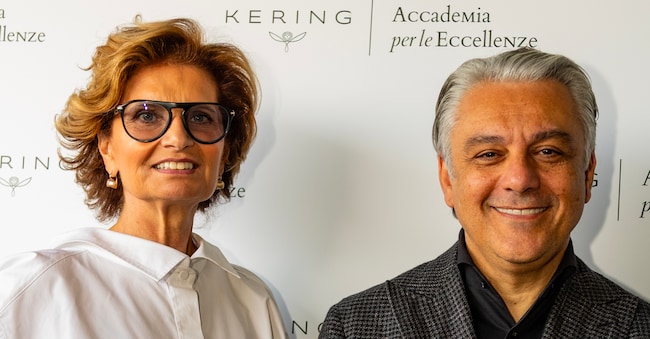
Italia remains the industrial heart of Kering, but the group led by Luca de Meo is being called upon to redesign its business model to cope with a more selective phase in the luxury sector: from streamlining the retail network to overhauling the supply chain, from striking a new balance between prices and value to the need to win back millions of customers who have left the market. This development strategy, however, forms part of an evolution within the sector which, according to the CEO, will continue to grow more than the global economy in the long term: “I am very optimistic about the sector, although I do think there will be cycles,” summarised De Meo, speaking on the sidelines of the opening of the academic year at Kering’s Accademia delle Eccellenze, at the Mind Milano Innovation District.

85 per cent of products made in Italia

Italy remains at the heart of Kering’s industrial strategy. The French luxury group has no intention of moving production out of the country and regards the Italian manufacturing sector as one of the cornerstones of its business model. This was reiterated by the chief executive: “We have absolutely no intention of relocating production or doing anything of the sort,” said the CEO, adding: “We have made it very clear that, in light of our ambitions, Italia’s central role in our production system remains one of the pillars of our strategy.”

Loading...

This position is borne out by the figures presented by the manager: ‘84–85 per cent of our products are manufactured in Italia, and 95 per cent of these are exported. Of our overseas sales, 80 per cent are made outside Europe, which means we receive high-value currencies ranging from the yuan to the dollar’. On the relationship between Kering and Italia, the CEO reiterated: “We are probably the group with the highest percentage of products made in this country. So Kering has invested heavily in Italia.”

Italia’s role must, however, be viewed within the broader context of the competitive position of the entire European sector: ‘Luxury is the last industry in which Europe is clearly ahead. We are leaders in the sector, from handbags to yachts. No one beats us, and no one should beat us.’

When asked about the production in China of certain trainers intended for Gucci, De Meo explained that the decision was driven by specific technical requirements. Production in Italia, however, remains the overwhelmingly dominant component of Kering’s business model. The group’s stated aim is to maintain the country’s central role within its manufacturing operations, whilst work continues on reviewing the entire supply chain.

The new supply chain: less fragmentation and more control

The French luxury group is working on a reorganisation of the supply chain . According to De Meo, the supply chain currently has too many levels and is overly fragmented, despite a high concentration of sourcing: 25 per cent of suppliers account for 98 per cent of total sourcing.

The group aims to exercise greater control throughout the supply chain, with the aim of ensuring quality, cost control, traceability and sustainability. This is not, as De Meo pointed out, a traditional restructuring: “We need to reinvent a model and build an ecosystem of very solid suppliers around us. The supply chain today is very deep – perhaps too deep – with too many levels and is too fragmented.”

According to the manager, the problem affects the entire sector: “There are around 600,000 employees and 60,000 companies in the sector.” This results in an extremely fragmented structure: “So, on average, these are companies with ten employees or fewer, which are fine for small-scale coastal trade in the Tyrrhenian Sea, but not for competing with strong, organised and structured systems.” The reorganisation of the supply chain is therefore part of a broader redesign of Kering’s production ecosystem, with the aim of increasing scale and making the supply chain more robust and manageable.

Network rationalisation and ‘fair’ prices

As regards the retail network, the business plan presented in the spring envisaged the closure of around a hundred shops. The process is already at an advanced stage. “By July, we had closed 84 shops,” said De Meo. The reduction in the network goes hand in hand with a review of the group’s business model, at a time when the luxury sector is entering a phase of normalisation following years of strong growth.

For the luxury sector as a whole, one of the key strategic issues to be addressed in the short term is undoubtedly that of pricing, as several analysts have pointed out. Kering is reviewing its price list, but De Meo has made it clear that this does not necessarily mean implementing an across-the-board price reduction: “I’ve always said this: we’re developing an approach we call ‘fair’ pricing,” explained the CEO, referring also to criticism that the luxury industry has created a disconnect between perceived value and price, and adding: “We are trying, in an intelligent way, to address these issues because we are aware that 50 or perhaps 70 million customers have moved away from the luxury sector and we need to win them back. However, this does not necessarily mean lowering prices. There are other things we can do, such as enhancing value and creating products that make people appreciate what the price represents.”

Loading...

De Meo also acknowledged that the fashion houses bear some responsibility: “The industry has, to some extent, suffered from a kind of tunnel vision, focusing on the high-end luxury segment whilst neglecting the aspirational customer and those situated between high-end luxury and the aspirational segment.” The challenge, therefore, is not necessarily to adjust prices in the strictest sense, but to rebuild the relationship between price, product and perceived value. “At Kering,” the CEO concluded, “we are focusing on creativity, the product and quality. Customers will come once you have built up a certain level of desirability.”

Armani: no proposal on the table

On the subject of extraordinary transactions, De Meo ruled out any interest on Kering’s part in Giorgio Armani: “We’re not involved in Armani’s will. We have other challenges,” he replied to journalists who asked him whether the French group was considering the matter.

The fashion designer, who passed away last year, had named LVMH, EssilorLuxottica and L’Oréal as potential buyers of the fashion house, alongside other luxury conglomerates. De Meo has therefore ruled out any interest in acquiring a minority stake in the fashion house. The first 15 per cent of Giorgio Armani is expected to be sold within 18 months of the designer’s death and could be divided amongst several parties, according to a statement made in recent days by the chief executive, Giuseppe Marsocci, on the sidelines of the Giorgio Armani Spring/Summer 2027 fashion show at the Armani Theatre in Milan

De Meo: ‘Luxury is a long-term affair’

When it comes to the sector’s overall picture, De Meo maintains a broader perspective, urging people not to be swayed by the markets’ impatience: ‘I have to keep my eyes on the medium to long term, and maintain perspective even though the system, the media and the markets are, of course, very impatient. The luxury sector operates on a very long timescale, and we must have the patience and resilience not to get carried away. Looking at historical data, this is a sector that actually grows more than proportionally compared to global wealth growth. All the indicators and analyses from all the institutes and studies tell us that, in any case, the world will grow by 2–3 per cent in the long term; so if the world grows by 3 per cent, the luxury sector will grow even more.”

According to Kering’s CEO, future market growth must also be viewed in the context of the changing global affluent population: ‘We target the affluent population – that is, technically, people who have at least one million dollars to spend on luxury goods and services. Today, we’re talking about 80 million people worldwide, and if the figures are accurate – as they should be – this market is likely to double.”

The geography of growth, however, could differ from the current situation. As De Meo observed, new high-income consumers could be concentrated in the United States, Latin America or India. This shift is also set to be reflected in the composition of demand: ‘For example, Indians buy fewer handbags, but they buy more jewellery.’ This means there is a need to rethink the geographical strategy and the mix of product categories, adapting them to changes in the various markets.

De Meo’s conclusion remains one of confidence, whilst not overlooking the cyclical nature of the sector: “I am very positive about the sector. Obviously, we’ll have to ride the waves and there will be cycles, but we must stay on course, especially for someone like me who has joined Kering from the automotive sector to re-engineer the group. My mission is to create an integrated group that, in 10 years’ time, will leave a legacy for future generations – a group whose business model is far better suited to what the luxury sector will look like in 10 to 15 years’ time.”

Copyright reserved ©
Loading...

Brand connect

Loading...

Newsletter

Notizie e approfondimenti sugli avvenimenti politici, economici e finanziari.

Iscriviti