Luxury

Kering, revenues down 16% and profit halved in the first half of the year

Turnover fell by 16% to 7.587 billion and the group's net attributable profit fell to 474 million from 878 million in 2024

by Monica D'Ascenzo

6' min read

6' min read

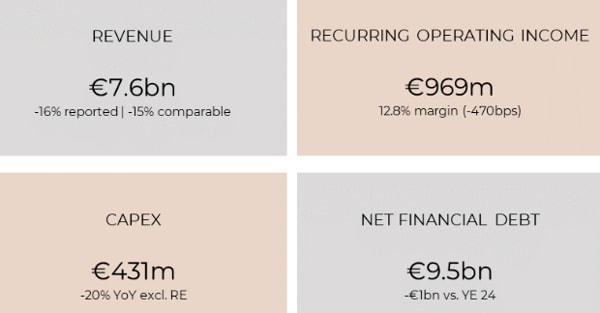
New quarter down for Kering, with negative performance across all geographies. The French luxury group ended the first half of 2025 with revenues of €7.6 billion, down 16% on a reported basis and 15% on a comparable basis. The performance reflected a particularly difficult market environment, to which the group responded with targeted actions on its cost structure and a strategy of financial strengthening.

Recurring operating profit amounted to EUR 969 million, with an operating margin of 12.8% (down 4.7% year-on-year). Net profit attributable to the group was EUR 474 million, down sharply from EUR 878 million in H1 2024, a decrease of 46%.

Loading...

"The first half of 2025 represented a period of significant strategic decisions for Kering. On the governance front, I proposed to the board of directors, which was favourably received, that Luca de Meo be entrusted with the role of ceo of Kering, while I will retain the chairmanship of the board. At the creative level, the strengthened teams, led by new artistic directors in three of our major maisons, are working with passion and determination to increase the desirability and enhance the heritage of our brands. At the operational and financial level, in a particularly difficult market environment, we continued to rationalise our distribution network and cost structure and, following our roadmap, we took decisive steps to strengthen our financial structure. Although the results are still far from our potential, we are confident that the efforts undertaken over the past two years have laid a solid foundation for the next stages of Kering's development," comments François-Henri Pinault, Chairman and CEO of the French group.

Operating free cash flow in the first half year amounted to EUR 2.4 billion, of which EUR 1.3 billion came from real estate disposals.
The performance of individual brands

.

A heavy half-year for Gucci. The group's main fashion house posted revenues of €3 billion, down 26% (reported), following a 42% slump in the wholesale channel, while the retail network posted -24%. "In the second quarter, sales showed a slight sequential improvement, supported by performance in North America and Asia Pacific. The new leather goods lines, in particular the 'Giglio' bag launched in the Cruise 2026 collection, were a strong success," the statement read. Gucci's recurring operating profit was €486 million, with a margin of 16%, down 8.7 percentage points year-on-year.
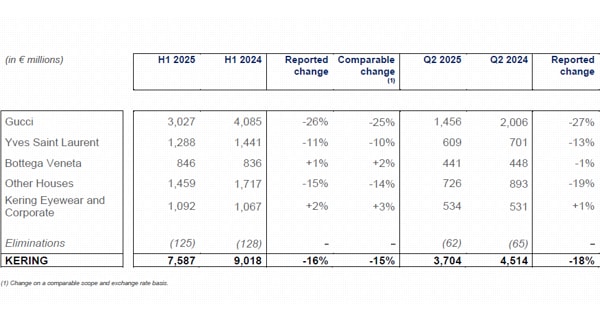
Yves Saint Laurent generated sales of EUR 1.3 billion in the half year (-11% reported, -10% comparable). Retail sales fell by 10% and the wholesale channel posted -17%. "New products, particularly in ready-to-wear and footwear, received a favourable reception," reports the group's note. The recurring operating margin stood at 20.4% (-1.6%).

Bottega Veneta was the only brand to perform against the trend. Revenues amounted to €846 million (+1% reported, +2% comparable). Retail sales grew by 3% and wholesale sales declined by 3%. The second quarter showed good resilience, especially in North America. The recurring operating margin increased to 15% (+0.5%).

The other maisons generated revenues of EUR 1.5 billion, down 15% on a reported basis and 14% on a comparable basis. Retail sales fell 11%, while wholesale contracted 23%. Balenciaga maintained resilient results in North America and Asia Pacific, whileMcQueen accelerated the rationalisation of its retail network.

The jewellery maisons held up, with a good performance by Qeelin and significant developments for Boucheron and Pomellato. However, the operating result was negative by EUR 29 million, mainly due to the effect of McQueen.

Kering Eyewear and corporate generated revenues of €1.1 billion (+2% published, +3% comparable). Kering Eyewear recorded €921 million in revenue, while Kering Beauté reached €150 million, driven by Creed's women's fragrances. Total recurring operating profit was EUR 126 million (+25%).

The second quarter of 2025

.

Second quarter 2025 revenues for the luxury group came in at €3.7bn, down 18% on a reported basis and 15% on a comparable basis. The exchange rate effect was a negative 3%, according to a Kering release.

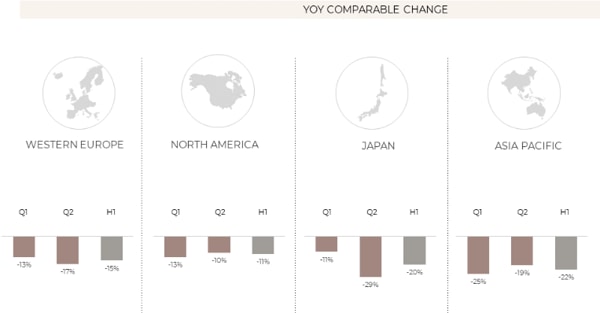
Sales through the direct retail network decreased by 16% on a comparable basis, in line with the trend in Q1 2025. Trends improved in North America (-10%) and Asia-Pacific (-19%) compared to Q1, while Western Europe (-17%) and Japan (-29%) slowed, mainly due to the decline in tourism. Revenues from the Wholesale and Others channel declined by 12% on a comparable basis.

The estimates for the whole year

During the conference call with analysts, management pointed out that the group expects margins for the full year 2025 to be lower than in 2024, but less than they were in the first half of the year.

"In pursuit of its long-term vision," the statement goes on to say, "Kering continues to invest in the development of its maisons, to strengthen their desirability and distributive exclusivity, balancing creative innovation and heritage enhancement, and ensuring the highest standards of quality, sustainability and customer experience," reads the statement, which continues, "In a still uncertain economic and geopolitical environment, the Group continues with determination to execute its strategy for a profitable and sustainable long-term growth path. Initiatives are underway to accelerate the development of the maisons, accompanied by a rigorous control of operational and financial efficiency, through disciplined cost management, selective investments and sound balance sheet management"..

During the conference call with analysts, Kering group chief financial officer Armelle Poulou commented: 'As you know, Luca de Meo will join us as CEO in mid-September. Of course, it is still too early to outline new directions' strategic, 'but we have already started working with him so that he can hit the ground running from day one'.

As announced, Luca de Meo will take over as group CEO on 15 September. 'In the meantime,' the cfo added, 'we have continued to make progress on several fronts. We know that this comes at a difficult time for the global economy and for the industry, but we are already ready for the new chapter that will begin in the second half of the year'.

Also on De Meo's arrival, Deputy CEO Jean-Marc Duplaix. added: 'Luca has already met several stakeholders in the group, starting in France, and is preparing for his official arrival. We look forward to working with him. But of course it will be up to him to define his roadmap and to present his ambitions. When you have a new manager on board, there is a time to talk to the market,' and 'we think it will be in 2026, just to give him time, although we are working hard with him precisely to enable him to go quickly when he arrives,' Duplaix continued, explaining that 'there is no reason to believe that in 2026 we will not have some kind of appointment' in which 'to discuss the ambitions of the group, led by Luca'.

The analysts' comment

.

"In the second quarter, all the group's fashion houses - with the exception of Gucci - performed slightly below or in line with already negative expectations, according to the consensus gathered internally by the company. This hints at a potential turning point in the deteriorating trend in results," writes Bernstein's Luca Solca in a note, which continues, "Gucci lived up to expectations with a -25% year-on-year decline (in line with consensus), while Saint Laurent posted -10% (also in line), and Bottega Veneta disappointed with modest growth of +1% versus the expected +3%.

On the profitability front, Bernstein analysts point out: "Despite the weakness in the top line, operating profit was +4% above expectations, thanks to an operating margin of 12.8%, or +57 basis points above estimates. The positive surprise came mainly from Saint Laurent, which reported a first half margin of 20.4%, +212 basis points above consensus, albeit down -153 basis points year-on-year. In contrast, Gucci disappointed on the profitability front: the operating margin came in -66 bps below expectations, a significant drop of -865 bps year-on-year. This deterioration was attributable to operational deleveraging, partially offset by cost efficiency initiatives.

The note ends by noting: "The market's attention now remains focused on Gucci's relaunch plan and management transition. Current market valuations already incorporate expectations of significant improvement: Kering trades at 27 times expected earnings over the next 12 months, one of the highest multiples among covered companies, when compared to the average of the last ten years - a valuation only partly justified by earnings compression due to strong operating deleveraging".

Copyright reserved ©
Loading...

Brand connect

Loading...

Newsletter

Notizie e approfondimenti sugli avvenimenti politici, economici e finanziari.

Iscriviti