

With Khamenei’s funeral, the Gulf enters a grey area
Beyond the anti-US and anti-Israel rhetoric, Tehran’s use of verses from the Qur’an to create new concentric circles around the power of the Pasdaran is a strategic move. Riyadh must keep the channels of communication open, but it cannot accept Iran using religious rhetoric to cast the Saudi leadership in a suspicious light. So now nobody wants war, and nobody trusts the other side enough to defuse the crisis.

Key points
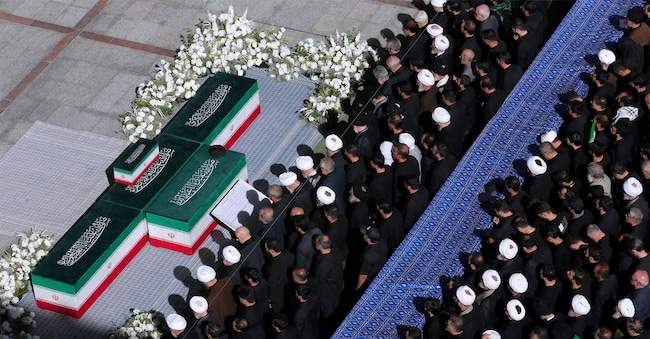
Ali Khamenei’s funeral in Tehran has come to an end. But its reverberations will, on the contrary, be felt for a long time to come in the palaces, streets and ports of the Gulf – in the coming months and perhaps even years. Beyond the usual messages directed at the West – against the US and Israel – and the propaganda for domestic consumption, what proved most interesting was the use of verses from the Qur’an to create new concentric circles around the power of the Pasdaran. Iran has chosen a specific surah for each of the states and political actors whose representatives attended the ceremony. Turkey was assigned a verse that extols those who fight over those who sit idly by (Surah An-Nisa, 4:95). Turkey’s active neutrality or ambiguity does not, in fact, confer full status in the eyes of the leadership in Tehran, but it does leave avenues for dialogue open, based on a tradition of opportunism.
The Sura
Hamas has been presented with a verse honouring those who have fulfilled their covenant with God: ‘Some have died, and others are waiting’ (Sura Al-Ahzab, 33:23). In other words: this loss is not a defeat; the resistance remains superior. In effect, this is a posthumous recognition and validation of a role played in the past but which will not be repeated in the future. Hezbollah, on the other hand, was told: ‘Do not lose heart, nor grieve, for you are the best’ (Sura Al-Imran, 3:139). Ansar Allah has received a verse praising the believers who fought without faltering (Sura Al-Imran, 3:146). This is a sign that the terrorist group will remain intact, retaining its role as a proxy. Similarly, Hezbollah has been instructed to remain a terrorist force acting as a buffer between the government in Beirut, Syria and the Israeli army. Remaining within the Lebanese context, the official government heard a verse concerning those who refuse to make the ultimate sacrifice when called upon to do so (Sura Muhammad, 47:38). In effect, this is a confirmation of the status quo. Finally, the last two verses were dedicated to Qatar and Saudi Arabia. In the first case, Sura Al-Fath, 48:1–2, was chosen, which conveys a message of forgiveness through divine favour as a sign of gratitude for their role as mediators. As for Mohammed Bin Salman, the Pasdaran chose a verse concerning two armies meeting in battle, one that believes and the other that does not (Sura Al-Imran, 3:13). There were numerous delegations from Asia and the Global East, but the interest and focus centred on the Gulf’s partners and non-allies.
The Balance
The funeral did not merely determine who stands close to or distant from Iran, but who can be utilised and in what capacity. Hezbollah, Hamas and Ansar Allah do not fall within the category of traditional diplomacy, but within that of militant loyalty. Qatar is not treated as an ideological ally, but as a negotiating platform. Saudi Arabia is not viewed as a partner, but as a rival with whom open war must be avoided. Turkey is recognised as an autonomous Muslim power, but challenged on the ground in terms of mobilisation; the Lebanese state is separated from Hezbollah, confirming the Iranian line that formal Lebanese sovereignty does not exhaust the political legitimacy of the ‘resistance front’. Within this logic, religion does not replace geopolitics: it enriches it, as it allows different messages to be conveyed without issuing a formally hostile diplomatic communiqué. The selection of verses, if confirmed in the form indicated, can be interpreted as serving three operational functions: warning, discipline and gratitude. This three-part division is significant because it highlights how Tehran does not communicate with the Gulf in a monolithic manner. It distinguishes between those who must be contained, those who must be used as a channel, those who must be encouraged, those who must be admonished and those who must be kept in limbo.
The Gulf monarchies are therefore not viewing the ceremony as a mere symbolic gesture, but are interpreting it in the context of the Strait of Hormuz, drones, missiles, proxies, nuclear issues, civilian infrastructure and energy. It is no coincidence that, on 25 June 2026, during a ministerial meeting with the United States, the GCC declared the need to address the full spectrum of Iranian threats without disrupting shipping. In a briefing to the Security Council, the GCC Secretary-General argued that Iranian attacks would target civilian and vital infrastructure, including airports, oil facilities, desalination plants, ports and residential areas, and linked the crisis to the security of sea lanes, supply chains and energy markets. So far, these are all elements of geopolitical analysis that are clear and emerge from official statements. The difficulty lies in projecting what lies between the lines into the immediate future.
Status quo
The reality now is that none of the Middle Eastern players can afford to let the funeral turn into a diplomatic rift, nor can they allow Tehran to have the final say on what is moral or immoral according to the Qur’an or the political struggle that stems from it. Riyadh must keep the channels of communication open, especially following the normalisation of relations brokered by China in 2023, but it cannot accept Iran using religious rhetoric to portray the Saudi leadership as a suspicious presence within the Islamic community. Meanwhile, Oman remains the most effective mediator, because its usefulness depends not on media exposure but on its geographical position. The result is that a phase of Middle Eastern ‘cold war’ is beginning. Blocs and sub-blocs are forming, which in turn are working to consolidate separate and intersecting agreements for European countries and other global actors. Nobody wants war. Nobody trusts the other side to defuse the crisis. We do not know how long this form of Cold War will last. Whether Israel’s need to establish a buffer state between Lebanon and Syria will gather pace, or whether the conflicts will shift elsewhere – to Africa, for example. But it is certainly a new reality with which Italia, too, will have to contend.

