Test drive

Kia PV5, our test in Korea of the multi-role electrovan

The Korean brand continues its journey into electric mobility by flanking its SUVs and sedans with the first extensively configurable battery-powered commercial vehicles, which have just gone on sale in Italy

by Massimo Mambretti

5' min read

Translated by AI
Versione italiana

5' min read

Translated by AI
Versione italiana

Kia enters full electric commercial vehicle territory with the PV5 Passenger and Cargo. In other words, a van and a van. They are the first representatives of the Pbv, or Purpose Built Vehicle, family, which aims to offer functionality, technology and fittings outside the norm to meet even the most specialised needs. A species that the larger PV7 will enter in 2027 and PV9 in 2029.


Loading...

Kia PV5, innovative solutions for a large ecosystem

.


To effectively enter the light transport sector, Kia also took advantage of suggestions from industry players, for example Uber for ride-hailing and Dhl for logistics, and developed new technologies. In particular, a modular skateboard christened E-Gmp.S derived from that of cars, which integrates cell-to-pack batteries of different capacities in both lithium and nickel-cobalt-manganese and with a 400 V electric architecture, together with a styling language based on modular body components, which allows very different versions to be produced on the same assembly line, linked only by the appearance of the front module. The line-up includes the Passenger and Cargo versions also in the high roof configuration that shifts the load volume from 4 to 5.2 cubic metres, with a double cab, the Wav designed for maximum wheelchair accessibility thanks to solutions such as a retractable side platform and a suitably designed interior, and the specialised versions based on the Chassis Cab configuration. For this variant, Kia has made agreements with some leading conversion companies (including the Italian Scattolini for what concerns the bodies) to produce these versions directly in the new Evo plant in Korea, specially built for the Pbv range.

Kia PV5, le foto della prova in Corea del van elettrico

Photogallery17 foto


Kia PV5, two versions and two powertrains

.


The first two PV5s on sale in Italy are both 4.69 metres long, 1.89 metres wide, 1.89 metres high and have a wheelbase of 2.99 metres. However, there is also a 4.50-metre long variant for the Cargo, which is currently not imported. Both are driven by front powertrains with 122 or 163 horsepower and 250 Nm of torque powered, respectively, by 51.5 and 71.2 kWh batteries rechargeable with alternating current at 11 kW and direct current up to 350 kW for distances in the Wltp cycle of up to 412 kilometres for the Passenger version and 416 kilometres for the Cargo. In detail, with direct current at 50 kW a 10 to 80 per cent refuelling of the largest one is done in one hour, while at 350 kW both are refuelled in half an hour. In addition, the PV5's electrical architecture allows recharging with the practical Plug & Charge function and integrates bi-directional recharging to power devices. Kia is the first brand of the Korean group to form with Hyundai to use cell-to-pack batteries, i.e. without modules and with prismatic cells from Chinese Catl. To this record, the PV5 range also adds the absolute advantage of being able to use Samsung's Ai SmartThings Pro to optimise the complete management of both fleets by monitoring all the functions of each vehicle and precisely locating each one, and the management of the entire distribution chain.


Kia PV5, original line with rational solutions

.


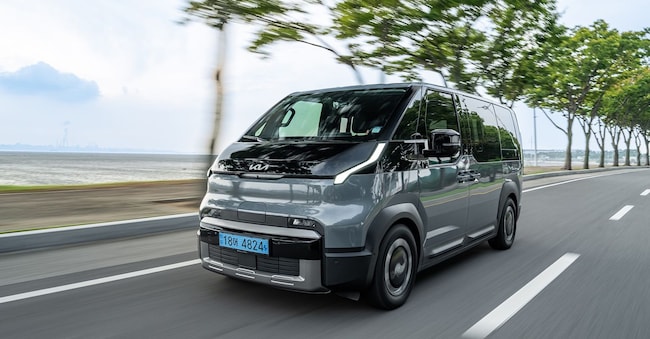
Stylistically, the range is defined by a design that is in line with that of the cars. The PV5 is an original van, distinguished as much by the appearance of the front, which also introduces a newly interpreted light signature, as by that of the rear, regardless of whether it features the top-hinged tailgate or the two side-hinged doors that are most congenial to the commercial variant. Overall, the lines generated by the Flexible Body System transfer the design of Kia's electric EV range to the van world. From a practical point of view, the collaboration with passenger transport and logistics operators resulted in the decision to create an access threshold to the passenger compartment just 40 centimetres from the ground and to the load area of 42 centimetres for the commercial version.


PV5, inside is big and functional

.


In addition, it inspired the integration of compartments and accessories for PCs and tablets, electronic payment devices and frequently used material into the interior design. In the passenger compartment, the rationality of the design manifests itself through the rational intertwining of the exterior design and the mechanical layout, as the low floor and long wheelbase together with the integration of the compact powertrain and accessory components as well as the special suspension architecture maximises the availability of space, so much so that the Passenger version with a five-passenger interior (which will later be joined by those with a six-passenger and seven-passenger interior) offers a load capacity of 1,320 to 2,300 litres. The interior design is common to both types of PV5. The interior features a well-organised dashboard that supports the 7.5-inch digital cockpit and 12.8-inch central touchscreen of the Android Automotive-based infotainment system that also integrates connectivity for Apple CarPlay, voice assistant with Ai and the Ota protocol for updating the car's software. The presentation of the ambience is pleasing, the construction is based on robust, washable furniture materials and bio polyurethane seat covers, as on Kia cars. Functionality is underpinned by plenty of storage compartments and floor wells as well as a double floor under the load floor that stops the compartment sill at 60 centimetres, which on the Passenger is also complemented by rear USB sockets and accessibility to the rear seats facilitated by the two large sliding doors and the low floor sill height.


Kia PV5, handy and efficient

.


With the PV5 Passenger that we tested in Seoul traffic and on Korean roads in the 163-horsepower version with the 71.2 kWh battery, a good feeling is immediately established, because the elevated and forward driving position together with the extensive glazing allows you to locate the footprint well and dominate the road. Also, because you can easily locate and operate the controls, many of which are concentrated at the bottom of the infotainment display. Dynamically, the PV5 offers the driveability of a normal car, turning out to be less bulky than its build suggests, reliable handling and very good comfort thanks to the 'automotive' calibration of the set-up and, of course, the quietness that reigns in the cabin that is not shattered at motorway speeds by annoying hissing noises. The powertrain pushes this PV5 up to 135 km/h and to 100 km/h in 12"5, with an average consumption of 19.6 kWh/100 km. In this regard, at the end of the test, which took place under optimal conditions and in compliance with Korea's low speed limits (as well as the numerous speed cameras), and making the most of the three steps of energy recovery during slowdowns, the on-board computer reported an average of 18.4 kWh/100 km. The drivability is supported by the performance of the powertrain, which is always linear and even in the most eco-friendly car configuration offers appreciable verve.


Kia PV5, ranges and prices

.


The Passenger and Cargo families are practically mirrored in terms of powertrain, batteries and range, while they differ in terms of equipment. For the two van versions, the Air and Earth are available, for the van the Business and Pro. In all cases, you can count on Adas for semi-assisted driving level 2 with the top of the range equipment which, among other things, also offers comfort and functionality features specific to each PV5. For example, alloy wheels and opening windows on the sliding side doors, heated steering wheel and front seats for the van and also rear seats on the van in the top-of-the-range trim. The latter, by the way, also includes electric adjustment of the two front seats and an electrically operated tailgate. The Passenger is on sale at prices ranging from 38,000 to 47,000 euros, while the VAT van's price list goes from 31,850 to 37,650 euros.

Motor24 videos

Brand connect

Loading...

Newsletter

Notizie e approfondimenti sugli avvenimenti politici, economici e finanziari.

Iscriviti