
Kosovo, Kurti wins but loses absolute majority. In Armenia, victory for pro-Western premier
Elections in Kosovo were called after the main political parties failed to reach an agreement by the March deadline on who should succeed former President Vjosa Osmani. In Armenia, the parliamentary elections tested the pro-Western orientation of Prime Minister Nikol Pashinyan, after threats and accusations of interference by Russia
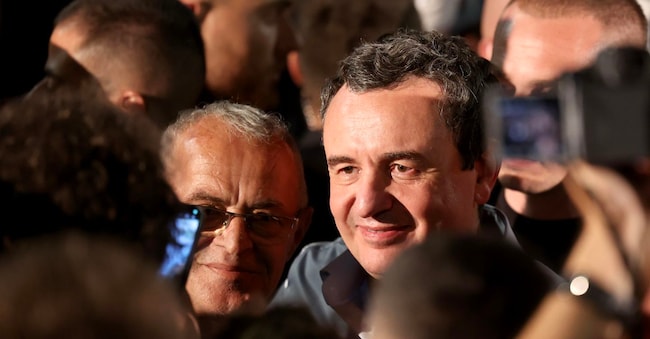
Albin Kurti again won the elections in Kosovo, but lost his absolute majority and will now have predictable difficulties in forming a new government. The outgoing premier and his Vetvëndosje movement, with three small allies, dropped from the 51% he had obtained last December to 43-46%.
This is the result of the third parliamentary elections in Kosovo in the past 16 months, according to the first exit polls, against preliminary data showing a sharply declining turnout: only one voter out of three would have cast his vote, a clear sign of fatigue from a political paralysis that has lasted for a year and a half and risks repeating itself in the new Kosovo Assembly. Unless the three main opposition parties - the second is the Pdk at 21-22%, heir to the stable Uck independence militia (it had 21%), the third Ldk with former president Vjosa Osmani on the list at 17-18% (up from the previous 13%) and the Aak at 7% (up from 5.6% in December) -, all conservatives, decide to put aside their recent enmities and agree to form an alternative majority.
Kurti, a populist centre-left nationalist, thus seems to have missed a historic opportunity in the last ephemeral legislature, which lasted four months in all, in which he had 57 seats out of 120: a victim of his own oppositional attitude, which produced the same mirror effect in his main opponents, resulting in institutional paralysis. Kosovo has had neither a president of the republic nor a president of parliament for over two months. Indeed, for Kurti it is a step backwards compared to the vote in February last year, when a parliament without a majority - Kurti had only 42% - failed to produce a majority government. It could only be these parties in the Albanian majority that have passed the 5% threshold.
As for the Serbian minority, which is constitutionally guaranteed 10 seats, the Belgrade-linked Srpska Lista (Sl) would have about 5%, and it remains to be seen whether they will make the en plein. According to preliminary results in the largest of the Serbian municipalities of North Mitrovica, for example, with 30% of the votes counted they would have 75% against the realist and Kurti-affiliated Spo Serb party, which does not reach 5%. Another 10 seats are reserved for other non-Serbian ethnic minorities (Roma, Turks, Bosnians and Egyptians), who almost always ally themselves with the incumbent government. The elections were monitored by some 16,000 domestic and international observers, but for the first time without an EU election observation mission. Since the proclamation of independence, general elections have been held seven times, three of them in the last 16 months alone. The cost of the entire electoral process was estimated at EUR 10.9 million, a significant expense for one of the most economically fragile states in Europe. With a population of around 1.6 million, Kosovo remains particularly vulnerable to the effects of political instability. A recent European Parliament report described 2025 as a 'lost year' for Kosovo, warning that political stagnation could continue into 2026, undermining the benefits of the EU Growth Plan and funds for the Western Balkans.
Premier Pashinyan's party's victory confirmed in Armenia
Premier Pashinyan's party's victory confirmed in Armenia
The Central Election Commission confirmed the victory of the party of Armenian Prime Minister, Nikol Pashinyan, in the parliamentary elections yesterday, 6 June, an outcome that strengthens the government's policy of rapprochement with the EU and the US. When all the votes were counted, the Russian Interfax news agency reported, it announced the victory of the governing Civic Contract party with 49.81%. Far behind were the two opposition parties in favour of maintaining the traditionally good relations with Moscow: Armenia Strong, of Russian-Armenian billionaire Samvel Karapetyan, obtained 23.29% and Armenian Alliance of former president Robert Kocharyan 9.94%.

