
Defence, Kubilius: 'Russia could test us as early as 2027. I hope Italy finds a way to increase spending'
Kubilius' trip to Rome was aimed at promoting European space policy and strengthening the continent's space economy and competitiveness

3' min read
Key points
3' min read
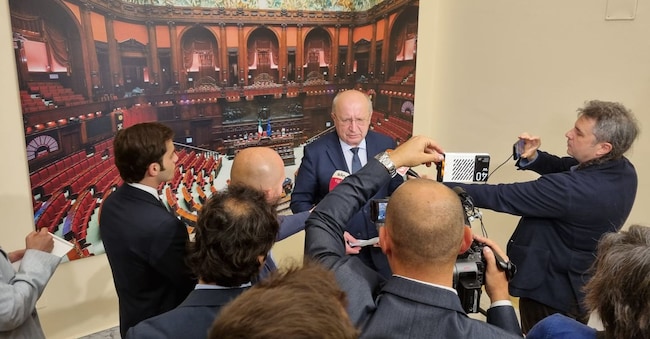
The time for European rearmament is tight because the possibility of Moscow's aggression against NATO could be just around the corner. "Russia could test our resilience and response with Article 5 (of the North Atlantic Treaty, ed.). And it could test us as early as 2027," emphasised the EU Commissioner for Defence and Space, Andrius Kubilius, who was heard on Monday 26 May by the EU House and Senate Political Committees as part of his visit to Italy.
"We have to be ready for such developments," he added, speaking of the challenges that the EU and NATO face in the area of defence. But there are two other factors to consider. The first is that 'we must remember that we have to be ready for the military rise of China'. The second is the fact that the 'US is shifting more and more resources to the Indo-Pacific and less to Europe'.
In general, Kubilius has no doubts: 'We are in a particularly delicate moment, with a particularly serious situation, not only given the threat of aggression from Russia but also the various signals coming from the intelligence community,' he said, answering questions from journalists, including Il Sole 24 Ore.
Kubilius and Urso visit Thales Alenia, Telespazio and Avio
Kubilius' trip to Rome was aimed at promoting European space policy and strengthening the continent's space economy and competitiveness. In the morning, prior to his speech in parliament, the European Commissioner (Vice-President of the Commission) met with the Minister for Enterprise and Made in Italy and Delegated Authority for Space and Aerospace Policy, Adolfo Urso. The two visited the satellite integration centre of Thales Alenia Space (a Thales and Leonardo joint venture) in Via Tiburtina in Rome, a strategic hub for Italian production capacity in satellite systems, telecommunications and Earth observation. The components required to build small and medium-sized satellites for national and European programmes, such as Galileo and COSMO-SkyMed second-generation satellites, the IRIDE programme satellites, and the third satellite for Defence, Sicral, are integrated here. Urso and Kubilius then reached the Fucino Space Centre of Telespazio (a joint venture between Leonardo and Thales), the world's first and most important 'teleport' for civil use, where in-orbit satellite control, telecommunications and television services are carried out on a global scale. Finally, Urso and Kubilius visited Avio's headquarters in Colleferro, Lazio.
Satellites: 'With Galileo and Copernicus we hope to do better than Starlink'
."The Galileo programme," the EU commissioner emphasised in front of MEPs, "is the best satellite positioning programme in the world, Copernicus is the best as far as monitoring is concerned, we also have other programmes and we hope that there will be improvements, even to be better than Starlink, we hope to achieve better results.


