Birth rate

Ukraine’s other war: the demographic crisis

The population was already in decline before the Russian invasion. Today, the war, migration and the slump in birth rates are exacerbating a crisis that could weigh heavily on the country’s future even after the conflict has ended

by Silvia Martelli (Il Sole 24 Ore) and Francesca Barca (Voxeurop)
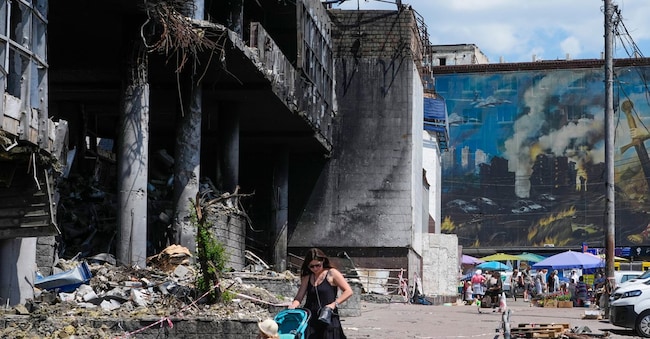
Una madre spinge un passeggino davanti a un edificio danneggiato, ricoperto da murales di street art, e accanto a un grande mercato cittadino recentemente distrutto da un attacco missilistico russo, a Kyiv, in Ucraina, lunedì 22 giugno 2026.(AP Photo/Efrem Lukatsky)


Associate Press/ LaPresse
Only Italy and Spain APN

6' min read

Translated by AI
Versione italiana

6' min read

Translated by AI
Versione italiana

The war in Ukraine is also being fought far from the front line. It is being fought in the empty cots, in the millions of people who have left the country, and in the question that more and more young people are asking themselves: does it make sense to build a future here?

“I asked myself time and again whether it was responsible to bring a child into the world in a place under constant attack,” says Ukrainian journalist Angelina Kariakina. “When I was pregnant, I had to take shelter in the basement during the night-time attacks. Yet my husband and I decided to carry on. We felt that the time we had might be limited and that we had to live our lives regardless.” Today, her children are growing up in Kyiv. “We want them to stay here. As long as it’s possible to live safely, this will continue to be our home.”

Loading...

Kariakina’s story highlights one of the most profound dilemmas facing Ukraine: how to safeguard its future whilst its present is marked by war.

Ukraine was already experiencing a demographic crisis even before the Russian invasion. The population has been declining for over thirty years, and the conflict has therefore accelerated a process that was already underway. It is no coincidence that, as early as 2023, the Kyiv Independent described the demographic decline as ‘the greatest threat to post-war Ukraine’.

“The decline in Ukraine’s population is not an isolated case,” explains Oleksander Gladun, a demographer at the Ptoukha Institute for Demography and Social Studies of the National Academy of Sciences of Ukraine. “It is part of a global process that demographers refer to as the ‘demographic transition’. What makes the Ukrainian case unique is the context in which this phenomenon is taking place.”

“In addition to the loss of military personnel and civilians, mortality rates are rising due to the worsening of chronic illnesses, stress and, in some cases, the inability to receive timely treatment,” Gladun continues. At the same time, birth rates are plummeting: “People are putting off the decision to have children. It’s a natural reaction.”

The figures confirm the scale of the phenomenon. According to the Ukrainian Ministry of Justice, 495,090 deaths were recorded in 2024, almost three times the number of births. Since the start of the Russian invasion in February 2022, President Volodymyr Zelensky has stated that Ukraine has lost 55,000 military personnel, including career soldiers and conscripts, a figure that many analysts believe to be an underestimate. The Centre for Strategic and International Studies (CSIS) in Washington, however, estimates Ukrainian losses at between 100,000 and 140,000 soldiers, whilst Russian losses are estimated to be between 275,000 and 325,000.

A population halved in just over thirty years

Since 1991, the year it gained independence from the Soviet Union, Ukraine has lost almost half its population. ‘According to my estimates,’ says Gladun, ‘at the start of 2026, around 28 million people were living in government-controlled territories. At the end of 1991, the figure was 51.7 million.’

A United Nations projection, reported by Ukrainska Pravda, suggests that the population could fall to as low as 15.3 million by 2100.

However, as the demographer points out, these figures must be interpreted with caution. ‘Firstly, the territory currently controlled by the government is about 20 per cent smaller than it was in 1991. Furthermore, we do not know the exact size of the population living in the territories occupied by Russia, nor do we know how many of those who have fled abroad will return once the war is over.’

How many Ukrainians are living abroad today?

Then there is the issue of refugees: according to the fifth report by the Centre for Economic Strategy (CES), an independent think tank founded in Kyiv in 2015, by early 2026, 5.6 million Ukrainians were living abroad with refugee status. Of these, around 4 million left the country by crossing the western borders.

Added to these are the internally displaced people. “We also have over four million people displaced within the country. This means that more than ten million people have had to leave their homes: around a fifth of Ukraine’s population before the invasion,” explains Gladun.

“Four years on from the start of the large-scale invasion, Ukraine continues to lose population,” confirms Iryna Ippolitova, a senior researcher at the CES. “The main cause is migration. According to our estimates, in 2025 alone, around 300,000 people left the country. Added to this are the losses caused by the war, among both military personnel and civilians, and the drastic fall in the birth rate.”

The dilemma facing young men

At the end of August 2025, the Ukrainian government decided to ease restrictions on cross-border travel, allowing young people aged between 18 and 22 to leave the country and men over the age of 23 living abroad to return to Ukraine temporarily.

Until then, the martial law introduced at the start of the Russian invasion in 2022 had prohibited almost all men aged between 18 and 60 from leaving the country, with very few exceptions. The aim was to ensure that the armed forces had a sufficient pool of potential recruits. “We want Ukrainians to maintain as many ties as possible with their country,” said Prime Minister Yulia Svyrydenko. The government thus faces a difficult balancing act: meeting the demands of the war without jeopardising the country’s demographic future.

According to the CES, between August and November 2025, around 96,000 men left Ukraine. The estimates are based on data from the Polish, Slovak and Romanian border guards, supplemented by figures from the Ukrainian Border Guard Service; for Hungary and Moldova, the centre uses statistical extrapolations. ‘Since last August, around one in seven young men aged between 18 and 22 has left the country,’ the report states.

Who will return to Ukraine?

According to the CES, between 1.3 and 2.2 million people could return to Ukraine once the war is over.

“The decision to return will depend on a number of factors,” explains Gladun. “The availability of housing, job opportunities, childcare facilities, schools. Those living abroad today will weigh up the quality of life they have achieved in their host country against what they might find in Ukraine. The extent to which they have integrated into their new society will also be a significant factor.”

Of course, the decisive factor remains the end of the conflict. “Two years ago, a survey showed that the number of people willing to return would increase by 25 per cent if the war were to end with the restoration of the 1991 borders, compared with the scenario of a settlement along the current front line,” adds Gladun.

According to Gladun, many Ukrainians are convinced that ‘if the conflict were to become frozen along the front line, Russia would launch another attack within a few years’.

Furthermore, 66 per cent of Ukrainian refugees abroad are of working age (18–65 years). More than half (56%) are under 35. It is precisely this group that represents the human capital on which the country’s future depends. Yet they are also the group least likely to return.

“We are seeing today that those under 35 are far less keen to return than older people, particularly those over 50,” explains Iryna Ippolitova. “There are many reasons for this: better integration in their host countries, more favourable economic prospects, higher wages and, above all, safety. To persuade this generation to return, certain essential conditions are needed: an end to the war, a safe environment and the resumption of civilian flights. A frozen conflict would have a much smaller impact on refugees’ willingness to return.”

The future of temporary protection

Today, Ukrainians living in European Union countries benefit from the temporary protection scheme, which was introduced in March 2022 to enable refugees to work, study and access national healthcare systems.

The measure, which has been extended several times, is set to expire in March 2027. What will happen after that remains unclear. Some European governments have already begun to consider the future of the millions of Ukrainian citizens living within their respective territories. German Chancellor Friedrich Merz, for example, has reiterated his intention to limit the number of Ukrainian men seeking asylum in Germany, arguing that they should be enabled to return home to help rebuild their country.

*This article is part of the European journalistic collaboration within the “EU Neighbours East” project

Copyright reserved ©
Loading...

Brand connect

Loading...

Newsletter

Notizie e approfondimenti sugli avvenimenti politici, economici e finanziari.

Iscriviti