
Lepas L8: a test drive of the Chinese super-hybrid SUV aiming for the premium market
The third brand created for Europe by the Chery Group makes its debut with a plug-in SUV. It offers a good balance of technology, features and price. The design has a sense of déjà vu.

Key points
The Chinese giant Chery is continuing its expansion in Europe with the new Lepas brand, which joins Omoda and Jaecoo. All three have been created for Europe, where, incidentally, the off-road brands Freelander and Icaur are also set to launch next year, alongside the parent company’s brand.
Lepas makes its debut with the L8 plug-in hybrid, a medium-to-large SUV which, needless to say, belongs to the Gen SH. That is to say, the category of Super Hybrid models launched – not to say invented – by Chinese manufacturers. This category has proliferated rapidly and, regardless of the brand, has pushed the benchmark for the total range of plug-in hybrids well beyond 1,000 kilometres. The L8 aims to appeal both to those who’d like to enter the premium market without spending a fortune and to those seeking to review their spending without having to compromise on advanced technologies and comprehensive, high-end specifications.
Lepas L8: a three-engine powertrain and familiar technologies
Lepas is a brand that aims to distinguish itself in terms of image from the other brands within the Chery Group, to which it nevertheless remains linked technologically. Indeed, the L8 is based on the T1x architecture used in the Jaecoo 7 and Omoda 7 plug-in SUVs. It also shares with these models the sophisticated three-motor powertrain, which delivers 279 cavalli and is paired with a single-speed gearbox. The system comprises the familiar 1.5-litre turbocharged petrol engine with a Miller cycle, producing 143 cavalli and 215 Nm of torque, which rarely powers the SUV itself as it primarily drives an 82 cavalli electric motor that generates electricity for the battery or for the 204 cavalli traction motor with 310 Nm of torque. The system’s operation is entirely managed by the electronics. Thus, when the battery is fully charged, the L8 is powered solely by the more powerful electric motor; when the charge level approaches 25 per cent, the petrol engine switches on to power the unit that generates electricity, whilst when higher performance is required or when driving uphill, the petrol engine is connected to the front axle and works in parallel with the electric drive motor to deliver maximum power, just like a classic full hybrid. The 18.4 kWh LFP battery, which promises a zero-emission range of up to 120 kilometres in urban areas, can be recharged using 6.6 kW AC charging from 25 per cent to 100 per cent in under three hours, and with continuous charging at up to 40 kW from 30% to 80% in 20 minutes, whilst the V2L function, which comes as standard, allows 220-volt power to be supplied to external devices. The plug-in three-motor powertrain propels the L8 to a top speed of 180 per hour and accelerates it from 0 to 100 in 7.9 seconds, whilst delivering an average fuel consumption of 2.2 l/100 km and a total range of up to 1,100 kilometres.
Lepas L8, a range with European “inspirations”
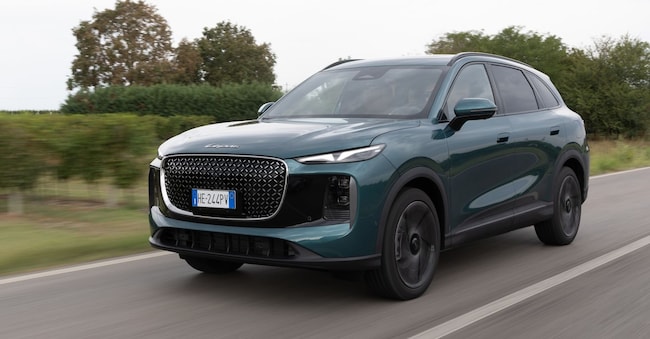
Aesthetically, the L8 follows the design trends currently popular amongst Chinese brands. In fact, its design is not so original as to be easily distinguishable from that of other Chinese SUVs; moreover, it incorporates certain design elements strongly inspired by those of premium European models. Specifically, the front end, with its large trapezoidal grille and light signature, is reminiscent of many Audi models, whilst at the rear, the light strip running across the tailgate is reminiscent of that found, for example, on the Porsche Cayenne. That said, the design is suitably muscular, as one would expect from an SUV, and well-proportioned given its length of 4.69 metres, width of 1.7 metres, height of 1.69 metres and wheelbase of 2.80 metres.
Lepas L8: a spacious, well-finished and thoughtfully designed digitalised cabin
The skilful balance between the L8’s design and dimensions ensures a generous amount of space inside, even in the rear of the cabin, where even the passenger in the middle can sit comfortably thanks to the flat floor. The interior design features a linear dashboard supported in the centre by the centre console, on which sits the 13.2-inch vertical infotainment display which, unlike those of most Chinese brands, does not conceal the controls for the car’s main functions. Consequently, the climate control settings are visible on the display, and on the centre console – alongside the ventilated charging pad for smartphones – there are physical switches for certain functions and for the Eco, Comfort, Sport, EV and Custom driving modes, allowing users to customise features linked to the battery charge level as well. Unfortunately, however, the controls for muting the intrusive speed limit alerts and lane departure warnings, as well as those for adjusting the intensity of regenerative braking, are located on specific pages within the infotainment system – though these can be accessed intuitively. The infotainment system, powered by a Qualcomm Snapdragon 8155 processor, responds quickly to commands and supports wireless connectivity for smartphones.

