
La Molisana invests 230 million in plants and new product lines for sauces and gnocchi
Revenues to 550 million in 2026. CEO Giuseppe Ferro: 'A miracle to reach the top in 15 years, we will stay in the territory'

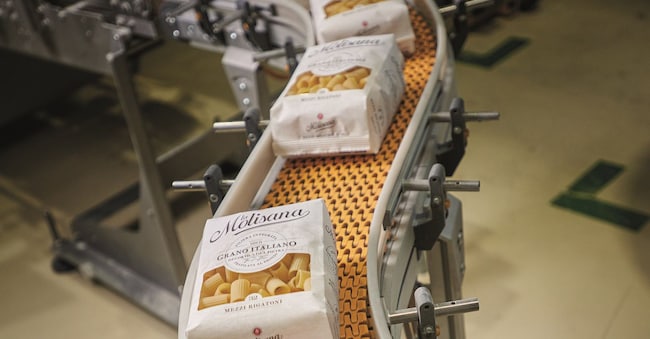
"In two months it will be 15 years since our family decided to go beyond the traditional milling business and acquireLa Molisana, then a 16 million turnover brand with 0.3% market share. In these years we have achieved a small miracle in an area like Molise, where it is certainly not easy for companies to grow, and now we have a 10.8 per cent share of the Italia market (dry and whole wheat, Circana data, ed.) behind Barilla's 21 per cent, as well as being well ahead in the whole wheat segment with a 20 per cent share'.
This is proudly affirmed by Giuseppe Ferro, managing director of La Molisana, who does not intend to stop and announces his intention to make important investments to continue growing beyond the 500 million turnover reached in 2025 (it was 450 million in 2024). 'A new line for the production of short pasta has just come on stream,' says Ferro, 'which is worth about 40 million in new turnover, so that in 2026 we will reach at least 550 million group sales, 400 million of which will be due to pasta alone (of which about 12% will be made with the distributor's brands, ed.). And we have reached this point even with zero debt'.
The intention is to invest again, after the approximately 200 million already put on track in recent years, without leaving Molise. "We will start up a new mill with a pasta factory, an operation for which more than 100 million euros are needed,'' Ferro continues, "and we are happy to remain in our territory where there is no crime and the work is good, especially if we think that we are giving people the chance not to leave their homeland.
Although Molisana has steadily conquered spaces in a mature market like Italia, the natural outlet is now beyond the borders. 'Half of the turnover already comes from abroad,' he continues, 'but we count on being able to reach 70 per cent. We are doing very well in Europe, for example in Germany and Spain, but also in the East, Australia and South America'. And then there is the United States: La Molisana was among the brands affected at the end of 2025 by an anti-dumping investigation with threats of tariffs of up to 107 per cent, reduced in January 2026 to 2.2 per cent (to be added to the 15 per cent that applies to all). 'It is a path that still has to be concluded,' Ferro comments, 'there is a complex regulation to which we, being a relatively new brand in that market, are more exposed. The US remains important and today is worth 15% of exports'.
Returning to the investment front, an additional 130 million will be budgeted to expand production to related products, either directly or through acquisitions. "We have opened a dossier especially on gnocchi and on sauces and gravies, but also on biscuits, a product that is more different from our business," says Ferro. "At present we already sell some products made by others, but starting production radically changes our commitment and development horizons.


