
This is why Khamenei's death risks leaving Putin more isolated
Putin loses key allies like Assad, Maduro and Khamenei in the last year and a half, while a difficult war in Ukraine continues

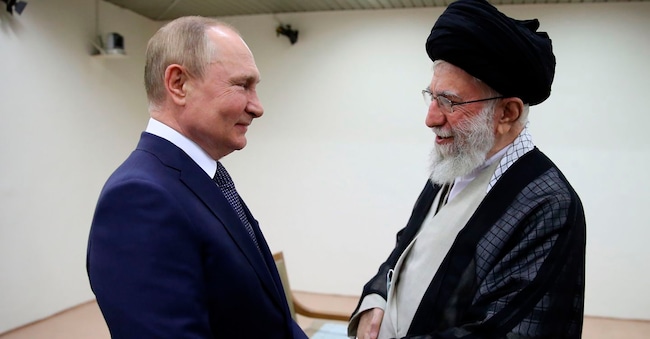
First the Syrian president Bashar al-Assad, then the Venezuelan leader Nicolas Maduro and now the Iranian Supreme Leader, the Ayatollah Ali Khamenei. In the space of a year and a half, Kremlin leader Vladimir Putin has lost many of his key foreign allies and the Kremlin, mired in the war in Ukraine, is struggling to react.
Putin has so far sent a letter of condolence to President Masoud Pezeshkian, describing Khamenei as 'an outstanding statesman who made an immense personal contribution to the development of friendly relations between Russia and Iran'. While denouncing a 'cynical violation' of 'morality and international law', Putin and the Russian authorities have not officially announced any concrete aid to Tehran in the face of the continuing US and Israeli air strikes. Moreover, yesterday, according to Moscow, it was the Iranian Foreign Minister Abbas Araghchi who called his Russian counterpart, Sergey Lavrov, at the start of the attacks.
A difficult friendship
For Russian expert Alexander Baunov of the Carnegie Center, the death of Khamenei puts the Russian president in a "difficult situation". Since the re-election of Donald Trump, Putin has been trying to curry favour with Washington in negotiations to end the war in Ukraine. But the US capture of Maduro on 3 January marked the loss of another Moscow partner. Again, the Kremlin found itself powerless. 'Twice in two months, Putin has failed to play his role as saviour,' Baunov noted on his Telegram account. And, in Khamenei's case, according to the expert, 'the assassin is his friend Trump'. Previously, Putin had at least managed to help former Ukrainian leader Viktor Yanukovych find refuge in Russia in February 2014. He had also offered asylum to Bashar al-Assad and his family after his fall in Syria in December 2024.
Field invasion
Unlike the Maduro case, Khamenei's death took place in a part of the world that Russia considers its "hemisphere", Baounov explains. The expert compares this assassination to that of the Libyan leader and Kremlin ally Muammar Gaddafi in 2011, which, according to Baounov, marked "a turning point in Russian politics" and one of the points that Putin exploited to "break with the West". Tehran is among Moscow's closest allies during the offensive in Ukraine.
Uncertain Supplies
Kiev and the West accuse Tehran of supplying Moscow with weapons and military technology, such as the Shahed drones that Russia uses daily to bomb Ukraine. Moreover, last year Russia and Iran signed a strategic partnership to strengthen their ties, including in the military sphere. Besides the loss of a key ally like Khamenei, the consequences for Moscow of the ongoing conflict in Iran are still difficult to assess. Russian MP Anatoly Vasserman, interviewed by the Russian media MK.ru, said that the war could benefit Russia in the short term if it led to a sharp rise in oil prices, but could pose 'serious problems' for the US and Israel in the long term if the Iranian authorities 'resisted'.

