Technological frontiers

The new geopolitics of 6G: Artificial Intelligence enters mobile networks

The trial by Nvidia, Nokia and T-Mobile heralds a new era in telecommunications. At stake is control over digital infrastructure, semiconductors and distributed intelligence. For Europe, this marks the start of a decisive battle between investment, national security and technological sovereignty

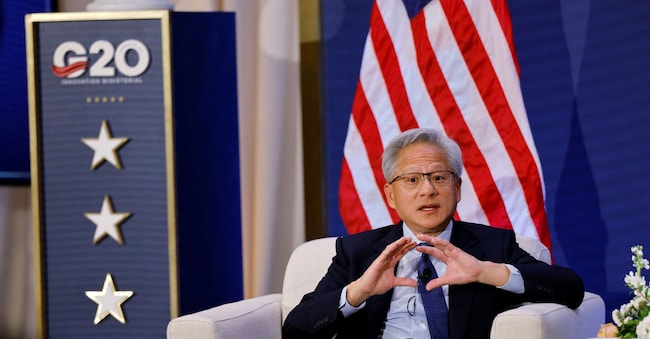
L'amministratore delegato di Nvidia, Jensen Huang  REUTERS/Jonathan Drake

5' min read

Translated by AI
Versione italiana

5' min read

Translated by AI
Versione italiana

On 21 October 2026, in Bellevue, Washington, an ordinary phone call marked a significant milestone in the transformation of global telecommunications. Nvidia, Nokia and T-Mobile have demonstrated that a commercial 5G network can process radio signals using servers equipped with artificial intelligence accelerators. Behind this seemingly ordinary experiment lies a far greater industrial and geopolitical issue: who will control the computational infrastructure on which communications will run over the next decade? For Europe, which retains leading expertise in radio technologies but relies on external platforms for advanced computing, the risk is that it will fund the transformation of networks without acquiring a proportionate share of the technological power that will result from it.

The result achieved in Bellevue marks a turning point in industrial integration, though it does not yet constitute proof of a fully realised economic revolution. The trial utilised Nokia Massive MIMO antennas, 5G anyRan software and Nvidia Aerial Ran Computer servers, connected to T-Mobile’s existing operational 5G Standalone core . The call was made using a commercial smartphone, demonstrating that accelerated radio signal processing can be integrated into existing infrastructure without requiring a device specifically built for the test.

Loading...

With AI-Ran, the relationship between telecommunications and computing power is changing: the very same platforms that process communications could host artificial intelligence applications designed for industry, hospitals, logistics systems and public services. The network would thus cease to be merely an infrastructure for transmitting data, taking on the additional role of a distributed platform for processing it.

Nvidia has unveiled MGX 2U and MGX 4U server configurations based on RTX PRO 6,000 Blackwell Server Edition accelerators, in collaboration with Dell Technologies, Quanta Cloud Technology and Supermicro. A supply chain is emerging in which economic value no longer belongs solely to radio equipment manufacturers and operators holding frequency licences: semiconductor designers, providers of acceleration software and companies that control artificial intelligence runtime environments are now part of the decision-making chain. This is where the issue of technological sovereignty arises, because owning national antennas, licences and infrastructure does not equate to controlling the IT systems essential to their operation.

The gap between technological promises and economic returns

The trial demonstrated the ability to integrate AI-RAN, rather than its economic superiority over existing architectures. Nokia and Deutsche Telekom reported typical improvements of 10–15 per cent in uplink transmission speeds during laboratory tests focused on radio channel estimation using artificial intelligence; Nokia has also set a target of achieving spectral efficiency gains of over 100 per cent by 2028. The first figure relates to a specific technique measured in the laboratory, whilst the second is an industry target: neither demonstrates that an entire commercial network can double its available capacity or halve its operating costs.

The financial aspect is just as significant as the engineering one. Accelerators require investment in power supply, cooling and specialised software; centralising computing may entail additional costs for fibre optics, synchronisation and redundancy. Sharing resources between radio traffic and AI applications can increase server utilisation, but communications must adhere to much stricter time constraints than ordinary computing: unused capacity cannot be sold indiscriminately if service continuity is to be guaranteed. This presents a dilemma for operators: investing to transform the network into a computational infrastructure without any certainty that businesses and public authorities will purchase local AI services in sufficient quantities to make the investment profitable. An industrial application may justify processing close to the factory; other services will find it more cost-effective to use large, centralised data centres.

Competition between the United States, China and Europe

The United States has already recognised the industrial value of convergence. On 10 March 2026, the National Telecommunications and Information Administration announced a reorientation of the Public Wireless Supply Chain Innovation Fund towards AI-native technologies for radio networks. The link to American leadership in AI is clear: mobile infrastructure could become a new market for accelerators, software and computing platforms.

China is pursuing a nationwide industrial coordination strategy. In January 2026, it reported over 4.8 million 5G base stations and more than 1.2 billion users; the following May it authorised 6G trials in the 6 GHz band, whilst in June the Ministry of Industry and Information Technology launched a programme involving local authorities, operators, businesses and research centres, with targets extending to 2029. These figures do not demonstrate China’s definitive technological superiority, but they do illustrate a capacity for coordination and a domestic market capable of supporting industrial research and development. Europe, on the other hand, risks finding itself in an intermediate position, which is indispensable in the design of radio networks but less influential at the computational levels on which the new services will be delivered.

National security, NATO and the boundary between civilian networks and military capabilities

AI-Ran has implications that go beyond commercial competition. A network capable of hosting distributed processing can support analytics, monitoring and coordination applications, but it can also concentrate new vulnerabilities: accelerator firmware, hypervisors, AI models, orchestration software and automated agents become components of the chain of trust. ENISA had already identified sixty security vulnerabilities in virtualised 5G infrastructure in February 2022, proposing fifty-five best practices; the integration of additional AI workloads makes it even more important to prevent a compromised application from interfering with essential radio functions.

NATO’s digital strategy of January 2026 and its implementation plan of the following May emphasise distributed processing, secure data sharing and interoperability. Commercial networks may offer useful capabilities, but the functioning of a civilian platform does not constitute proof of resilience to electronic warfare, sabotage or military operating conditions: defence requires qualified systems, operational autonomy and communications that remain intact even when commercial infrastructure is compromised.

Loading...

The European Union also has specific regulatory instruments. The NIS2 Directive sets out obligations regarding risk management and incident reporting; the AI Act introduces obligations that vary according to the classification and intended use of systems; the Digital Networks Act, proposed in January 2026, addresses the structural and regulatory conditions of the European communications market, but remains a legislative proposal. The combined effect will be significant, though it will not resolve the industrial challenge: regulation can impose security and accountability, but cannot, on its own, ensure that Europe controls the accelerators, software and intellectual property on which future infrastructure will be based.

Future challenges

The path towards 6G has already been set out in terms of its key institutional objectives. The IMT-2030 framework of the International Telecommunication Union encompasses six use cases, ranging from high reliability to immersive communications, through to integrated artificial intelligence and environmental sensing via radio signals; by 2026, the technical requirements and evaluation methods for candidate technologies will have advanced, whilst the development of 3GPP specifications will need to transform these prospects into interoperable systems. Between 2027 and 2028, the economic assessment of AI-RAN will depend primarily on actual server costs, energy consumption, service continuity and revenue from distributed applications: the availability of greater technological capabilities will not automatically make investments profitable.

21 October 2026 demonstrated that radio processing and AI platforms can converge within a commercial network. Over the coming years, it will be the operators’ financial results, the outcomes of trials and the terms of supply that will determine who will succeed in transforming that convergence into industrial power.

 Charlye Ghezzi is a geopolitical analyst and specialist in technology and government security

Sign up to the NextMed newsletter so you don’t miss out on previews and in-depth articles

Brand connect

Loading...

Newsletter

Notizie e approfondimenti sugli avvenimenti politici, economici e finanziari.

Iscriviti