Astronomy

Largest ever merger of two black holes observed: 225 times the size of the Sun

GW231123 event opens new frontiers in the understanding of space-time and stellar physics

by Leopoldo Benacchio

Firma delle onde gravitazionali rilevata dai due strumenti statunitensi. Fotografia: Caltech/MIT/LIGO Lab

4' min read

4' min read

The merger of two enormous black holes has been observed, the most important and massive of the more than 300 so far revealed by the three existing large gravitational antennas in the USA, LIGO, in Japan, KARMA, and also here in Italy, Virgo, near Pisa. It all happened on 23 November 2023, when the signal passed through the antennas for only a tenth of a second. It took a year and a half to analyse the signals and arrive at a level of security that was safe enough to present to the world community.

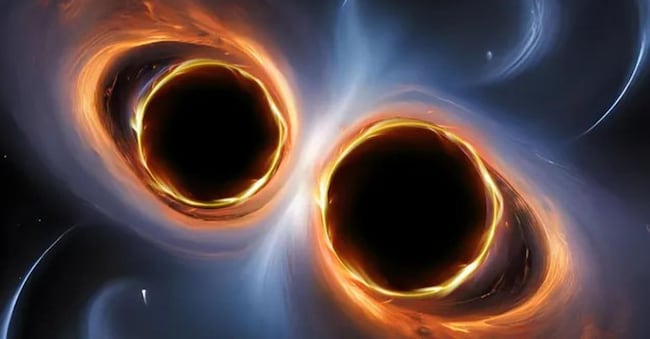
That's the news, but trying to understand this remarkable phenomenon a little better, which as of today is definitely questioning the thousands of interested physicists, we can meanwhile say that the event, which has been labelled GW231123, was generated by two 'progenitors', black holes of great mass: 100 and 140 times that of our Sun respectively. By merging, they created a single black hole with a mass 225 times that of the Sun.

Loading...

The mass of matter missing from the purely arithmetic count, 15 solar masses, was converted into energy, according to Einstein's famous formula: E= mc2. This amount was so large and emitted in a fraction of a second that it created the gravitational waves later picked up by Earth's antennas. 225 times the Sun's mass makes this new phenomenon the most important ever observed, the previous one having been 140 times the Sun's mass, so to speak, in 2021.

Most black holes form when large stars exhaust their nuclear fuel and collapse in on themselves, forming objects so dense that they can sometimes warp space-time to such an extent that they create a zone with a boundary, called the event horizon, within which even light cannot escape.

We are in fact used to thinking of space and time as entities that exist in themselves, a house is in simple terms, a volume in which we live and put furniture and other things. But this is not actually the case if we think of the universe, over the last hundred years, from Einstein onwards, we know that space-time exists as a function of the masses that are in it, as if we were dealing with a fabric whose warp and weft are deformed, for example, by the presence of the Sun and the Earth.

When there are events such as these, the perturbation is so strong that a wave is generated that propagates through space and that, finally after years of study, the antennas we have at our disposal allow us to reveal the almost intangible and fleeting signature. A signal that opens the way for us to understand phenomena in the universe that we have not 'seen' at all until now.

 The problem is that such an event, a final black hole of this size, is not conceivable with the theories of the evolution of stars, which have worked very well so far. What needs to be done we will know when an answer is given after careful study, whether it will be enough to revise a few paragraphs of the final life of stars or rewrite entire chapters. Science cannot turn a blind eye to the evidence.

 The size of the masses involved is not, however, the only data to be emphasised and which raises questions. Before the merger that gave rise to GW231123, analysis of the brief signal recorded suggests that at least one of the two black holes was rotating extremely fast, at the limits of physics, i.e. with an astonishing speed close to that of light. This too is a difficult point to interpret and take into account when constructing a new mathematical model of black holes..

 The idea has been put forward, yet to be verified but interesting, that the two large black holes involved in the phenomenon are themselves the result of previous mergers between smaller objects. This would explain both why they are so massive and their fantastic speed..

As mentioned to date there are about 300 black holes detected by the worldwide collaboration that has over 1000 physicists signing the scientific papers concerning the phenomenon, it is a remarkable achievement in just 10 years. The first gravitational wave was revealed by the American LIGO alone, as the Italian Virgo was unfortunately down for maintenance on 15 September 2015, even in science a bit of luck doesn't hurt.

 To fully unravel the secrets of this and other signals detected by the LVK collaboration in the observation period up to January 2024 will, according to the physicists themselves, require further refinement of the methods of analysis and interpretation. Contrary to what happens in the normal way, when scientists come up against something that does not or should not even exist, enthusiasm skyrockets. After all, it is a race with nature to discover its innermost secrets.

GW231123 was presented at the 16th Edoardo Amaldi Conference on Gravitational Waves on 14 July in Glasgow, Scotland.

Copyright reserved ©
Loading...

Brand connect

Loading...

Newsletter

Notizie e approfondimenti sugli avvenimenti politici, economici e finanziari.

Iscriviti