First election results

India, Narendra Modi wins election but loses majority

Historic third term for the premier who, for the first time, will have to reckon with his allies. Reforms more difficult. Stock markets plummet

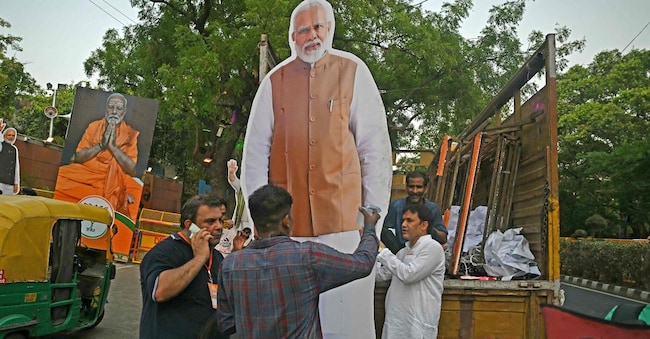
Sostenitori di Narendra Modi in India

4' min read

Key points

  • Narendra Modi's BJP lost some 60 seats and with them its majority
  • After touching all-time highs on Monday, the Nifty index went on to lose 8.5 per cent and closed at -5.93 per cent
  • Stocks linked to the Adani Group swept away, burning $45 billion in one session

4' min read

From our correspondent

NEW DELHI - India's Prime Minister Narendra Modi on Tuesday cashed in on his third consecutive term at the helm of the most populous country on Earth at the end of an election that put him in history and brutally downsized politically.

Loading...

From an electoral point of view, the most significant fact of the vote is undoubtedly the loss of the parliamentary majority of the Bharatiya Janata Party, or BJP. For the first time since it returned to power ten years ago, the premier's party will only be able to govern thanks to an alliance with its partners in the National Democratic Alliance (NDA), led by two uneven and opportunist regional parties that, for now, have pledged their support and will have veto power over reforms.

On the political front, the most important news on Tuesday concerned the good health of the most populous democracy on the planet, which, especially during the second, pervasive five-year period of power of Modi and the BJP, had been sending out worrying signals, so much so that it was relegated to 'electoral autocracy' by the V-Dem Institute.

According to the near-final data available late Tuesday evening in India, the premier's National Democratic Alliance (NDA) won 291 seats, 52 fewer than five years ago. Behind the decline is the disappointing performance of Modi's BJP, which lost 63 MPs. In 2019, Modi's Bjp won 303 seats (31 more than the 272 needed to have a majority) with 37.4% of the vote. Today, due to dry majoritarianism, a similar percentage (36.6%) corresponds to only 240 seats. The parties gathered under the acronym India (Indian National Developmental Inclusive Alliance), after five years of absolute marginality, will return to the role of parliamentary opposition thanks to 234 seats, 107 more than in 2019. The Indian National Congress, the main party in the coalition will send 99 MPs to New Delhi, almost twice as many as five years ago. The parties not aligned with the two coalitions are much reduced: 18 seats, 55 fewer than in 2019.

The other big losers of Tuesday's election day were the financial markets. Partly because many stocks, already with high multiples, 'priced in' a wide victory for the governing coalition. Partly because, after more cautious weeks during which there had been signs of a comeback by the opposition, a series of polls were published over the weekend giving the BJP a large lead. On the basis of that data - and despite the history of Indian exit polls calling for caution - the Indian Bourse indices rose to all-time highs on Monday.

But on Tuesday, the Sensex of the Bombay Stock Exchange and the Nifty of the National Stock Exchange closed at -5.75% and -5.93% respectively, burning, as they say in such cases, $386 billion. The companies of the Adani Group - whose chairman, Gautam Adani, is the entrepreneur who has benefited the most from Narendra Modi's years in power - lost $45 billion in capitalisation in a single session. Among the Nifty 50 listed companies, the two absolute worst were Adani Ports (-21.15%) and Adani Enterprises (-19.31%). The rupee lost about 0.5% against the dollar. Among government bonds, the ten-year yield rose 11 basis points to 7.06%, the sharpest increase since October.

Despite an election campaign built around the goal of reaching 400 coalition seats, Modi on Tuesday evening described the outcome of the vote in triumphant tones. While an opposition galvanised by the results called somewhat defiantly for a mandate to form the new government.

The states from which the most resounding figures came were Uttar Pradesh, Maharashtra and West Bengal. Electorally speaking, these are three heavyweights: they are worth 80, 48 and 42 seats respectively. The most symbolic defeat of the BJP is undoubtedly that of Faizabad, the constituency that includes Ayodhya, the town in Uttar Pradesh where a few months ago Modi personally consecrated, in an elaborate religious ceremony, a colossal Hindu temple built on the rubble of a mosque illegally demolished by a mob of extremists close to his party.

During the election campaign, the insistence on such contrasts was seen by several observers as a sign of nervousness on Modi's part and an attempt to motivate the radical Hindu electorate. Never before had a prime minister called members of a religious minority 'infiltrated'.

The economic performance of Modi's decade of power probably counted more on the final result: the +8.2% growth in the fiscal year just ended, but also the two GDP collapses during a resounding demonetisation experiment in 2016 and coinciding with the pandemic in 2020. The post-Covid recovery was under the banner of widening inequality, creating even greater rifts between the upper classes, who benefited from a boom that drove consumption of luxury goods, and the lower classes who continued to contend with high unemployment, modest wages and stubbornly high inflation.

Copyright reserved ©
Loading...

Brand connect

Loading...

Newsletter

Notizie e approfondimenti sugli avvenimenti politici, economici e finanziari.

Iscriviti