Middle East

Lebanon, three Indonesian soldiers killed. Italia under pressure to change Unifil's rules of engagement

Israeli Prime Minister Benjamin Netanyahu made it clear that he had ordered the army to 'further expand' a security zone in the Cedar Country

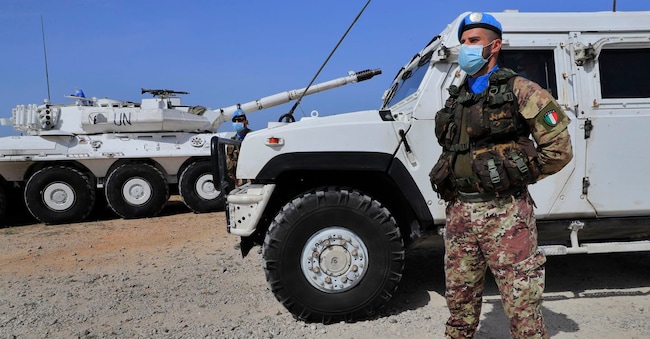
Un soldato italiano della missione Unifil nel Libano del Sud AP

4' min read

Translated by AI
Versione italiana

4' min read

Translated by AI
Versione italiana

The killing of three Unifil Indonesian soldiers in the space of a few hours, victims of crossfire between the Israeli army and Hezbollah militiamen, has reopened the debate on the need to rework the UN mission's rules of engagement. A debate that becomes even more topical considering the overall scenario: Israeli Prime Minister Benjamin Netanyahu has made it clear that he has ordered the army to "further expand" a security zone in the Cedar Country, in order to definitively neutralise the threat of invasion (by Hezbollah militants) and to keep anti-tank missile fire away from the border".

Ministers of Defence of Italia and France: 'Strong concern over attacks against Unifil'

On Monday, 30 March, Italy's Defence Minister, Guido Crosetto, and the Minister of the Armed Forces and Veterans of the French Republic, Catherine Vautrin, had a telephone conversation devoted to the serious crisis in Lebanon.

Loading...

The two, explains a Defence note, "expressed strong and deep concern over the deterioration of the security situation in the area, with particular reference to the recent attacks that have affected Unifil personnel, causing the death of three peacekeepers and the injury of others. They strongly emphasised the unacceptability of such incidents and the increasing risks to which the personnel involved in the mission are exposed.

During the discussion, the document goes on to say, a full convergence emerged on the strategic relevance of Unifil. It was stressed that the stability of Lebanon is an essential pillar for the balance of the entire Mediterranean area, confirming that Italia and France will continue to work in close coordination to ensure the safety of international personnel, the protection of peace and support for the Lebanese authorities".

Crosetto: "Hitting UN contingents is neither tolerable nor acceptable in any way"

In a post on X Crosetto emphasised that 'striking UN contingents is neither tolerable nor acceptable in any way. The UN forces are in Lebanon to guarantee peace. Those who attack the blue helmets do not strike at individual contingents: they strike at the international community as a whole and at the principles that guarantee coexistence between states".

Italy pressing to adjust mission rules of engagement

Italy, which has been in command of the mission since last 24 June, with Division General Diodato Abagnara - who holds the position of Head of Mission and Force Commander - has been pressing for some time for the United Nations to move in that direction as soon as possible. The UN mission (United Nations Interim Force in Lebanon) has been extended until 31 December 2026, leaving 2027 as the year for final dismantling, should there be no news in the coming months, and at present there does not seem to be

Security Council Resolutions 425 and 426

Unifil was established by the Security Council in 1978 with resolutions 425 and 426. In 2006, the same Security Council strengthened the mandate of the mission in southern Lebanon entrusting it, among other tasks, with monitoring the cessation of hostilities. Around 8,500 blue helmets from almost 50 countries operate under Unifil.

Meloni: if the mission is extended, the rules must be revised

In the past few days, Prime Minister Giorgia Meloni, speaking in the Senate during the reply to the general debate on the communications ahead of the EU Council and the crisis in the Middle East, explained that there are "perplexities about Unifil: on the one hand, we believe that in the current context the mission remains important, but you know that the rules of engagement it has had in recent years would not be sufficient to deal with the current crisis.

The debate, he added, must be of this kind: I am more than in favour and I pointed out what I did not agree with about the US initiative with respect to Unifil, but if we wanted to extend the mission we would have to review the rules. But it is an issue on which we have not found much agreement'.

The current rules of engagement

At present, the legal frame of reference for the Unifil mission's rules of engagement is the UN Charter, the Statute of the United Nations adopted on 26 June 1945 in San Francisco, which came into force on 24 October 1945.

The mission falls under 'peacekeeping', i.e. operations that are authorised by the Security Council to support countries in transition from conflict to peace. The 'blue helmets', civilian, police and military personnel provided by member states, operate with the consent of the parties, impartiality and limited use of force.

Unifil, on the other hand, does not fall under the umbrella of 'peace enforcing', under which the use of force is authorised. Chapter Six of the UN Charter provides the legal basis for peacekeeping operations; Chapter Seven for 'peace enforcing' operations.

When Unifil may resort to force

Question: can the blue helmets use force? The answer is that since Unifil operates under Chapter VI of the United Nations Charter, peacekeepers are only authorised to do so in very specific and limited situations (defined in paragraph 12 of resolution 1701). In particular, peacekeepers may always use force in self-defence to protect UN personnel, facilities, installations and equipment.

In addition to self-defence, Unifil can also use force, within the limits of its means and capabilities, to achieve certain well-defined objectives to ensure that the operational area of the mission is not used for hostile activities of any kind (mainly in support of and in coordination with the Lebanese Armed Forces); to resist attempts by coercive means to prevent peacekeepers from carrying out their tasks within the mandate authorised by the Security Council; to protect UN personnel, facilities, installations and equipment; and to ensure the security and freedom of movement of UN personnel and humanitarian workers.

And, without prejudice to the primary responsibility of the Government of Lebanon, to protect civilians under imminent threat of physical violence.

Brand connect

Loading...

Newsletter

Notizie e approfondimenti sugli avvenimenti politici, economici e finanziari.

Iscriviti