Managing Director Strategy & Innovation Simone Ungaro speaks

'Leonardo aims for leadership in supercomputing and innovation'

Launch of new business line to sell services also externally: expected 230 million euro cumulative revenue to 2029
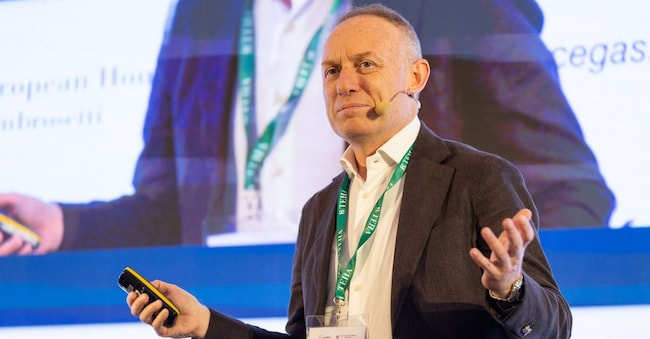
by Celestina Dominelli

SIMONE UNGARO CO-GENERAL MANAGER LEONARDO

3' min read

3' min read

'We aim to lead the transition towards the realisation of interoperable multi-domain technologies for global security, updating the concept of traditional defence'. Simone Ungaro, Leonardo's new co-director general of Strategy & Innovation, gets straight to the point in this interview with Il Sole 24 Ore, the first since CEO Roberto Cingolani redesigned the top management by assigning him a 'heavy' delegation that will allow the manager, who arrived in Piazza Montegrappa in 2023 and has solid experience in the innovation and digitalisation sector, to make the group make the further leap contained in the updated industrial plan. Which envisages a new business line, Leonardo Hypercomputing Continuum (LHyC), the 'engine' of the entire challenge.

Let's start with the new line of business. What is the mission?

Loading...

LHyC was created with the aim of developing, both inside and outside the company, the full potential of digital technologies, artificial intelligence and high performance computing (Hpc) to improve Leonardo's entire value chain, from engineering simulation to predictive systems and satellite image analysis. All this will bring a benefit in terms of revenues.

What contribution will it make to the budget?

Over the plan period (2025-2029), cumulative revenues of EUR 230 million are expected, not least because we intend to tap into the enormous potential that exists, and we will do so by exploiting the extraordinary skills and cutting-edge technologies that we have 'in house'.

One of them is the Hpc Davinci-1, your supercomputer.

It is one of the most powerful in the industry and is already fully integrated in our processes. It is now being upgraded and, by the end of the year, will have a power of over 20 Petaflops (20 million billion 64-bit operations per second), tripling its current capacity. Today it is mainly used for internal purposes, with over 2 thousand registered users from the various divisions accessing it, but we want to start offering a service externally as well.

In what way?

We will provide three types of services: supercomputing, cloud and artificial intelligence. The first option involves the possibility of 'renting' the Hpc and cloud infrastructure from the customer using original algorithms and data, with the advantage of having a European group as a partner that also guarantees the highest levels of security. The second option, on the other hand, includes the 'on premise' solution: in practice, Leonardo builds a new infrastructure on behalf of its customer and supports it at every stage, from design to the start of operations. Finally, the third, 'Advanced Cognitive Solutions', represents more of a consultancy service and concerns the development of advanced algorithms for the end customer.

You spoke earlier about a huge potential to be exploited. Who will you turn to?

Obviously we are starting from our sector (aerospace, defence and security), but the aim is to make the computing infrastructure available to other markets, ranging from health to transport, to public administrations, not forgetting SMEs, which are a very interesting target. Computational capacity is turning the world upside down and we have experienced first-hand, within the company, how disruptive it can be.

Can you give us some examples?

I will mention one of them all: the project that has allowed us to collect 12 years of flights of 1,200 Leonardo helicopters. These are millions and millions of hours of activity that we have entered into our Hpc with the result of being able to accurately predict all the operations to be carried out on our helicopters.

Artificial intelligence is also at the centre of the Brussels strategy that has put 20 billion on the table to build five AI gigafactories in Europe. Could this be an opportunity for Italy?

Absolutely, and we are pushing hard on this front because our country must equip itself with a single infrastructure, as we have already done with the National Strategic Hub. Computational capacity is an extraordinary lever and we are so convinced of this that we have decided to put one in orbit as well with the Space Cloud project. Which involves placing supercomputers, artificial intelligence and clouds aboard a constellation of cyber-secure satellites orbiting the Earth.

With what return?

This space architecture will be able to provide government agencies and national armed forces with high-performance computing and storage capacity directly in space. And it is clear that, in a multi-domain scenario, the management, security and rapid exchange of an ever-increasing amount of data, much of it tactical, become strategic elements for a country's defence.

Copyright reserved ©
Loading...

Brand connect

Loading...

Newsletter

Notizie e approfondimenti sugli avvenimenti politici, economici e finanziari.

Iscriviti