

Leonardo is looking to the Ukrainian model and market for its Turkish drones
At the Farnborough Airshow, CEO Mariani officially announced the Baykar TB-3-derived aircraft, developed by the LBA System joint venture, and added: “We should be looking to establish forms of cooperation with the industry in Kyiv.” Meanwhile, “an agreement in the Middle East regarding aerostructures is expected by the end of the year”. These two developments illustrate just how important the ‘Middle Powers’ have become and how the ‘go-to-market’ strategy tested in Ukraine is now an irreversible process.

Key points
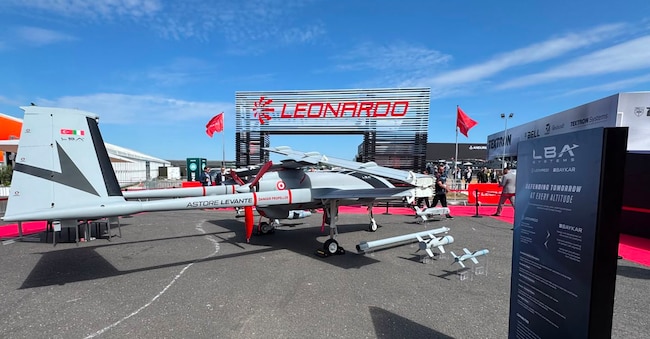
From Leonardo’s exhibition stand, you can see the Farnborough airfield, bustling with aircraft performing at the international air show near London. Just behind the chalet stands an M 345, a training aircraft in green and red livery, alongside an AW 149 helicopter in the very latest configuration selected by the Ministry of Defence. The third aircraft on static display is the Astore Levante drone. On the ground, beneath its folding wings, are some of the applicable payloads: from Roketsan’s Mam family of guided bombs to Baykar’s KEW MANKES 1 mini cruise missiles. However, these are not the important details. It is the aircraft itself that makes the difference. This is a customised version of Baykar’s TB-3 drone, tailored to the requirements of the European, NATO and Italia markets, and currently in production at Leonardo’s plant in Ronchi dei Legionari. The drone is therefore the result of LBA System, the joint venture between Leonardo and Baykar (supported in Italia by the law firm Gianni & Origoni), which was formally announced yesterday by Leonardo’s CEO and General Manager, Lorenzo Mariani.
Buyers
The aircraft is expected to have its first buyer within our Navy, but specialist publications such as RID speculate that the launch customer will be the Air Force. Regardless of the timing, it is interesting to analyse the potential international implications of the joint venture with the Turks. Baykar is a well-known name in the sector, and this could open up interesting opportunities and likely or possible link-ups with the Ukrainian market. ‘The expertise acquired by Ukrainian industry during the conflict is truly exceptional,’ said Mariani at a press conference. Having been ‘exposed to threats, it has gained operational experience that no one else could have acquired previously. Therefore, I believe there is ample scope for collaboration. There is no specific objective I can announce today, but I am firmly convinced that a successful partnership, such as that between Leonardo and Baykar, should also include forms of cooperation with Ukrainian industry in the field of drones.’ This decision would be fully supported by the impressive figures from this new market.
The market
At the start of the war, in 2022, fewer than 500 drones were produced in Ukraine. In 2025, Ukraine announced a production target of around 4.5 million drones (mainly FPV drones, but also reconnaissance drones and long-range UAVs). The final figure was very close to the forecast: 4 million. Meanwhile, the target for the current year – achieved in part through the efforts of over 160 companies – is to reach 8 million units. This explains the enormous number of attacks, often carried out using entire swarms. The AN-196 Liutyi and FP-1 drones have become key assets. The FP-1 is reported to have a range of around 1,600 kilometres and a cost of approximately $55,000. This is by no means a small sum, but it is much less than the cost of a cruise missile. In 2025, Ukraine is said to have launched between 18,000 and 22,000 drones towards Russia, a massive increase compared with 2024. Moscow claims to have shot down around 22,500 out of an estimated 25,000–27,000 launches, which is a very high reported success rate. Beyond partisan claims, these figures are reflected in the stock market performance of companies that are demonstrating their ability to skilfully navigate this new model of conflict and deploy anti-drone systems.
Middle East
The market for unmanned aircraft also overlaps with a second geographical area of great interest to Leonardo: the Middle East, where the company led by Mariani is in talks to finalise an industrial and financial partnership aimed at revitalising its Aerostructures business. “The joint venture project in the Aerostructures sector is moving forward,” confirmed Mariani. “The underlying objective is to have a partner who, on the one hand, can share the burden of investment in this field – which requires continuous expenditure to improve quality and production capacity, reduce lead times and introduce new technologies – and, on the other hand, can bring in new business. We have already identified a potential partner.” “Initially,” he clarified, “my predecessor had planned to finalise an initial memorandum of understanding by June this year. However, due to the difficulties caused by the conflict in the Middle East, face-to-face meetings have proved more challenging. Some activities related to finalising the project have been slightly delayed, but it remains our shared objective to reach a conclusion by the end of the year. This is a complex project, not only in terms of the commitment of the parties involved, but also regarding the structure that the final agreement will take.”
Overall, there are essentially two lessons that the defence and security market is learning from the unfolding conflict in Ukraine and the clashes around the Strait of Hormuz. Firstly, the so-called ‘middle powers’ are not only more influential, but also offer European companies a new perspective and the opportunity to triangulate markets. This is a tactic that can no longer be underestimated in a context such as the current one, characterised by shifting dynamics and a waning era of multilateralism. The second lesson concerns financial investments, which must be more flexible, and implementation times, which must be extremely short. The ‘go-to-market’ strategy, moving towards a Ukrainian model…

