
Google Meet's live translation also detects moods. The video
You speak in Italian and the listener hears your voice in English, and vice versa, as if you had an interpreter. Here's how it works and our test.

2' min read
2' min read
You speak in Italian and the listener hears your voice in English, and vice versa, as if you had an interpreter. This new function of Google Meet, which will be launched first for consumer users and later on enterprise users, is something new. It does not just translate in real time what we say while we are in a video conference. It mimics our voice, tone and expression. The result is an authentic and natural conversation, even a bit disturbing because it sounds like you but is not you. I previewed this Google innovation as soon as the possibility to translate from Intalian to English and vice versa was activated.
How does it work
?It is based on Audio LM, which is an artificial intelligence model developed by Google that focuses on the generation of high-quality, coherent audio. Its main innovation lies in the approach it takes, which is similar to that of language models (such as GPT-3) for text generation. Through Audio LMSI, the context of the communication can be preserved, i.e. the tone, the emotions and the speech of the person is preserved, and this allows for conversations that are richer, more empathetic, and clearer even when there are multiple voices. An important aspect.
Our test.
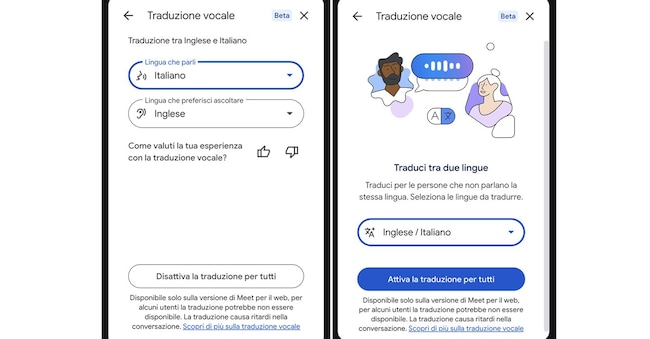
The interface is quite intuitive. From Google Meet, a drop-down menu appears on the right-hand side that allows you to choose which language you want the other translated into and how you want yours translated. For now, only Italian and English are provided. When you activate the translation mode, you will get a request with the translation and you will have to go and indicate what the inputs and outputs are. Later, they say, the other languages will be activated. Communication begins without interruption. You hear the other person start speaking in English and a second later a voice similar to his or her own arrives speaking in Italian. The effect is that of dubbed interviews on television, identical. The difference being that overlapping is not the voice of the journalist or the translator, but an imitation of your own. As you can see in the rehearsal, I also tried to give an emotional colour to my voice, speaking more sadly and more cheerfully, and the effect is what you are hearing.
Something in translation and video conferencing has now really changed. Voice translation in Google Meet has started to be rolled out to subscribers of the Google AI Pro and Ultra plans in beta, initially in English and Spanish, with more languages coming in the coming weeks. Google is also further developing this feature for businesses, with the first tests coming for Workspace customers this year.


