

London, gold medal for Italian Peter Schwartz
The European Society of Cardiology presented the award to the cardiologist whose career is linked to Long QT syndrome

4' min read
4' min read
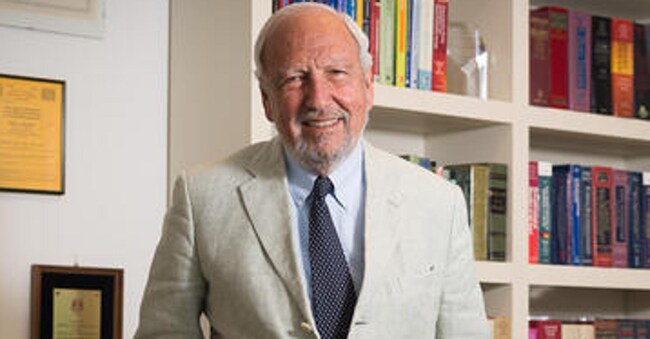
The 2024 Gold Medal that the European Society of Cardiology (Esc) awards each year at the inaugural session of the congress, which opens today in London, was awarded to the Italian cardiologist Peter Schwartz. Formerly chair of Cardiology at the University of Pavia, he is currently director of the Centre for the Study and Treatment of Cardiac Arrhythmias of Genetic Origin and of the Laboratory of Cardiovascular Genetics at the Auxologico in Milan.
The prize is awarded to someone who has made an important contribution to medicine in the course of his or her career, but the award is also intended to be a model for new generations of doctors and scientists, inspiring them to take the road less travelled and to engage in high-quality research. These are the 'ingredients' that have characterised the professional life of Schwartz, who is internationally recognised as one of the world's leading experts in the research and treatment of genetic arrhythmias.
The cardiologist has dedicated his life to cot deaths, especially related to long QT syndrome, the leading cause of sudden death in the young. An incredible adventure that started almost 50 years ago in cardiovascular research and began with two sisters: Cesarina and Agostina. The first had died suddenly at the age of 18 while taking part in the Rischiatutto television programme: after a question from Mike Bongiorno, on live television, her emotion was such that her heart stopped. Her sister Agostina, who was 8 years old at the time, met the young Schwartz when she was admitted to the Cardiology ward of the Policlinico di Milano.
"Both sisters had the characteristic of losing consciousness when they became excited, frightened, thus following physical or emotional stress, which immediately led me to make a connection with an increased activity of the sympathetic nervous system, with release of catecholamines. From here, we arrived at the diagnosis: Long QT syndrome,' recalls Peter Schwartz with emotion. 'At the time, it was a very rare syndrome, Agostina was perhaps the twentieth case worldwide, certainly an open field to be studied'. Thus, in the experimental cardiology laboratory where he worked, Schwartz was able to reproduce the fundamental aspects of the disease, i.e. the electrocardiographic changes by stimulating the left sympathetic cardiac nerves, and this led him to link the disease and the increased activity of these nerves, laying the rational basis for new therapies: beta-blocking drugs to antagonise the release of catecholamines from sympathetic overactivity and cardiac denervation, i.e. cutting the left sympathetic cardiac nerves so as to eliminate the brain-heart connection. 'In this way,' explains the expert, 'even if a certain type of impulse starts in the brain, it does not reach the heart. It is like cutting off the current, and this has a great protective effect and the great advantage that it is done once in a lifetime'.
And today this technique, after Schwartz first used it in 1973 on Agostina, enabling her to lead a life without risk of sudden death, has become standard therapy for patients who are not protected by beta-blockers.


