Test drive

Lotus Eletre X: we test-drove the 950 cv ‘hypersuv’ that combines electric and petrol engines

The British brand is returning to the internal combustion engine market with a PHEV/EREV SUV

6' min read

Translated by AI
Versione italiana

6' min read

Translated by AI
Versione italiana

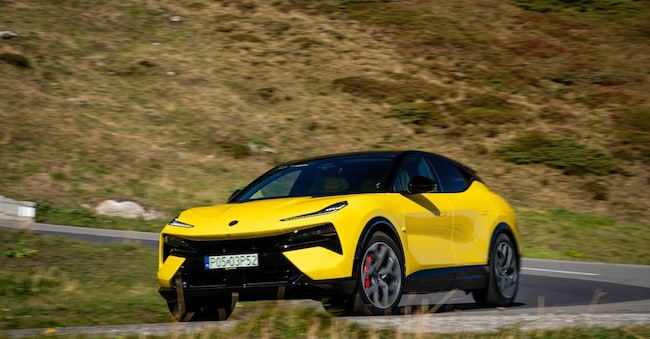
The first result of the revised plan announced by Lotus to bid a definitive farewell to internal combustion engines is the Eletre X, derived from the Eletre electric SUV. The Eletre X is the British manufacturer’s first plug-in hybrid, although it could also be considered an EREV, as its petrol engine is almost always used to recharge the battery so that the car can travel as far as possible on electric power. This model, which launches the ‘Focus 2030’ plan of the brand owned by the Chinese Geely Group – inspired by the lack of popularity of electric sports cars amongst enthusiasts – competes, in particular, with the BMW XM, Lamborghini Urus and Porsche Cayenne, with the H550 version costing 100,000 euros and the H1000 on sale for 124,000 euros.


Loading...

Lotus Eletre X: how the electric hyper-SUV became a hybrid


The first model in the British brand’s new era is based on a platform dubbed the Lotus X Hybrid, operating at 900 volts, but which is, in fact, the same platform that the Geely Group also uses for the Zeekr 9x SUV. The powertrain combines two electric motors – one at the front and one at the rear, which also provide all-wheel drive – with a 2-litre turbocharged petrol engine producing 275 cavalli, developed by Horse Powertrain, a joint venture between the Chinese group and Renault. This engine drives a 150 kW (204 cavalli) generator to power a 70 kWh NCM battery pack – essentially that of a 100 per cent electric car. However, in certain situations and at speeds above 85 per hour, the electronic control system engages the front-wheel drive to optimise the release of energy from the battery, recharge it, or support the Eletre X’s maximum performance.

Depending on the power output of the electric motors, there are two versions of the Eletre X: the H550, with 550 cavalli and 953 Nm of torque, capable of reaching 210 all’ora and accelerating to 100 orari in 4”9, and the H1000, with 952 cavalli and the same torque as the H550, which reaches 230 all’ora and 100 orari in 3”3, promising a total range of over 1,200 kilometres, 305 of which are emission-free, thanks to the 52 litres of petrol held in the petrol tank. The battery recharges via direct current at up to 350 kW, going from 20 per cent to 80 per cent in nine minutes.

The Eletre X is also equipped with Lotus Intelligent Drive, which controls the dual-chamber air suspension, adaptive dampers and 48-volt active anti-roll bars that counteract body roll – fitted as standard on the H1000 and available as an option on the other version. Finally, the range utilises the extremely powerful Nvidia Thor chip to manage four LiDAR sensors, 4D radar and 360° cameras for Level 3 semi-autonomous driving, whilst being ready for Level 4.


Lotus Eletre X, le foto della prova del nuovo suv inglese

Photogallery16 foto

Lotus Eletre X: its sculpted lines, shaped by airflow, are reminiscent of coupés


The new model retains the appearance and dimensions of the all-electric Eletre, measuring 5.10 metres long, 2.13 metres wide, 1.63 metres high and with a wheelbase of 3.02 metres. The design is inspired by aerodynamic porosity, aimed at optimising the efficiency of the Eletre X, as the bodywork features strategically placed intakes, vents and ducts that optimise airflow distribution to reduce drag, alongside solutions that enhance aerodynamics. The styling conveys the personality of this Lotus without being over the top, and is characterised by a cab-forward layout with a forward-positioned cabin featuring a steeply raked windscreen, a short and aggressive front end, short overhangs and a roofline that defines a coupé-SUV silhouette as it slopes down towards the rear. Above the rear window are two deflectors that channel air onto a lower spoiler, which adjusts to different positions depending on speed and the car’s configuration.

Loading...


Lotus Eletre X: the cabin combines luxury and high-tech


Thanks to its long wheelbase, the interior is very spacious and is enhanced by the extensive use of Alcantara and leather upholstery, as well as carbon fibre trim, which soften the impact of the minimalist interior design. The slim, low-slung dashboard helps to enhance the feeling of spaciousness in the cabin and features the 15.1-inch infotainment display at its centre. The system, which is quite responsive, utilises a dual Qualcomm processor, Unreal Engine technology and Android OS, whilst the interface is developed by Lotus. Naturally, it incorporates AI and wireless connectivity for smartphones. In front of the driver is a configurable digital cockpit, 3 centimetres high, whilst a head-up display is also fitted as standard, projecting key information onto a large area of the windscreen. The digital ecosystem is complemented by another slim display for the passenger, which, however, is used solely to control the hi-fi and music streaming apps. In this regard, a 2,160-watt KEF hi-fi system with twenty-three speakers is available as an option, creating three-dimensional sound. Despite the extensive digitalisation, many physical controls for the climate control remain visible on the centre console and on the steering wheel; however, they are not easily identifiable as they are small. As for luggage capacity, the Eletre X offers a boot with a capacity ranging from 450 to 1,532 litres.


Lotus Eletre X: a wide-ranging test to get to know the H1000


We tested the most powerful Eletre X on a journey from Munich to Zurich, covering almost 700 kilometres in two stages. Naturally, we made use of the various powertrain operating modes currently available, which can be selected via the central display. Namely, the default all-electric mode; ‘EV Priority’, which activates the petrol engine only when the battery charge drops to 6 per cent; and ‘Hybrid’, which maintains a charge level that the driver can set between 30 and 85 per cent. Added to these is the mode integrated into the sat-nav, which automatically manages the use of either battery power alone or the petrol engine. Naturally, in addition to the vehicle’s settings, the various powertrain operating modes currently available can be selected via the central display. Namely, the default all-electric mode, ‘EV Pure’, which activates the internal combustion engine only when the battery charge level drops to 6 per cent, and ‘Hybrid’, which maintains the battery charge level set by the driver between 30 and 85 per cent. Added to these will be the mode integrated into the sat-nav, which automatically manages the use of either battery power alone or the petrol engine.

During the first leg of the journey, as we were able to push the Eletre X to high speeds on the German motorways, we made extensive use of the 2-litre engine for propulsion, recording a fuel consumption of 10.5 litres per 100 kilometres rather than the 7 litres per 100 kilometres claimed by Lotus.

On our second trip through the Swiss valleys, we also climbed the steep Gotthard Pass using only electric power, setting off with the battery and fuel tank almost full and covering nearly 200 kilometres. On arrival, the sum of the zero-emission distance travelled and the total remaining distance was identical to the figure displayed at the start – 1,052 kilometres – indicating a remaining battery charge of 55 per cent.


The Lotus Eletre X accelerates like a hypercar whilst offering grand tourer comfort


Once you’ve got to grips with the physical controls and the rocker paddles – the right-hand one adjusting the car’s settings and the left-hand one controlling the levels of regenerative braking, which can be set to one-pedal mode – driving theEletre X impresses with its character, which always responds promptly to the driver’s inputs, effectively supporting the instinctive driving experience and the dynamism that, despite its size and weight of 2,600 kg, surprises with its agility and reliability even on the most winding stretches. However, it does not evoke the sensations one would expect from an SUV offering outstanding performance with the rapid acceleration of an electric powertrain and, if you will, the driving excitement promised by the Lotus badge. In fact, the power delivery is less impetuous than that of electric supercars claiming similar acceleration times, partly because it is somewhat dampened by features designed to enhance comfort. For example, the density of the seat padding, which dampens the sensation of your back being catapulted against the seat, and the soundproofing of the cabin, which is never disrupted by tyre noise, thanks to the specific Pirelli PZero tyres

specifically developed for this Lotus, and the soundproofing that prevents the noise of the petrol engine from reaching the cabin.

Copyright reserved ©
Loading...

Brand connect

Loading...

Newsletter

Notizie e approfondimenti sugli avvenimenti politici, economici e finanziari.

Iscriviti