Luxury

LVMH disappoints the market with revenue down 1.6 per cent at current exchange rates

The group recorded organic growth of 2 per cent to 57.1 billion in the first nine months. The share price has fallen by 40 per cent since the start of the year in Paris


 Paris Fashion Week in Paris, France, October 6, 2026. REUTERS/Sarah Meyssonnier/File Photo

4' min read

Translated by AI
Versione italiana

4' min read

Translated by AI
Versione italiana

Weak Chinese demand is weighing on LVMH’s third-quarter results. In the July–September period, the French group’s revenue totalled €18.50 billion, compared with €18.28 billion in the third quarter of 2025. Organic growth stood at 1 per cent, following +3 per cent in the second quarter and +1 per cent in the first three months of the year. The figure highlights a slowdown in the pace of growth compared with the previous quarter, although trends varied across the group’s different business segments.

All divisions recorded positive organic growth, with the exception of Fashion & Leather Goods, which saw a 5 per cent decline in sales to 8.2 billion. Wines & Spirits (1.4 billion) and Watches & Jewellery (2.5 billion) were the best-performing divisions (+6%), whilst Perfumes & Cosmetics (2 billion) recorded organic growth of 1%. The Selective Retailing segment also performed well, rising by 8% to 4 billion.

Loading...

In New York, the share price reacted by falling, whilst in Paris – the group’s main stock exchange – the shares have lost 40 per cent of their value since the start of the year.

Fashion & leather goods

During the earnings call to present the quarterly results, Chief Financial Officer Cécile Cabanis focused in particular on the Fashion & Leather Goods division, partly in response to questions from analysts. At group level, she stated that she did not see any structural factors that could jeopardise the recovery of the fashion and leather goods sector. This assessment signals confidence in the segment’s prospects for recovery, despite a market environment that remains challenging.

Speaking about the individual brands, she was keen to emphasise that Louis Vuitton’s performance in the third quarter did not deviate significantly from the average, noting that the brand’s results were affected by a logistical issue which reduced organic growth by just over one percentage point during the period. The CFO also ruled out any drastic changes to commercial policy, such as price cuts, emphasising that there are no shortcuts for Louis Vuitton to accelerate growth. The group’s strategy therefore remains focused on preserving the brand’s positioning and its value in the long term, without resorting to price reductions to sustain demand.
For Dior, the trend since the start of the year remains positive, whilst the third quarter showed substantial stability. Meanwhile, Loro Piana, the Italian brand specialising in luxury and high-end fabrics, continues to grow at a steady pace.

The other divisions

The slowdown in the watches and jewellery sector is mainly linked to the macroeconomic environment and weak demand from China. The CFO also indicated that price rises in the sector are likely to moderate, suggesting a more restrained approach to pricing policy.

The Geography of Revenue

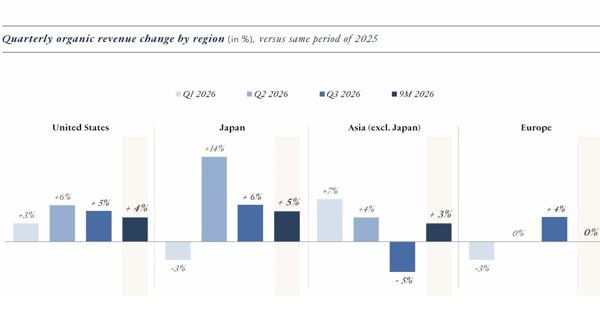
Geographically, the United States, Europe and Japan all recorded positive growth. In the US, revenue grew organically by 5 per cent in the third quarter, following a 6 per cent increase in the second quarter, bringing nine-month growth to 4 per cent. Japan recorded a 6 per cent increase for the quarter and a 5 per cent increase year-to-date. In Europe, excluding France, quarterly growth stood at 4 per cent, following a period of relative stability in the second quarter; for the January–September period, the figure remained unchanged.

The trend in Asia, excluding Japan, was the opposite. Following organic growth of 7 per cent in the first quarter and 4 per cent in the second, the region recorded a 5 per cent contraction in the third quarter. Growth for the first nine months remains positive at 3 per cent, but this slowdown confirms the impact of the decline in Chinese demand.

Loading...

However, LVMH has not halted its investments in China, the chief financial officer reiterated, confirming the market’s strategic importance for the group. On the demand side, however, the flow of news from the country has affected the so-called feel-good factor, that is, consumer confidence and their propensity to spend. When asked about the taxation of Chinese consumers’ overseas purchases, the executive highlighted the impact of the news on consumer sentiment.

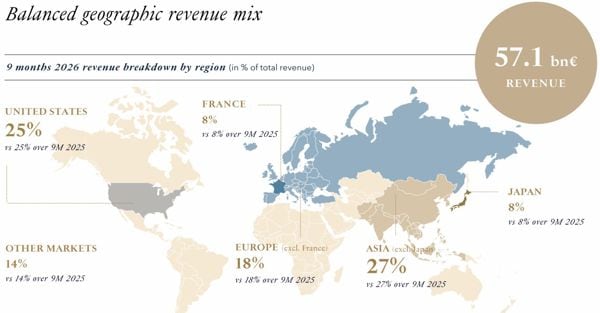
The geographical breakdown of revenue highlights the central role played by Asia, excluding Japan, which accounts for 27 per cent of total turnover, ahead of the United States with 25 per cent and Europe, excluding France, with 18 per cent. Other markets follow with 14 per cent, whilst France and Japan each account for 8 per cent.

The first nine months

LVMH reported revenue of €57.15 billion for the first nine months of 2026, down 1.6 per cent from the €58.09 billion recorded in the same period of the previous year. However, when adjusted for exchange rate fluctuations and changes in the scope of consolidation, this result paints a more resilient picture: organic growth stood at 2 per cent, driven primarily by jewellery, wines and spirits, and selective retail. The main factor holding back the group led by Bernard Arnault is the weakness of Chinese demand, which in the third quarter affected the performance of the Fashion and Leather Goods division.

The results, which were generally slightly below analysts’ forecasts, show revenues for the Fashion & Leather division at 26.39 billion for the nine-month period (-4 per cent reported, -2 per cent organic). The Dior brand reported strong demand for its ready-to-wear and leather goods ranges, whilst the Loro Piana brand also performed strongly. Wines & Spirits recorded revenues of 4 billion (+3% and +5%); Perfumes & Cosmetics recorded revenue of 5.92 billion (-2% and unchanged); Watches & Jewellery recorded revenue of 7.72 billion (+4% and 8%). Finally, revenue from Retailing – essentially Sephora – stood at 12.47 billion (-1% and 6%).

Outlook for 2026

For the remainder of the year, LVMH points to an economic and geopolitical environment that remains uncertain, without providing quantitative targets for revenue or profitability for the full financial year. The group intends to continue on the path of strengthening its iconic brands, creative renewal and the development of new in-store experiences. The strategy also focuses on manufacturing excellence, targeted investments and greater organisational agility, with the aim of maintaining the desirability of its products and consolidating its global leadership in the luxury sector.

The group’s performance over the coming months will depend on its ability to translate creative renewal into actual demand and on the recovery of those markets most exposed to the slowdown in consumer spending.

Copyright reserved ©
Loading...

Brand connect

Loading...

Newsletter

Notizie e approfondimenti sugli avvenimenti politici, economici e finanziari.

Iscriviti