

Macron sets his sights on Lebanon and Syria. He is driving forward IMEC with his ‘Spice Route’ initiative
The logistics company CMA GCM, led by the Franco-Lebanese Saadé, is consolidating its presence in the region and establishing a foothold in the port of Latakia. Having announced agreements with Modi last year, Paris’s aim is to strengthen Marseille as part of its Indo-Pacific strategy

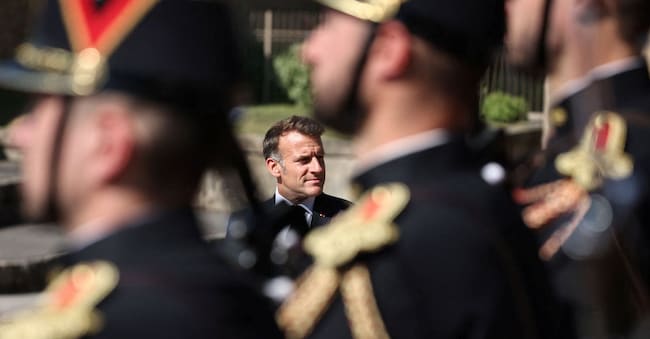
Following the explosion in the port of Beirut, Rodolphe Saadé, Chairman and Chief Executive Officer of the global shipping and logistics group CMA CGM, and Emmanuel Macron travelled to Lebanon. On 6 August 2020, they visited the port together to assess the effects of the shockwave. On 1 September, the French President publicly praised CMA CGM’s commitment to the humanitarian vessel Aknoul. The operation, carried out in collaboration with the French Ministry of Foreign Affairs’ Crisis and Support Centre and the French Embassy in Lebanon, co-ordinates donations to over 70 local organisations, transporting building materials, food, medical equipment and hygiene products. This is not an isolated incident. On the one hand, the Franco-Lebanese entrepreneur is a key figure in Paris’s economic diplomacy, a strategic pillar of France’s influence in the wider Mediterranean region, with a particular focus on Lebanon and Syria. However, the relationship between Macron and Saadé goes back a long way and has grown stronger over the last six years. French newspapers report a working breakfast in 2012, when Macron was a managing partner at Banque Rothschild and was preparing a financial transaction for CMA CGM. Saadé became chairman and CEO of CMA CGM in November 2017 and found himself on the same wavelength as a head of state who shared the same background and a similar worldview. Thus, exactly one year after the trip to Lebanon, official meetings began to intensify.
The meetings
The visit on 2 September 2021 holds symbolic significance: never before had a sitting President of the Republic set foot in the 147-metre tower overlooking the port of Marseille. During the visit, Macron presented the France 2030 Plan for decarbonisation, and CMA CGM announced investments to support the energy transition. The visit in June 2023 took on a more personal tone. As reported by La Provence on X: “This morning, the President of the Republic was welcomed at the CMA CGM tower by the group’s chairman, Rodolphe Saade, a visit not scheduled in his programme” – a visit not included in the official schedule. The following day, BFMTV ran the headline: “Rodolphe Saade, Emmanuel Macron’s new favourite?”. The new favourite?
Foreign agreements
Whilst the group – which is worth over 50 billion euros – is investing in the publishing sector at home, it is looking even more towards the international market. In February 2025, during Prime Minister Narendra Modi’s visit to Paris, Macron – alongside CMA CGM – announced plans for a new ‘Spice Route’ to India. On 10 May 2026, CMA CGM signed a ‘strategic partnership agreement’ with the Kenyan government to develop maritime infrastructure. In May last year, a 30-year agreement was signed with Syria to modernise the port of Latakia. The agreement provides for the expansion and modernisation of port infrastructure, with new berths following dredging work to allow for greater draught. At the end of May this year, as reported by the Sana news agency, Syria’s General Authority for Borders and Customs extended the scope of the 30-year agreement and gave the go-ahead for the construction of dry ports – inland terminals – at the transhipment centres in Adra (which had been closed for 14 years) and Aleppo. The agreement covers management and logistics operations, including connections between the dry ports and Latakia, making the latter Syria’s true gateway to the Mediterranean. The issue remains sensitive given Syria’s geopolitical situation. However, should the port’s growth be consolidated, France would have planted its flag at one of the key junctions between East and West. The Franco-Lebanese shipping company could thus become an extension of ‘French power’ in the Indo-Pacific and Africa, regions that Macron has identified as priorities for French strategy.
The Spice Route
At this point, it is worth returning to the Spice Route. It fits perfectly into the IMEC project, particularly from an anti-China perspective. On the other hand, however, it could spark a form of internal competition within the second pillar of the Indo-Pacific corridor – that is, the section running from the northern part of the Middle East to link up with the Mediterranean routes. The European countries that have joined this major project, alongside France, are Germany and Italia. It is easy to imagine that a potential maritime link from Lebanon and Syria leading directly to Marseille could end up bypassing the Italian Peninsula. So whilst Syria is embarking on reconstruction and fighting continues in Lebanon over the presence of Israeli IDF soldiers in the south, France is taking steps to consolidate its presence with long-term objectives in mind.

