
Macron accepts Attal's resignation: big manoeuvres in the Assemblée
The decision is intended to favour the role of the prime minister, taken as chairman of the parliamentary group, in the creation of a new majority

3' min read
3' min read
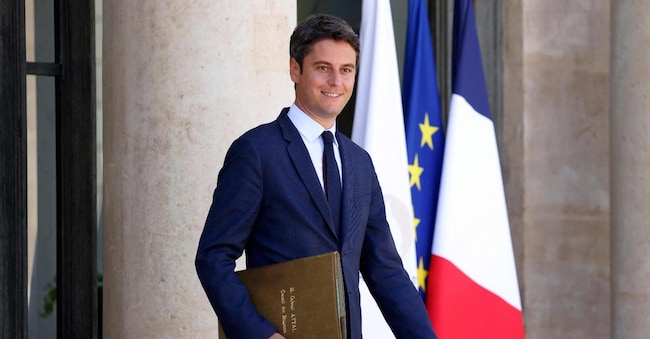
The French government is no longer in office. If not for 'current business'. Gabriel Attal held his last council of ministers in full power, and in the evening President Emmanuel Macron formally accepted his resignation and issued the corresponding decree. The aim is to allow the seventeen ministers elected deputies to attend the Assemblée sessions, where their presence becomes decisive in defining the weight of the presidential camp. Now, warns the Elysée, the Republican forces must 'build an alliance' and 'as quickly as possible.
It is a situation that has already raised many constitutionality doubts. With the government no longer formally in office, Gabriel Attal should be able to become president of the parliamentary group, where he will have a key role to play. It will be up to him to keep the helm straight and lead the presidential camp to participate in a coalition that goes - according to the wishes of Macron himself - from the Droite Républicaine, the old Républicains who have changed their name, to the non-extreme left, hence socialists, ecologists and perhaps communists, with the exclusion of Jean-Luc Mélenchon's France Insoumise.
This is the objective Attal has pursued since the first round of the legislative elections, but his dual role - head of a resigned government and president of a parliamentary group - raises many concerns. The French Constitution, which is strict in its distinction between legislative and executive power - with a few exceptions introduced to favour governability - provides that 'the functions of a member of the government are incompatible with the exercise of a parliamentary mandate, of professional representative functions of a national character, of any public employment or professional activity'. Accepting the resignation is therefore a ploy to overcome this constraint.
Negotiations on the creation of a new government remain a difficult task. France has no tradition of coalitions, its electoral system has almost always guaranteed at least solid minorities, and the only brief experiment with a proportional system did not satisfy anyone. However, the situation is evolving in the direction desired by the president.
The left has not yet managed to express its own candidate. The conflicts between Lfi and the other parties are very strong. Socialists, ecologists and communists, after the Ps's refusal to support the candidature of Huguette Bello, 73, communist president of the Regional Council of Reunion, proposed to choose Laurence Tubiana, 73, economist, former president of the Civic Convention for the Climate, independent but close to Lionel Jospin and François Hollande.


