
Macron: we will increase the number of nukes
No more numbers will be released. Opening the nuclear umbrella to European partners but with no automatic guarantee of intervention

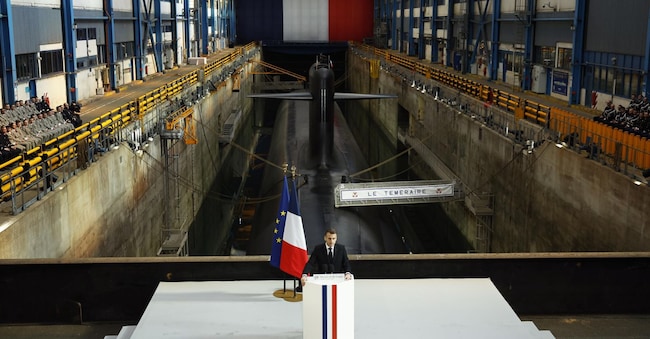
France will increase the number of its nuclear warheads. "My responsibility is to ensure that our deterrence maintains - and maintains in the future - its capacity for destruction" in a "dangerous, changing environment characterised by the proliferation" of atomic weapons, President Emmanuel Macron said in his speech at the Ile Longue base in Brittany, where submarines are stationed to ensure the country's second strike in the event of an attack. "That is why I have ordered an increase in the number of nuclear warheads in our arsenal," he said. "In order to put an end to any speculation," he added, "we will no longer communicate the figures of our nuclear arsenal, contrary to what could have happened in the past". 'To be free, therefore, one must be feared, and to be feared one must be powerful. This increase in our arsenal is proof of that,' Macron added. The nuclear arsenal will in any case remain 'strategic, and exclusively strategic': tactical weapons are excluded.
France is already very strong, the president repeated. "All those who would have the audacity to want to attack France know what an unbearable price they would have to pay," he had said at the beginning of his speech, adding: "In my capacity as President of the Republic, I will not hesitate for a moment to take the decisions that will be indispensable for the protection of our vital interests. In the new situation, however, 'we cannot be satisfied with the current trajectory'.
French security, moreover, 'has never been conceived within the limits of our territory alone', Macron said: 'It is a self-evident fact of geography, which cannot be negotiated'; and 'today more than ever, independence cannot be solitary'. French vital interests have always had a European dimension, he added. This is why the nuclear umbrella will also be extended to European countries, but 'there will be no sharing of the ultimate decision, nor of its planning, nor of its implementation'. It will remain in the hands of the Presidency of the French Republic: 'By virtue of our Constitution, it is exclusively up to the President of the Republic, who is responsible to the French people. There will also be no automatism in the interventions: 'Consequently,' Macron added, 'there will also be no sharing of the definition of vital interests, which will remain the subject of our country's sovereign assessment. And for this reason, as in other nuclear alliances, even those with plans and procedures, there will be no guarantee in the strict sense of the term. A strict guarantee would be imprudent, would lower the nuclear threshold and reduce the uncertainty of our adversaries'. By evoking strategic ambiguity again, Macron is also attempting to fend off criticism from various political forces, starting with the populist right-wing Rassemblement national (but not only), which fear an excessive French commitment outside its borders.
The creation of a European umbrella will take place in 'total transparency' towards the United States and in coordination with Great Britain. Collaboration with other countries will start with Germany, 'a key partner, the most ambitious', then be extended to others. In addition to London and Berlin, 'Poland, the Netherlands, Belgium, Greece, Sweden and Denmark' are already interested. These countries will be able to welcome 'strategic air forces' - the Fas, equipped with nuclear warheads - scattered 'like an archipelago of forces' to 'complicate the calculations of our adversaries'.
Macron thus outlined his new doctrine of 'advanced deterrence', which will have to be accompanied and supported by the development of conventional forces as well: 'To be strong in our nuclear deterrence we must be strong in our conventional capabilities in all their dimensions,' the president said: "The experience of the last few years clearly shows that there are at least three areas in which Europe, should it face an escalation and manage it below the nuclear threshold, would benefit from new collective means: early warning, i.e. the ability, through a combination of satellites and radar, to detect and track missiles that might target European sky control; expanded air defence, with anti-missile and anti-drone protection; and finally, deep strike capabilities." The partner countries will be able to make a contribution to strengthening Europe's capabilities with 'a fair division of effort' in which 'France will therefore clearly benefit'. Paris is already planning to develop a new next-generation nuclear submarine, the president said, which will be called L'Invincible and will be ready in 2036, while France Germany and Great Britain will work together on a long-range missile as part of the Elsa project.


