
Managers poised between control and flexibility
A journey through Cairo's busy and seemingly anarchic traffic, which surprisingly flows without incident. An experience that becomes food for thought on the delicate balance between control and flexibility in business management

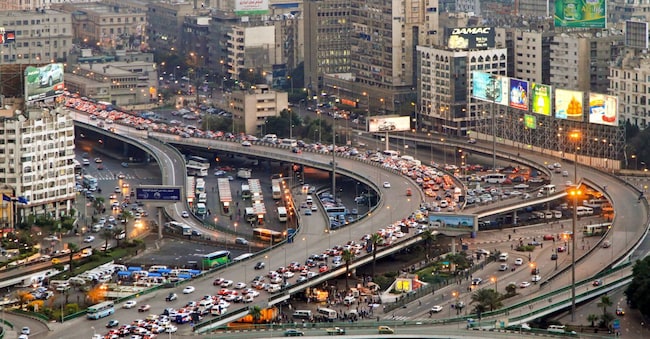
Among the few things that can strike and deeply mark the imagination of a child struggling with the study of ancient history in the early years of school, in my very humble opinion, are the Egyptian pyramids. And when one is lucky enough to see them in person, it is like realising that imagination. What one does not usually contemplate in that image one paints in one's mind is the urban context in which the most famous ones (Cheops, Chephren and Mycerinus) are set. Giza and Cairo constitute an urban agglomeration with an estimated population of around 25 million people. And, without detracting from the wonder of the pyramids, what struck me most and what I took away as a deep impression from this recent trip to Egypt was precisely the traffic in this megalopolis.
Perhaps it is only by witnessing it in person that you can understand, but I'll try to give you the idea: urban roads with up to eight lanes per carriageway, almost no traffic lights or pedestrian crossings, cars, motorbikes, tuk tuk, vans, buses, animal-drawn carts and, of course, pedestrians, all sharing the same space.
From my perspective, it was almost disturbing at first, as it resembled a kind of chaotic anarchy; gradually it became a characterising feature, in some ways a folkloric one; in the end (only as a pedestrian) I even 'jumped in'... very cool experience! Consider that it is absolutely natural for locals to cross that traffic on foot at any point, even on the main thoroughfares.
Yet, in seven days of immersion in this chaos, which was present at practically all hours, I never noticed any problems (pedestrians being run over or motorists intent on making an amicable statement!) and, above all, I never really found myself stuck in traffic... Everything simply flowed steadily and inexorably.
I come to the point. In my recent training and consultancy activities, I have increasingly found myself supporting high-level managers intent on trying to govern the trade-off between, on the one hand, strict adherence to rules and standards (of processes, activities, etc.) that guarantee certainty and, on the other, recourse to exceptions and flexibility (in actions and methods), elements that are able to offer room for manoeuvre and opportunities.

