
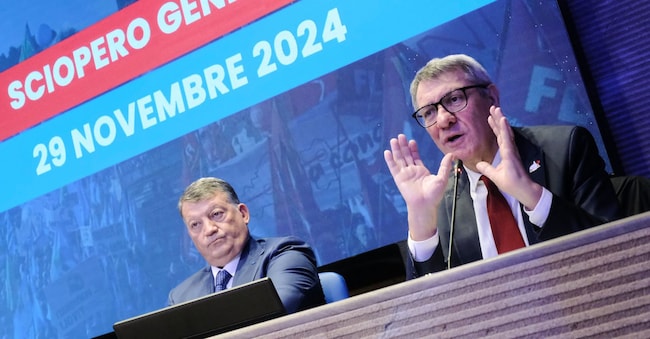
Manoeuvre, general strike by CGIL and UIL on 29 November (without the CISL)
Eight-hour stop. Luigi Sbarra demurred, pointing out that a large part of the 30 billion is concentrated on 'interventions consistent with our demands'.

3' min read
3' min read
An 'inadequate' manoeuvre: CGIL and UIL take to the streets, again without CISL, and against the choices made by the Meloni government. And in order to demand changes to the budget law they are once again proclaiming a general strike together: the date is Friday 29 November. A decision that further fractures the trade union front, crystallising very different positions, and reignites the clash with the majority.
Eight hours stop
.'I would say that there is a very small prejudice,' jokes Prime Minister Giorgia Meloni, who, interviewed by Bruno Vespa, points out the issues in the manoeuvre that the unions should like and emphasises that the protest comes before the convocation scheduled for Tuesday at Palazzo Chigi. The League, then, does not mince its words and rejects the reasons for the protest: 'Ridiculous unions, they are striking against the increase in incomes. The mobilisation could, on the contrary, find the backing of the opposition, as has already happened several times, including in the last squares. Eight hours of stoppages and territorial demonstrations will accompany the general strike while the politicians begin to imagine the changes to the Budget law that, for now, seem to concern cryptocurrencies and the introduction of representatives of the Accounting Department in companies that obtain public aid. They will arrive with amendments by 11 November with the aim of closing the manoeuvre before Christmas.
A slew of criticism
.But the themes of the changes seem really distant from those of the general strike, the fourth consecutive one by CGIL and UIL against the manoeuvre: they had done it in December 2021 when there was the Draghi government, and then in December 2022 and in November 2023 with the Meloni government. Now again at the end of November. The platform is a parade of criticism on taxation, wages and pensions, health, safety at work. It calls for a change in the manoeuvre that does not solve the country's problems, but rather 'brings it crashing down'. They say no to cuts and demand an increase in purchasing power, funding for health, education, public services and industrial policies. We must take 'the money where it is': extra-profits, annuities and great wealth, evasion. Moreover, the confirmation of the tax wedge cut is not enough.
Hearings start in the House
"Two extreme left-wing unions are striking against the salary increase for 14 million employees up to 40 thousand euro of income?", is the retort of the League. The premier also replies, talking about reducing precarious employment, increasing wages, cutting the wedge and money on lower incomes, increasing female employment, and 3.6 billion taken from the banks. And the summons to Palazzo Chigi for Tuesday 5 November may not be enough. The hearings in the Chamber of Deputies start on Monday 4 and close on the 7th with the Minister of Economy, Giancarlo Giorgetti. A convocation considered late and that risks being only 'an informative report', attack Landini and Bombardieri again, who see very little margin for change and obviously - says the Uil leader - they are ready to review the strike decision if the government should accept the proposals. On the opposite side is the judgement of the Cisl, which with leader Luigi Sbarra highlights the positive points: a large part of the 30 billion of the manoeuvre is concentrated on "interventions consistent with our demands".
Sparks between leaders
.There is no shortage of sparks with Landini. The CGIL leader's words set them off: 'If other organisations think that the task is always to tell the government "how good and handsome you are", I instead think that the workers' interests must be protected'. Words that 'offend' the Cisl, replies Sbarra, advising him 'to put on the trade unionist's shoes and stop pulling a political opposition that does not need collateralism'.

