
Manoeuvre, Meloni to ministers: 'Do you want to raise taxes or cut spending? Better to cut spending'
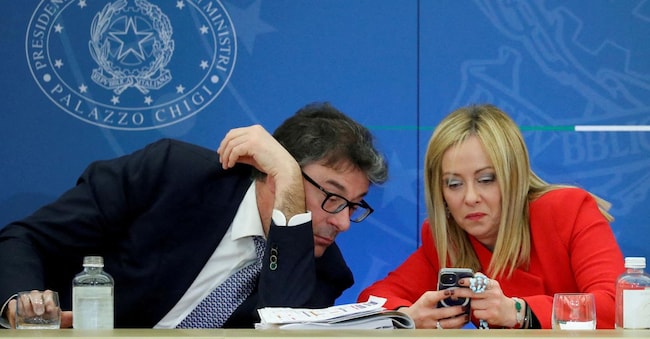
According to several participants, during the Council of Ministers the Prime Minister and Economics Minister Giancarlo Giorgetti returned to urging department holders to discipline themselves with the spending review

3' min read
Key points
3' min read
Reduce 'unnecessary' expenditure. Not least because it will be better to 'cut spending' than to 'raise taxes'. There was not only the migrants decree on the menu of the Council of Ministers that met on Wednesday 2 October. According to reports from several participants, Prime Minister Giorgia Meloni and Economy Minister Giancarlo Giorgetti returned to urging the heads of the ministries to discipline themselves with the spending review. Not least because otherwise, the economy minister repeated, everyone will have to make 'linear cuts'. A new round of spending cuts was widely announced - it is the new parameter, moreover, to be respected in order to be in line with the new EU Stability Pact - and now, about ten days from when the government will have to put the manoeuvre numbers on paper, defining this chapter also becomes urgent.
The new round of cuts
.From the new round of cuts should be safeguarded the local authorities, who were also at Via XX Settembre last Friday to plead their cause, well received, according to them, by Giorgetti. However, the exemption does not apply to ministers called upon to reduce 'waste' and 'inefficiencies'. Meloni particularly addresses the newcomer to the table, Alessandro Giuli, who has only been Culture Minister for a few weeks and is facing his first budget law. 'What am I telling you for...' the premier is said to have joked in Roman dialect, who nonetheless urged everyone to proceed spontaneously with the cut. 'Do you want to raise taxes or cut spending? It's better to cut spending...,' summarised Giorgetti, who has already been subjected to the procession of colleagues in the past who were trying to safeguard their budgets as much as possible. They have known for a long time in the ministries that they cannot circumvent expenditure restraint. With this justification, for example, in mid-July at the Ministry of Justice - as can be seen from a document available on the Via Arenula website - in the face of a request for three minibars (for around €500) the purchase of just one was authorised.
Twenty billion resources identified for now
.Spending is only one of the items on the list of covers for the manoeuvre. The puzzle is not yet complete, but with the resources identified so far, the counter would already be more or less at 20 billion. The last piece is outlined in the tables of the structural budget plan: in the planning framework (the one that also takes into account the effect of the measures of the budget law) the 2025 deficit is set at 3.3 per cent, while at current legislation it is 2.9 per cent: these 0.4 points of difference, which are equivalent to about 9 billion, are the dowry in deficit destined to lend a hand to the fine-tuning of the coverage chapter. In the reservoir of resources there are also the approximately 4 billion from the repeal of the Ace (a tax relief for companies) and the introduction of the global minimum tax, which are intended to refinance the new three-rate Irpef for another year.
Agreement match for VAT numbers
.Work is also underway to extend the cut to the middle classes, i.e. employees with incomes of up to EUR 50-60,000, but this step depends on the outcome of the agreement for VAT numbers. There is time to adhere to the two-year pact with the tax authorities until 31 October. The government is aiming to raise at least 1.5 billion euro from the newly approved special tax amnesty alone.
Tax expenditures
.To enrich the list of available resources, in addition to the 2 billion expected from the spending review, there is also the ongoing work to thin out the thicket of tax expenditures. This is a complex dossier, which was already opened last year and which could potentially yield up to one billion resources. The objective is a careful cleaning operation, but without touching the deductions for medical, home and work expenses. The subject is also touched upon in the Psb, which speaks of 'alignment of excise duty rates for diesel and petrol and/or policies to reorganise existing energy concessions'. Increasing excise duties on diesel would translate into revenue for the State of around 3 billion, calculates Assoutenti, which cries 'stangata' on motorists. A hypothesis that also agitates the road haulage category: Fai Conftrasporto warns that it will not accept any worsening and asks the government for 'certainties'. Among the matches still open on which other potential resources depend, in addition to the revision of tax expenditures and the two-year arrangement with creditors, there is also the delicate dossier of the voluntary contribution to be requested from the banks.

