Marco Caprai: against the wine crisis, fewer grapes, more quality and going abroad together
The case of the Umbrian winery: from Sagrantino di Montefalco - which in 10 years of collaboration with Michel Rolland has been able to transform itself to maintain its market - to the diversification of production with local whites

Key points
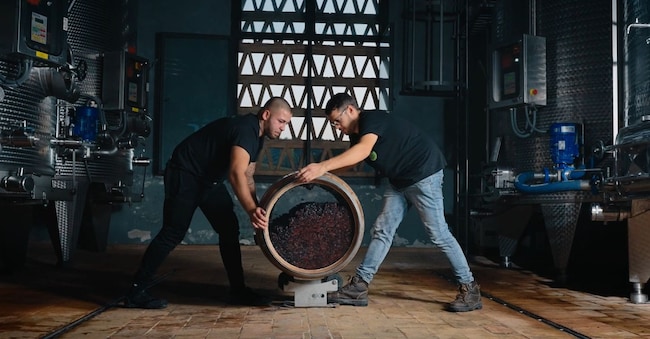
Integral vinification' involves placing the freshly destemmed Sagrantino grapes directly into barriques, where a pre-maceration phase takes place at a controlled temperature. Then, during fermentation, the barriques are rotated manually several times a day. This innovative method is the result of thedecade-long collaboration between the Arnaldo Caprai winery and Michel Rolland, probably the world's most influential oenologist, and allows, according to its creators, "a soft, continuous and natural extraction, without forcing or stressing" and thus "obtaining rounder, more elegant and silky wines, with sweet tannins, a full fruit and an extraordinary harmony between structure and freshness".
The Ten Years with Michel Rolland
A way to 'tame' the rough Sagrantino without 'waiting' for it for years and years, and also a way to make it more contemporary and suitable for international tastes. After all, wines evolve over time (not only in casks and bottles), even adapting to changing tastes. And tastes in today's world seem to be changing drastically and quickly, towards lighter and less structured wines, if not towards those with low alcohol content or to dealcolates.
Sagrantino therefore, despite its new look in the Caprai-Rolland interpretation, does not seem to be the identikit of the ideal product to challenge the storm on the markets, between overproduction and Trump's tariffs. "It is undeniable that at the moment other, let's say, less demanding wines seem to be at an advantage,' comments Marco Caprai. 'It is a phenomenon that starts with the culture of the table, which first promoted fizzy drinks and is now influenced by attention to calories and so-called healthiness. In a context where people eat less and differently, wines of a certain type are also affected. Then there would also be a discourse on bottle refills in restaurants, which are sometimes excessive, while at the same time the purchasing power of families drops. But then, looking in more detail, there are exceptions. Our Sagrantino is a niche, wine lovers have not disappeared and they reward quality and those who know how to innovate'.
The Sagrantino breakthrough, but not only
"We are not talking about Merlot or Pinot noir,' reiterates Rolland, 'Sagrantino is still practically unknown at an international level and we are trying to highlight its richness and peculiarities. I think we have done a good job so far, but we must never be satisfied and there is still much to be done. In the world of wine, one is successful when one is able to propose something original, and Sagrantino has the ability to be unique, just as the other grape varieties we are working on in Montefalco are also remarkable, and with excellent results, such as Merlot Belcompare and Pinot Noir Malcompare'.
Moreover, even within Caprai itself, Sagrantino, in its various declinations, reaches 100 thousand bottles compared to the remaining 800 thousand that the winery produces, from Rosso di Montefalco to whites: among others Grechetto, Sauvignon, to Trebbiano Spoletino. Up to the latest arrival: Puntabella, the winery's first still rosé, produced on Lake Trasimeno from Sangiovese (60%) and Grenache (40%) grapes.