
Mastercard: 2030 year of AI agentica, when software will pay for us
The market will be worth $155 billion by 2030 and cybercrime risks will grow. The solution, according to the international payment circuit, is to play ahead with technology

3' min read
3' min read
Now that artificial intelligence agents can, and increasingly will, do transactions for us, the payment security scenario becomes more complicated. Agents are the evolution of the simple artificial intelligence chatbot. Chatbots converse with us. Agents, they act. We can ask them to check in for a flight. Find and book the best sushi in a city area. They do repeated sequential actions. Until payment.
The white paper Securing Tomorrow by Mastercard imagines 2030 as the age of 'agent AI', in which autonomous software will manage purchases, payments and services. The market will be worth $155 billion (Bank of America Global Research figure), but criminals will also use these technologies for fraud and attacks on a global scale.
Already today, the phenomenon has enormous dimensions: in 2024, cybercrime damage reached 9.5 trillion dollars, the third largest 'economy' in the world after the United States and China; by 2029, it will rise to 15.6 trillion (+64%). Attacks on critical infrastructures - healthcare, energy, telecommunications - grew by 30% in 2023 alone and will continue to rise by double digits. Multiplying the risks will be the 40 billion connected devices expected by 2030.
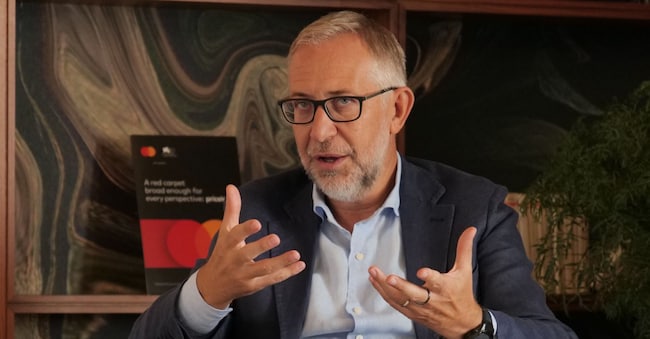
'We are investing a lot to make our customers trust us, payment has to be secure even in these new scenarios,' explained Luca Corti, Mastercard's Country Manager for Italy at a meeting with the press on the sidelines of the Venice Film Festival. 'In 2024 in Italy, digital payments will overtake cash. And there are more and more devices playing a leading role in this transition, such as Nfc rings'.
The answer to the growth of these digital solutions is called 'tokenisation'. It means protecting sensitive card data with unique, secure and dynamic credentials. "In Italy, this is already a reality for about 30 per cent of Mastercard circuit transactions, with the goal of reaching 100 per cent by 2030. It applies to physical payments, but also online, on websites or apps'. Looking ahead, from a predominantly protective tool, tokenisation will become an enabling strategic infrastructure for a wider ecosystem, which will include autonomous, AI-driven payment scenarios integrated with digital identity and biometrics.


