Bilateral

‘Raw materials, joint stockpiling and defence. Japan and Italia join forces in the Indo-Pacific’

Interview with Deputy Foreign Minister Eri Arfiya: “The agreements on space, energy security, semiconductors and the GCAP confirm that our two countries share common ground and are working in regions of the world where the rule of law prevails”

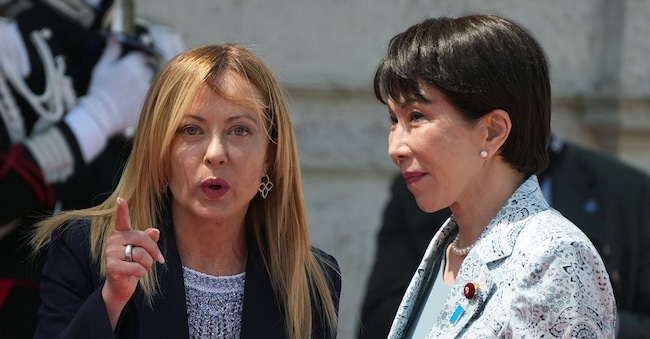
La premier italiana Giorgia Meloni, a sinistra, riceve il primo ministro giapponese Sanae Takaichi a Villa Pamphili, a Roma, lunedì 15 giugno 2026.  (AP Photo/Gregorio Borgia)

5' min read

Translated by AI
Versione italiana

5' min read

Translated by AI
Versione italiana

“Italia is a key partner for Japan. Our two countries have much in common: from the fundamental values of freedom, democracy, human rights and the rule of law, to our appreciation of food, community and family,” Japan’s Deputy Minister for Foreign Affairs, Eri Arfiya, told our newspaper, emphasising on several occasions that, in an increasingly complex international context, the shared commitment to these values takes on greater importance. This commitment is aimed at a free and open Indo-Pacific, the protection of an international order based on the rule of law, economic and energy security, and the defence of human rights. “Cooperation with Italia will continue to be a fundamental pillar of our diplomatic action,” she adds, “across a wide range of sectors: security and defence, space, economic security and the strengthening of supply chains.” This refers to joint efforts to promote stability in the Middle East, including freedom of navigation and maritime security in the Strait of Hormuz, as well as energy security. With a focus on relations between Europe and the Indo-Pacific.

Deputy Minister, Italia and Japan share the view that vulnerabilities in supply chains need to be reduced. What forms of cooperation do you envisage in the field of critical raw materials?

Loading...

‘As you have pointed out, the need to strengthen autonomy and resilience is becoming increasingly urgent in the current international situation. At the Japan–Italia summit held in January this year, Prime Minister Takaichi and Prime Minister Meloni agreed to strengthen cooperation on economic security to improve the resilience of supply chains, including cooperation on critical minerals. At the Japan–Italia summit on 15 June, a memorandum was signed covering the sectors of semiconductors, minerals and advanced technologies. In this way, both countries are working closely together to promote bilateral cooperation in the field of economic security, including the resilience of supply chains. As agreed at the recent G7 Summit, Japan will further strengthen the resilience of supply chains for critical minerals by diversifying supply sources in cooperation with like-minded partners, providing public financial support and engaging in international cooperation on joint stockpiling.”

Does it envisage closer cooperation in satellite technology, Earth observation and telecommunications?

“Japan and Italy are both active in the space sector and possess advanced technologies. Our space agencies, JAXA and ASI, have a long-standing cooperation in various fields, such as missions to the ISS, Earth observation and space science. Furthermore, collaboration between our industries is expanding, as demonstrated by the strategic partnership announced in May between Synspective, a provider of SAR satellite data and analysis solutions, and e-GEOS, an Italian provider of value-added Earth observation services. Space is a crucial sector that forms the basis of the economy, including disaster prevention and mitigation. As both Japan and Italia are countries prone to earthquakes, there is considerable scope for deepening space cooperation across all fields, particularly in Earth observation and disaster risk management.”

Italia and Japan have maintained aligned positions in support of Ukraine. How do you assess the current level of coordination between the two countries? What joint initiatives could support the reconstruction effort?

“Japan has pledged total support of around 20 billion dollars to Ukraine in the areas of finance, recovery and reconstruction, as well as humanitarian aid, and is implementing this on an ongoing basis. Representatives from Japan attended the Ukraine Recovery Conference hosted by the Italian government in Rome in 2025, where they actively exchanged views on support for Ukraine with participants from various countries. Furthermore, experts from Japan and Italia regularly collaborate on support for Ukraine through assistance provided via multilateral development banks, including the World Bank, and through the activities of the Donors’ Platform for Ukraine established by the G7.”

 As regards the situation in the Middle East, where do you see the greatest areas of common ground between Tokyo and Rome?

“With regard to the situation concerning Iran, following last month’s Japan–Italia summit talks, the two leaders welcomed the signing of the Memorandum of Understanding reached between the United States and Iran. They agreed to continue to make every diplomatic effort to ensure that the memorandum is implemented consistently, that free and safe navigation through the Strait of Hormuz is permanently guaranteed, and that a final agreement on the Iranian nuclear issue is reached as soon as possible. Furthermore, with regard to Palestine, following the Japan–Italia summit talks in January, the two countries agreed to continue working towards the stabilisation and reconstruction of Gaza, and reaffirmed their commitment to achieving a two-state solution.”

How important is Italia’s growing involvement in the Indo-Pacific to Japan?

“As part of an updated ‘Free and Open Indo-Pacific (FOIP)’ announced by Prime Minister Takaichi, Japan and Italia will work together to strengthen resilience and promote their freedom to make their own decisions, thereby contributing to peace and stability in the region. Japan is committed to working with Italia, taking into account the growing links between the Mediterranean and the Indo-Pacific, to make the entire region stronger and more prosperous together. As like-minded partners, the two countries will further strengthen their strategic cooperation in the field of economic security and work together to support and shape the regional order in the Indo-Pacific.”

What are the priorities for the coming years?

“Prime Minister Takaichi highlighted efforts to promote cooperation through ‘POWERR Asia’, a framework for strengthening energy resilience in Asia launched in April this year. Italia and Japan agreed that the G7 should continue its efforts in three areas: maintaining free and transparent energy trade, coordinating the build-up of oil stocks at an international level, and strengthening cooperation between energy-producing and energy-consuming countries. In the field of security, it is essential to improve security in both the Euro-Atlantic and Indo-Pacific regions. Japan expects that continued cooperation between the two countries in this area will help to address the security challenges affecting both regions.”

 The Italy-Japan Business Group (IJBG) has played an important role in promoting economic dialogue between the two countries. What do you consider to be its main added value today?

“The IJBG not only serves as a forum where member companies can draw inspiration and develop their cooperation, but also provides an important opportunity to broaden the scope of cooperation between Japan and Italia through its outreach sessions, which also bring together non-member companies and help to generate momentum for bilateral collaboration amongst a wider audience. Its main added value lies in offering participants a first-hand understanding of each other’s strengths.”


 Defence cooperation between Italia and Japan has entered a new phase of development. What are the main shared priorities today?

“The Global Combat Air Programme (GCAP), a trilateral initiative involving Japan, Italia and the United Kingdom, is one of the most significant projects. The success of the GCAP will not only help to maintain and strengthen the participating countries’ future air combat capabilities, but also further deepen the strategic partnership between Japan, Italia and the United Kingdom, contributing to peace and stability in both the Indo-Pacific and Europe. Japan intends to further strengthen its close cooperation with Italia, including exchanges between their respective armed forces and collaboration within the GCAP. By making full use of the Mutual Acquisition and Support Agreement between Japan and Italia, which came into force last year, the two countries aim to strengthen a free and open international order.”

Copyright reserved ©
Loading...

Brand connect

Loading...

Newsletter

Notizie e approfondimenti sugli avvenimenti politici, economici e finanziari.

Iscriviti