
Mattarella: 'In Gaza obstinacy to kill'
"In the Strip there was talk of mistakes, errare humanum est perseverare diabolicum". Condemnation of anti-Semitism. Sinking on Putin: "he cancelled peace".
3' min read
3' min read
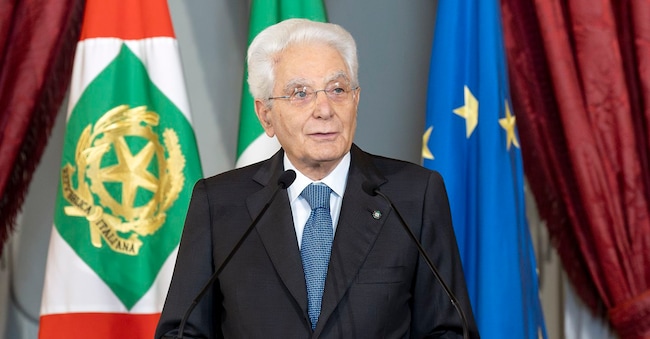
Mattarella's speech yesterday at the Fan ceremony in front of the parliamentary press was marked by more than one lunge. He looked at the different scenarios to focus on Israel where the 'obstinacy to kill indiscriminately' continues and on Putin who has 'cancelled peace'. And it is precisely in the light of the violation of every rule and humanitarian law that he arrives at explaining the need for a common EU defence while there is bitterness for a multilateralism called into question by those who want to shelve the UN and the WHO, with no vision for the risks for the future.
In this scenario, there is also Trump's hand that has become very heavy on tariffs with a choice of 'economic opposition that risks producing other, more rude and dangerous forms of opposition'. A high risk in a world where there is 'a growing polarisation of wealth in the face of large pockets of poverty'. But, turning our gaze to domestic facts, there are two notations from his speech yesterday: the call for politics and justice "not to be perceived as opposing fortresses, with the aim of conquering space in other people's territory"; and the parties on the RAI. "The picture offered in the parliamentary supervisory committee on the appointment of the RAI president is discouraging. Freedom lives from the functioning of institutions, not from their paralysis'. These are the points that Mattarella sets out before the summer break, and on the very day on which the government recalls the Russian ambassador for having included the head of state among Moscow's 'enemies', he does not retreat an inch in his j'accuse to Putin, indeed with irony he says "we do not miss anything".
But then he attacks: 'Russia's aggressive posture in Ukraine continues, distressing: a boulder on the prospects of the European continent and its young people'. And again he places historical responsibility on Moscow for having "cancelled the balance that guarantees peace", explaining that both the EU and NATO countries bordering the Baltic "nurture serious concern, if not conviction, that Russia is cultivating new initiatives of aggression", so much so that Finland has abandoned its neutrality. He retraces all the stages of that phase of 'absence of war' as a result of 'the nuclear balance between the two great opposing blocs', then the prospect of disarmament, and finally from 2022 this balance - already weakened by some steps backwards - is no more. He therefore reminds Europe of the urgency of 'restoring it, together with NATO, not to cultivate prospects and dangers of war but, on the contrary, to preserve peace'. He is keen to note that 'the need for adequate defensive capabilities of EU countries', serves above all to safeguard 'sovereignty', a magic word these days but one that is scarcely used in practice.
The harshest lunge, however, is on what is happening in Gaza and the West Bank. And he does so with truly scathing words against Israel. After recalling the brutal attack by Hamas, he is not silent, however, on what is still happening, years later. And it is essential to read his entire passage. "The incredible bombing of the Holy Family Parish in Gaza has been called a mistake. For many centuries, from Seneca to St Augustine, we have been reminded that "errare humanum est, perseverare diabolicum". Mistakes have also been spoken of in shooting at ambulances and killing doctors and nurses, in killing thirsty children in line for water'. Here, he adds, 'it is difficult, in such a chain, to see an involuntary repetition of errors and not to recognise the obstinacy to kill indiscriminately'. He also speaks of the "abusive, violent occupation of territories attributed to the Palestinian National Authority in the West Bank" but is silent on the "very serious resurgence of anti-Semitism, which also feeds on stupidity".
Looking at these scenarios, Mattarella defends - as he has done countless times - the role of the United Nations, accusing "the tendency to discredit the role of the UN, its Bodies, its Agencies, hinging on the ineffectiveness of its action that derives from the selfishness of the power of individual states, starting with the anti-historical right of veto". The US decision to sanction the special rapporteur on the occupied Palestinian territories, Francesca Albanese, also comes to mind. A central part of his speech, however, is on the freedom of opinion and information as opposed to fake news, new platforms and algorithms, new hybrid weapons, concluding that 'freedom to lie is not among those that can be claimed'. And on the subject of information, he returns to Gaza 'where it is claimed to obscure reality'.


