Climate and astronomy

Earth at maximum distance from the Sun: why it's hot anyway

Earth's tilt and distance from the Sun influence the seasons and temperature

by Leopoldo Benacchio

3' min read

3' min read

At 19.56 on 3 July 2025, the Earth will be at the farthest possible point from the Sun, some 152.1 million kilometres.

But how, the reader might say, if we are further away and it is terribly hot outside, indeed a Canicola!

Loading...

He is right, common sense leads us to think this: if I stand further away from a stove, for example, I am less hot, not more. Let us say right away that Canicola comes from the Latin, little dog, and the Treccani Vocabulary tells us that it is 'the period of maximum heat, corresponding to the time when the sun has just passed the constellations of the Greater Dog and the Lesser Dog'.

Actually, the Canicula is still a little while away, but the heat is already there, unfortunately, exaggerated and not only by us, but up to today's scorching London.

Back to our question: we are as far away as we can get and it is so hot. Simple because we catch a lot more sunlight at the right angle. The seasons are in fact given by the fact that the celestial equator is the projection of the Earth's equator on the celestial sphere, while the ecliptic is the apparent path of the Sun on the celestial sphere, inclined with respect to the celestial equator.
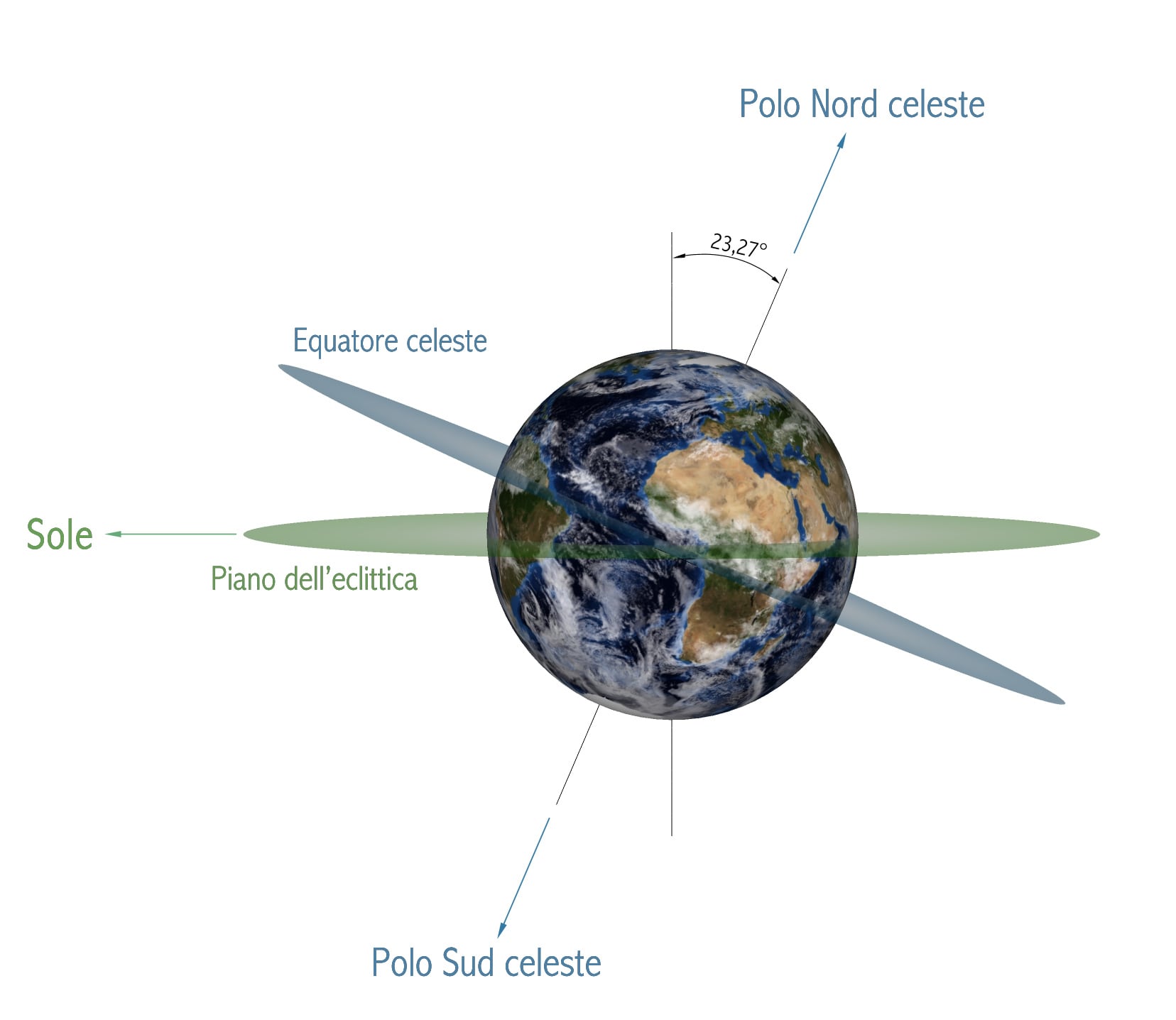
Saying it like that may bring back sad memories of secondary school for some, but it is simple: the Earth is tilted by 23.5 degrees and this causes the seasons: just take an apple, put it in front of the dining table, put another fruit on the table, for example an orange, which will be the Sun for us. With the apple, which will be our Earth, for six months we transit above the table, with about 23 degrees to a maximum from which we descend and for another six we stay below in the same way, the visualisation of the difference due to the Earth's inclination, however approximate, is soon made. Incidentally when we are with the apple on the table descending it will be the autumnal equinox, in the opposite case the spring equinox,

Back to us. The point of maximum proximity, perihelion, is the point in the orbit at which the Earth is closest to the Sun, and this year it was on 4 January 2025, when it came within just 147.1 kilometres of the Sun, so 5 million kilometres less, about 3% difference.

Our misconception arises from figures such as these, which we stumble upon as early as first grade and which are completely wrong: the Earth's orbit is indeed an ellipse, as prescribed by Kepler's laws, but it is almost a circle if the difference between perihelion and aphelion is so small!

Ever since we were kids, an idea was installed in our heads that the Sun's orbit is shaped like an egg, which fortunately it is not: it would cause us a lot of trouble, in fact, if it looked just like the picture.

A difference of 3 per cent between the positions of minimum and maximum distance from the Sun corresponds to about 6 per cent more energy falling to Earth from the Sun, not much.

For the Earth's inclination on the other hand, 23.5 degrees let us remember, for us who are roughly at 45 degrees we receive much more from the Sun, at least 30 times more. This explains why it is hot in the summer, even though it must be remembered that the Earth's temperature depends on many other factors that influence it more than just the distance from the Sun.

Copyright reserved ©
Loading...

Brand connect

Loading...

Newsletter

Notizie e approfondimenti sugli avvenimenti politici, economici e finanziari.

Iscriviti