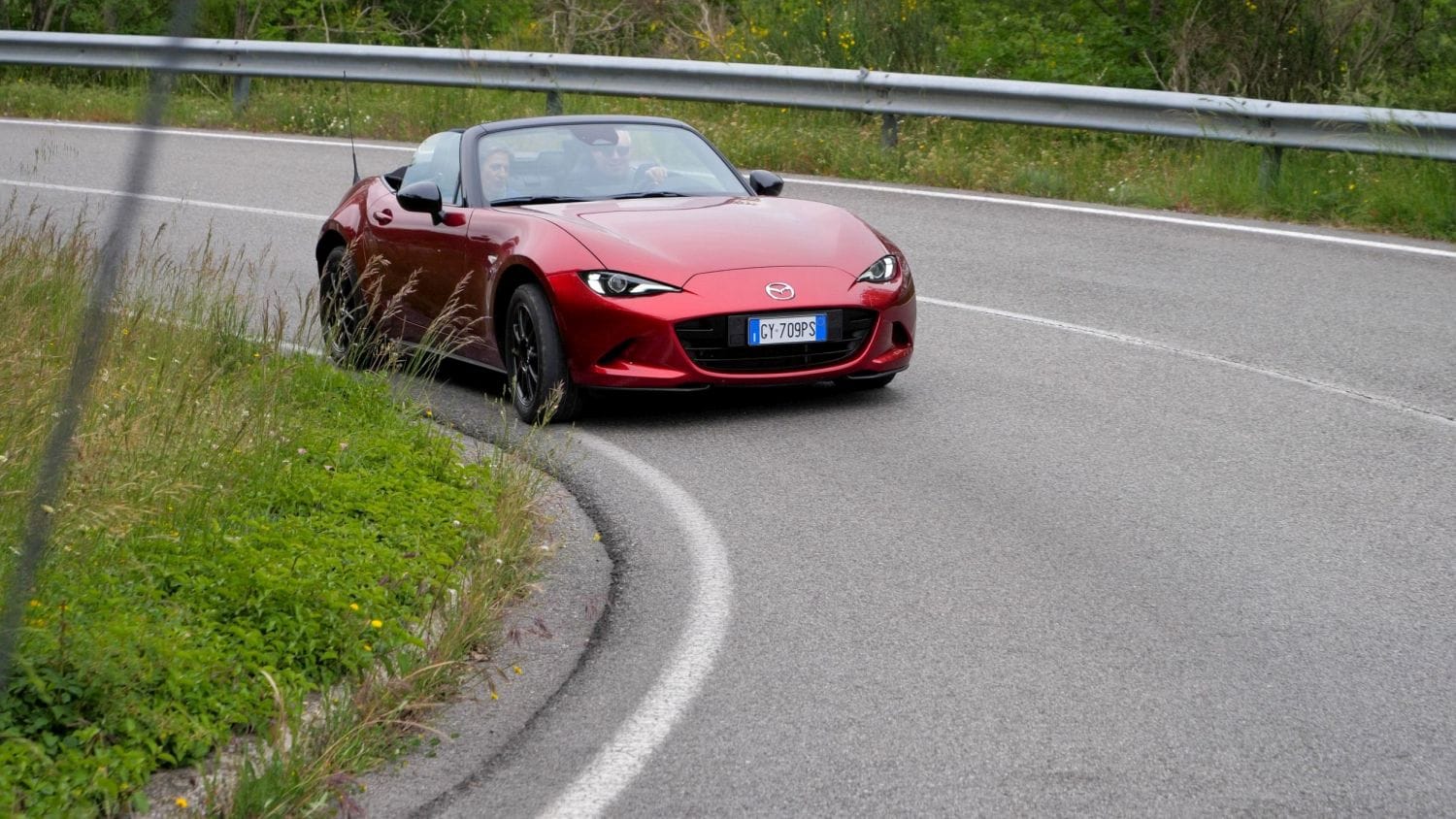
Mazda MX-5, 10th anniversary special editions Kazari and Homura arrive
The Japanese roadster does not lose its sporty soul and remains one of the few affordable cars pleasant to drive
by Danilo Loda

3' min read
Key points
3' min read
Launched in 2015, the fourth generation Mazda MX-5, named ND, still maintains a technical configuration devoted to lightness and agility. The chassis, with rear-wheel drive and longitudinal front engine, is 3,915 mm long with a wheelbase of 2,311 mm and a curb weight of around 1,000 kg. The body is available in two configurations: Soft Top with a soft top and RF (Retractable Fastback) with a retractable hard top.
Mazda X5 Kazari: focus on finish and comfort
The Kazari version is distinguished by a configuration oriented towards comfort and elegance. Aesthetically, it features light-coloured alloy wheels and a beige soft top, combined with blue bodywork. The interior is finished with beige Nappa leather seats and an upgraded infotainment system, compatible with Apple CarPlay and Android Auto wireless, on a horizontal display. Mechanical elements remain unchanged from the base, with high wishbone suspension at the front and multilink at the rear.
Mazda X5 Homura: sports equipment and lightening
The Homura focuses on a more pronounced dynamic stance. It adopts lightened black forged wheels (-1.5 kg each) with semi-slick tyres, Brembo brakes with 4-piston front calipers, and Recaro leather and Alcantara seats for greater lateral restraint. The configuration remains without a limited slip differential, but the presence of stability control with Track mode allows a good dynamic margin before the electronics intervene.

Mazda X5: powertrain and mechanical configuration
Both special editions, Kazari and Homura, are equipped with the naturally aspirated 1.5-litre Skyactiv-G 1,496 cm³ engine, capable of delivering 130 hp at 7,000 rpm and 150 Nm of torque at 4,800 rpm. The gearbox is a six-speed manual, with short, precise shifts. The engine has been optimised with a new filter box that channels intake sound into the cabin, improving acoustic perception despite the constraints of Euro 6 regulations.
Mazda X5: chassis and driving dynamics
The chassis remains one of the MX-5's strong points, with weight distribution close to 50:50 and improved steering both mechanically (reduction of internal friction) and in electronic calibration. The feeling with the asphalt is straightforward even with 16" tyres, thanks to the set-up calibration that manages to balance everyday use and sporty driving.