
Medicine, first appeal: physics the most feared, at Sapienza the lowest enrolment
The first November roll call sees almost 87% of enrolled students taking exams. Genoa tops with 100% of enrolled students

Key points
The exam that 'frightens' the white coats the most is physics. Among the three subjects of the first call for Medicine, scheduled for Thursday 20 November in all state universities in Italy (which provide 19,707 places out of a total of 24,000 for the 2025/26 academic year), it is the one with the fewest entrants. There will be 53,033. Less, albeit slightly, than chemistry (53,433) and biology (53,504).
How the examination works
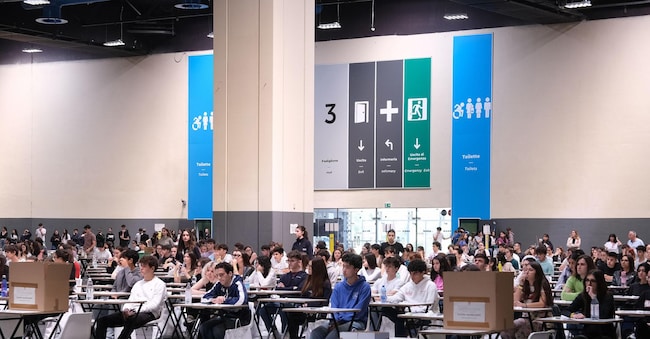
Each candidate who attended 51% of the courses for the three core subjects of the first semester could decide which and how many exams to take by registering by 15 November. For each test there will be 45 minutes with 15 between each one. Answers will be worth one point if correct; zero if not given and -0.1 if incorrect. For the exam to be considered passed, you will need to score 18 and the maximum will be honours by correctly answering the 31 questions (15 multiple choice and 16 completion).
How many try first appeal
On average, 87% of the 62,238 enrolled in the first semester, which is open as of this year, will attempt the exam. In some universities, everyone, or almost everyone, is taking part. As in Genoa, where 979 out of 979 enrolled will take the three tests. In contrast to the situation at La Sapienza in Rome, where 78% of the total will take the biology and chemistry exams and 73% the physics one. This means that around 1,000 people have not booked and, therefore, will have to do so at the second - and last - call on 10 December to enter the second semester.
Fullest classrooms
The classrooms of the Sapienza, which has 1,887 places available, will however be the most full, with around four thousand students attempting the tests. They are followed by Federico II in Naples and the universities of Milan and Padua, with more than 3,100 enrolled. In the latter two, at least at a flat rate, it will be more complicated to get in, since around 700 students will be admitted. It must be remembered, however, that this is only the first choice and that therefore, in the event of exclusion, there is the possibility of entering another university of the ten indicated by each aspiring doctor according to their position in the ranking list.
Universities with less 'competition'
There are cases where the number of enrolled students is not so far off the number of admitted students. At the Parthenope University of Naples, there are 88 enrolled students and 88 places available. High percentages also in the universities of Molise (267 enrolled and 192 places) Messina (1119 enrolled and 770 places), Camerino (96 enrolled and 65 places) and Siena (476 enrolled and 305 places).

