

Mediterranean: 43 countries renew their commitment to cooperation, with the focus on security, climate and development
In Barcelona, the 11th Regional Forum of the Union for the Mediterranean brings together the 27 EU Member States and the 16 countries on the southern and eastern shores. On the agenda are conflicts, water resource management, civil protection, migration and economic disparities. The aim is to turn political dialogue into concrete projects.

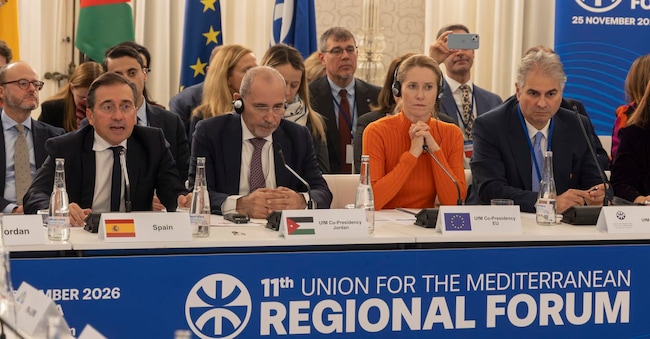
Cooperation between the two shores of the Mediterranean is back at the centre of the European diplomatic agenda. Representatives from the 43 countries of the Union for the Mediterranean (UpM) have gathered in Barcelona for the organisation’s 11th Regional Forum, at a time marked by conflict, political instability, economic disparities and the increasingly evident consequences of climate change. The meeting, which coincides with the 30th anniversary of the Barcelona Process (also known as the Euro-Mediterranean Partnership, a strategy for political, economic and cultural cooperation launched by the European Union with the countries of the Mediterranean basin during the conference of 27 and 28 November 1995; in 2008 it evolved into the Union for the Mediterranean), provided an opportunity to take stock of the initiatives launched over the past year and to revitalise the Euro-Mediterranean Partnership.
The meeting was attended by the 27 Member States of the European Union and the 16 countries of the southern and eastern Mediterranean that are members of the organisation. The meeting was co-chaired by Kaja Kallas, the EU’s High Representative for Foreign Affairs and Security Policy, and by Ayman Safadi, Deputy Prime Minister and Minister for Foreign Affairs of Jordan. Also in attendance were Fadi Hajali, Acting Secretary-General of the UfM, and Dubravka Šuica, European Commissioner for the Mediterranean. The meeting was hosted by José Manuel Albares, the Spanish Foreign Minister.
The discussion focused on the prospects for the partnership one year on from the adoption of the Pact for the Mediterranean and the UfM Strategic Vision . These two instruments aim to give greater substance to regional cooperation in an area where political and military crises are intertwined with structural problems relating to employment, energy security, the availability of resources and economic growth.
From water management to civil protection: the projects on the table
Among the achievements claimed by the organisation over the past year is the Rome Water Initiative, designed to facilitate technical assistance to countries in the region in the sustainable management of water resources. The programme also supports the planning and funding stages of projects, in a Mediterranean region increasingly exposed to drought and pressure on water reserves.
Another area of focus concerns emergency management. The UfM has begun establishing a regional mechanism for disaster prevention and response through the Civil Protection Action Plan 2030. The project includes the establishment of a permanent centre for air operations and training in Paphos, Cyprus, with the aim of improving coordination between countries in the event of fires, natural disasters and other crisis situations.

