Science

Mediterranean summer: what really ignites marine heatwaves

According to a study published in Nature, it is not the heat itself that triggers marine heatwaves, but its persistence.

2' min read

2' min read

The Mediterranean in summer turns into an open-air laboratory. It is not the heat itself that triggers marine heatwaves, but its persistence.

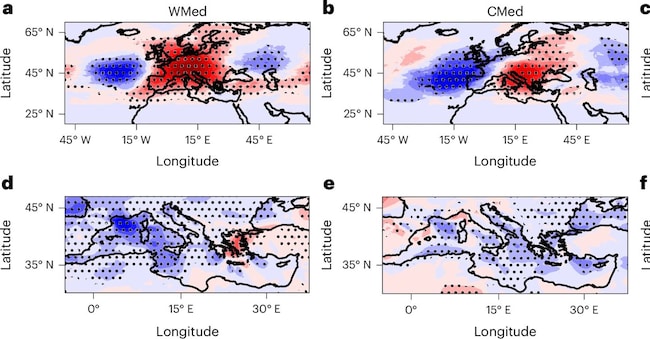
This is according to a study published in Nature Geoscience that for the first time clearly identifies what activates Marine HeatWaves (MHW) in the Mediterranean Sea.

Loading...

Areas of high pressure from Africa, in which hot, dry air tends to descend, bringing fine weather and atmospheric stability, can stay for up to five consecutive days over the Mediterranean Sea, until the winds stop and the surface waters warm up: this is how the heatwaves that are increasingly affecting the Mediterranean are born.

Without ventilation, the sea retains heat like a cauldron left on a low-flame fire, rapidly heating up until it exceeds critical thresholds.

Working as a team, oceanographers and meteorologists analysed data collected over 40 years, from 1982 to 2022, on 123 major marine heatwave events over an area of more than 100,000 square kilometres. They found that marine heatwaves in the Mediterranean are four to five times more likely to occur when they coincide with weak winds.

In the western Mediterranean, almost two thirds of heat waves coincide with these situations. In the central basin, half. In the east just over four out of ten.

One example is enough to understand the scale. In the Gulf of Lion, off the coast of France, in a recent wave, the underwater temperature rose by almost seven degrees in forty-eight hours. Such a rapid change leaves many marine species, from corals to gorgonians, defenceless. The mass mortality observed in recent years finds a concrete physical explanation here.

The practical value of the discovery is that it is no longer just a matter of statistics. A clear mechanism has been identified: persistent high pressure plus weak wind equals a sea that cannot disperse heat. The result now lays the foundation for more accurate forecasting systems, which could help protect marine ecosystems from future extreme events. Given that the Mediterranean warms up faster than the global average, knowing precisely when a heat wave is about to hit becomes essential

Copyright reserved ©
  • Luca Tremolada

    Luca TremoladaGiornalista

    Luogo: Milano via Monte Rosa 91

    Lingue parlate: Inglese, Francese

    Argomenti: Tecnologia, scienza, finanza, startup, dati

    Premi: Premio Gabriele Lanfredini sull’informazione; Premio giornalistico State Street, categoria "Innovation"; DStars 2019, categoria journalism

Loading...

Brand connect

Loading...

Newsletter

Notizie e approfondimenti sugli avvenimenti politici, economici e finanziari.

Iscriviti