
Meloni prepares debut with Merz. Summit with ministers: energy and industry on the table
Tuesday the point at Palazzo Chigi: the premier wants to propose 'concrete measures' to cut energy costs. Distances with Macron, starting with free trade agreements

Key points
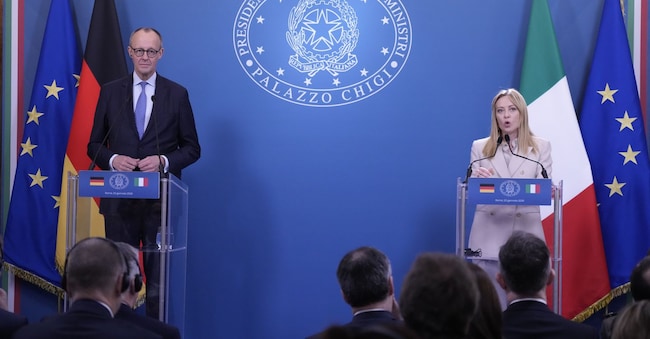
While Europe waits to understand the outcome of the pre-summit convened by Italia and Germany, with the support of Belgium, in view of the retreat on competitiveness to be held tomorrow at Alden Biesen Castle - "The states are free to meet, we will see what the objective of the meeting will be," explained a senior EU official - Giorgia Meloni is enjoying the victory of what she considers only the first round of the game: having replaced Rome in Paris in the preferential relationship with Berlin.
The point with ministers at Palazzo Chigi
Yesterday at Palazzo Chigi, the Prime Minister chaired a summit with Antonio Tajani (Foreign Affairs) and Giancarlo Giorgetti (Economy), Tommaso Foti (European Affairs, Pnrr and Cohesion), Adolfo Urso (Enterprise) and Gilberto Pichetto Fratin (Environment) to take stock of the dossier and consolidate his mandate. The intention is to propose concrete measures to help lower costs, starting with energy costs. On the table, interventions on the revenue from Ets auctions and a revision of the Cbam (Carbon Border Adjustment Mechanism) to prevent the prices of non-EU products from rising when entering Europe. Competition and parcel tax are also among the topics addressed.
The German-Italian document on competitiveness
At Alden Biesen, however, the starting point will be the document on competitiveness, anticipated on these pages on 22 January and shared by the Italian prime minister and the German chancellor Friedrich Merz during the intergovernmental summit on 23 January at Villa Pamphilj. Because it is not just a proposal to the other partners by the governments of Europe's two main manufacturing powers, to the tune of simplifications and monitoring of the legislative process, the dismantling of internal barriers, attention to SMEs, concentration on areas with the highest added value, a push to the single market for capital, energy, digital and Tlc, the establishment of a 28th regulatory regime for innovative companies, and the rapid implementation of the principle of technological neutrality in the automotive sector.
A political manifesto
The document is, also and above all, a political manifesto that goes in the opposite direction to Emmanuel Macron's recipe for a 'European awakening' outlined in an interview with Il Sole 24 Ore yesterday. The French president proposes a plan for new common debt to finance defence and technology? Germany closes: more investment is needed, Berlin sources say, but the issue must be addressed 'in the context of the multiannual financial framework', i.e. the EU budget 2028-2034 currently under negotiation. Macron relaunches 'European preference' in procurement, the so-called 'Buy European'? Meloni and Merz favour freeing the EU from 'self-imposed tariffs' and maintaining an open channel both with the United States, preaching 'pragmatism' in relations with Donald Trump, and with other international markets (and looking, after Mercosur, at agreements with India, Asean and Australia). Does the French president not confirm the demise of the Franco-German-Spanish Scaf project for the fighter aircraft of the future? From Rome, the Defence Minister Guido Crosetto stung: 'I don't think that an agreement has been reached on the Gcap (the Italia-United Kingdom-Japan agreement that Germany would now be interested in joining, ed.), I think that a disagreement has been reached on the Fcas'.


