At the National Youth Festival

Meloni cracks down on schools: cap on foreign pupils and burqa ban introduced

The Prime Minister: “We will soon pass the legislation introducing the term ‘liceo’ for technical and vocational schools as well.” Headteachers: the cap on foreign students is a reasonable measure but difficult to implement

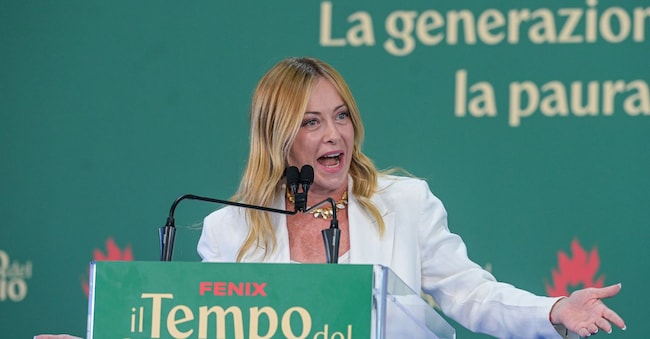
Giorgia Meloni a Fenix. Domenica 20 Settembre. News (Photo by Valentina Stefanelli/Lapresse)   LAPRESSE

10' min read

Translated by AI
Versione italiana

10' min read

Translated by AI
Versione italiana

“A measure is about to be tabled in the Council of Ministers that will legally set a maximum number of foreign pupils per class, introduce an obligation for parents of foreign pupils experiencing serious difficulties with school integration to learn Italian, and ban the burqa and niqab in schools.” The announcement was made by Prime Minister Giorgia Meloni during her speech at Fenix, the event organised in Rome by Gioventù Nazionale.

Headteachers: cap on foreign pupils is a reasonable idea but difficult to implement

According to Antonello Giannelli, president of the National Association of Headteachers (ANP), ‘from an educational point of view, the issue is well-founded and worthy of support, but it is difficult to find a practical solution’. ‘Schools must accept enrolments from local children, especially for nursery and primary schools’ and ‘if the majority of pupils in that area are foreign nationals, what are we to do? Send them away?’ For this reason, the circular setting a 30 per cent cap ‘could not be implemented’.

Loading...

‘We go to school with our faces uncovered; gender equality is non-negotiable’

The Prime Minister emphasised that ‘at school, you go with your face uncovered, and in Italia no one, in the name of a real or supposed tradition, can decide that a young woman should cover herself up. Equality between men and women is non-negotiable. It is not negotiable on our streets, nor is it in our schools’.

‘Italian children must not feel like a minority in the classroom’

“It’s unthinkable, simply unthinkable, that in an Italian classroom there should be Italian children feeling left out in a corner because they’ve become the minority. That simply cannot happen,” Meloni emphasised from the stage at Fenix. A child, she added, “must learn our language, get to know our culture and respect our rules. That is the only proper way to welcome them.”

That is why the Prime Minister has announced the introduction of a rule setting a maximum number of foreign pupils per class: ‘If there is just one child in a class who does not understand Italian, that child will probably manage, with the help of their classmates and teachers, to learn the language and integrate quickly. However, if the number of children who do not understand the language of instruction becomes large, or even forms the majority, that is no longer integration; that is neglect. And the only thing those children are likely to learn is marginalisation.’

Technical and vocational schools will also be known as ‘licei’

Still on the subject of schools, Meloni has revealed another upcoming change: ‘I am proud to announce that we will soon be passing the legislation introducing the term “liceo” for technical and vocational schools as well, because we want it to be clear from the name itself that these schools are of equal value and that the people who attend them are of equal value.’

‘Things are starting to change in the workplace, but it’s not enough – we need to keep young people here’

“Things are changing,” Meloni pointed out, “particularly in the labour market. Youth unemployment is at an all-time low, the number of workers in permanent roles is rising, and precarious employment is falling. Five years after graduating, nine out of ten graduates find a job. The number of young people who are neither in education nor employment has almost halved compared with 10 years ago. It’s not enough – I have to say it, I want to say it – it’s not enough.” “Our aim,” the Prime Minister emphasised, “must be to make Italia the place where people come to or return to, rather than the place they leave; the place where choosing to stay is no longer an act of courage but a competitive choice. And this, in my view, is the yardstick by which we must judge and challenge ourselves. When a young person stays in Italia because it is in their best interests to do so, and not because they were unable to leave, then on that day we will have succeeded.”

‘We have made a record investment,’ claimed Meloni, ‘to enable nearly 270,000 young people to undertake civil service, to do so in Italia, of course, but also abroad, and to have that experience certified so they can use it to gain access to the 15 per cent quota in public sector recruitment competitions. So far, so good. The problem arises when leaving is not a free choice, but the only option that seems possible to have your worth recognised. A nation that believes in itself cannot allow this to happen. And it is clear that to retain or bring back our talented people, we need higher wages, more suitable job opportunities, a greater emphasis on meritocracy, more efficient public services, investment, competitiveness and the right to housing. It is no easy task. And in recent years we have tried to work on all these fronts at national level. In particular, we have done so in the southern regions, which, more than any other part of the country, are paying the price of youth depopulation. I am thinking of the cuts to income tax, the incentives for permanent contracts, the ‘Piano Casa’ housing scheme, the increase in investment spending, and the single Special Economic Zone (ZES) in the South.’

‘Vehicle tax? It’s not true that the regions will pay’

Meloni also returned to the subject of the suspension of road tax for cars up to 80 kW and for motorbikes, which was agreed by the Council of Ministers for the time being only for 2027 but with the promise of making it a permanent measure: ‘I also owe a response to certain regional presidents from the left – the Five Star Movement and the PD – who have said: “Meloni’s election campaign is being funded by the regions”, referring to the fact that we would be taking the resources needed to cover the road tax exemption away from the regions, which is false. And we have already amply demonstrated, stated and reiterated this, and they know it full well, but they are used to playing politics like this.”

A dedicated account for those who still want to pay their road tax

‘Not even when we scrapped road tax for 14 million vehicles,’ Meloni continued, ‘did they take it well,’ she remarked in another passage, referring to the opposition. ‘There was a time when we thought we could all sing together, “Goodbye road tax, goodbye road tax”, but no – they couldn’t even stomach that. They want to pay the road tax; they want to pay it because we abolished it. We’ll set up a dedicated bank account for those nostalgic for the road tax, so they can pay it,” she added ironically.

Loading...

‘Is the Left calling it an electoral ploy following the superbonus fiasco?’

The Prime Minister also responded to accusations from the opposition that the decision to scrap the car tax was an electoral ploy. ‘Do you really have the nerve to talk about election campaigns after the farce of the superbonus? After you’ve racked up 200 billion in debt that you’ve dumped on these young people, and on the government that followed yours, so that Giuseppe Conte could go round campaigning and saying that houses were being renovated for free. Have you no shame! It takes some nerve,” the Prime Minister retorted.

A dig at Schlein: ‘Find something true to say, and I’ll slip it to you under the table’

She then launched a direct attack on PD secretary Elly Schlein: ‘We have raised the ordinary university funding allocation to its highest level ever – the fund used to pay lecturers and staff, maintain facilities, open new lecture theatres, carry out maintenance and fund student services. Today the fund stands at 9.4 billion euros, which is 25 per cent more than in 2019, and you’ll forgive me for being so matter-of-fact, but I’ve heard the Democratic Party secretary, Elly Schlein, say just in the last few days that Meloni is cutting university funding and opening the door to private providers. Now I want to ask: Elly, my dear, my very dear, is it possible that you cannot find a single genuine argument to challenge this? Just one genuine one, please. I’ll give them to you, I’ll give them to you if you like, because we’re imperfect too, but please, just once, give me a genuine one. Just one, please! I’ll slip them to you under the table. We make mistakes too, but a genuine one… She just can’t manage it. How can we be cutting university funding when the funding pot today stands at 9.4 billion and, when we took office, it was 8.6? And everyone knows I’m no maths whizz, but even I can work that out. You can’t just oppose everything like this.’

‘As we head towards the election, beware of those around the world who do not want a strong Italia and a free leader’

‘Algorithms can slander you, but they cannot override you. And look, I say this with full knowledge of the facts; I say this on the eve of an election campaign in which we will see at work the tools of all those around the world who do not want a strong democracy, a strong Italia or a free leader. We shall see,’ explained Meloni. ‘And I say this also because – she added – if I may offer you some advice, do not automatically take anything you see in the coming months at face value, and particularly not anything you see in the final days before the vote in the forthcoming general election.’

‘Platforms must take responsibility for restrictions on social media’

“It is the platforms that must take the lion’s share of the responsibility, because they are the ones with the tools to remove many of the mechanisms that create addiction among young people,” Meloni stated, speaking about the debate on restrictions on social media.

‘It is not true, as I hear some members of the left claiming, that we blocked the cross-party proposal for a moratorium on the use of social media by young children. Quite the contrary,’ she added, ‘we refrained from taking government action precisely because Parliament was already discussing the matter. Personally, I merely pointed out that a measure of this kind will only work if we do not simply introduce bans that are easily circumvented or shift the entire burden onto families. It is the platforms that must take on the bulk of the responsibility, because they are the ones with the tools to remove many of the mechanisms that create addiction amongst young people’. ‘I have simply raised practical issues that are not easy to resolve, the main one being: how do you verify users’ ages without forcing everyone to provide proof of identity to access a social network? A situation which – she concluded – would clearly amount to the largest-scale registration of citizens ever imagined. These are real problems, because the issue is there, but the solutions are less straightforward than they may seem to some.’

‘1968 was a failure; for decades, we were taught nothing but lies at school’

‘For decades, because of a certain brand of do-goodism, the Italian school system has been afraid to tell the truth. It was forbidden to say ‘you’ve got it wrong’, forbidden to say ‘that’s not right’, and so on. They tried to convince us that this was the right way to educate; they called it respect, but that is not education and it is not respect – it is a lie,” said Meloni. ‘A lie that a young person very often pays the price for, perhaps years later, during a job interview, when it is already too late to make up for it. And bear in mind,” she added, “that the hefty price was not paid by those who had the financial means to find elsewhere what the Italian school system could not guarantee – when it was not provided by high-quality private tuition, elite courses or study holidays abroad. No, the price was paid by those who, in order to grow and make their mark, could rely solely on state schools. So I’ve said it before and I’ll say it again, I’ve said it before and I’ll say it again: this was the greatest failure of ’68. This was the greatest failure of a revolution that began with the aim of building a school for everyone and by everyone, and ended up producing the exact opposite.”

Rejecting the so-called ‘success model’ that suggests there’s no need to study or ask questions

‘Essentially, only one ability will remain: the ability to distinguish between right and wrong, between true and false, between what is real and what is artificial. And the point is that cultivating this ability will require more than just rote learning. A nation that teaches only facts will, in less than 10 years, find itself having produced a generation that is perfectly replaceable – highly skilled at doing things that a machine can do better, much faster and often for free. But a nation that shapes the individual will not. And this is why free will, merit, responsibility and truth are not words of the past; indeed, they are the only words I can make out when I look to the future,” said Meloni, speaking about artificial intelligence and social media. ‘However, these concepts are diametrically opposed to those they are selling you. You are bombarded,’ she added, ‘by a model of success that simply does not exist – one in which there is no need to ask questions, to study, to develop skills; no need to queue up, no need to make mistakes, no need to start again; you don’t need to prove your worth; you just need to show that you possess something of value; you just need to be seen by as many people as possible; you need to sell – or even sell yourself’.”

‘You’d rather belong than look the part’

Addressing the audience at Gioventù Nazionale, Meloni stated that ‘at a time when everyone tells you that you must, above all, make an impression, you have chosen to belong. These are two very different concepts. Making an impression is quick; belonging takes time and requires sacrifice. You can make an impression on your own, but you certainly cannot belong on your own. Making an impression requires you to be seen; belonging requires you to be there – and, above all, to be there when the spotlight fades’.

“There’s not a single word’s difference between ‘appearing’ and ‘belonging’; what changes is the way we exist in the world, the way we value our time, and the way we build relationships with others,” added Meloni, explaining that ‘it is along this fault line that much of the way your generation is portrayed, represented and, above all, misled lies’. ‘As if being visible meant being recognised, as if collecting ‘likes’ meant building bonds, as if having an audience were the same as having a community. It is not the same thing,’ she emphasised. ‘It is not the same thing because when you have a community, there is someone willing to tell you the truth; there is someone willing to tell you the truth even when that truth is not what you’d like to hear, even if it’s not what you want, simply because it’s good for you to hear that truth.’

‘Tajani on women and skirts? It was a poorly worded remark; I wouldn’t make a big deal of it’

When reporters asked her, on the sidelines of her speech, for a comment on the remarks made by Antonio Tajani during the ‘Itaca’ event, Meloni replied: ‘I think it was simply a slip of the tongue; I wouldn’t make a big deal of it.’

Copyright reserved ©
Loading...

Brand connect

Loading...

Newsletter

Notizie e approfondimenti sugli avvenimenti politici, economici e finanziari.

Iscriviti