
Mercedes-Benz suffers China: profits down and estimates revised downwards
The German manufacturer expects an adjusted operating margin in the range of 10-11%, down from the previous target of 10-12%.

2' min read
2' min read
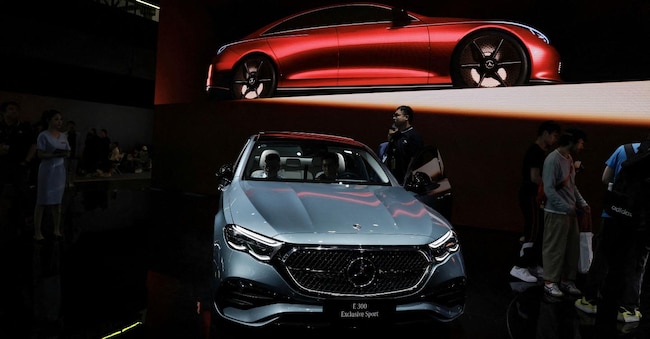
Mercedes-Benz Group lowered its annual operating margin estimates in light of weak, albeit in line with expectations, sales figures and second-quarter profits, but is betting on new models to keep up with strong competition in China in the second half of the year. The group reported a 27.5% drop in adjusted profits for its auto division in the second quarter, against the LSEG estimate of a 26% decline. The three-pointed star also reported a 6% drop in sales in the first half of the year, with battery-powered vehicles down 17% (plug-in hybrids up 16%). Ebit -35% to 5 billion for Mercedes cars and 1.7 billion (+12%) for vans.
For this year, therefore, the Stuttgart-based company expects an adjusted operating margin in the region of 10-11% (after 9.9% in the first half of the year versus 14.3% in 2023), down slightly from the previous target of 10-12%. Stocks under pressure in Frankfurt, hurting at the start (but then recovering) also on the back of a week that saw many competitors present disappointing results with dramatic sessions, from Stellantis to Porsche and Tesla, from Ford to Nissan.
All German biggies are struggling withpoor demand for electric vehicles, coupled with intense competition in China, supply bottlenecks and persistently high interest rates. Mercedes said it expects sales of plug-in hybrids, which together with plug-in hybrids (Hev and Mhev) are more popular with the general public, both in Europe and the US, to increase in the second half of 2024. The Stuttgart-based manufacturer has scaled back electrification plans, while it will focus more on the lucrative line of internal combustion engine (ICE) cars.
CEO Ola Källenius confirmed to investors that the group - which he has led since May 2019 - will continue to adopta flexible approach to offer consumers both Ice and electric models, depending on demand. A flexible and cautious approach, as the economic outlook is marked by uncertainty, the German manufacturer emphasised, adding that it has nevertheless seen an improvement in market sentiment in Europe and 'solid momentum' for sales and demand in the US market. And the house of the three-pointed star is not shying away from competing with numerous competitors in China, a market (the world's largest) with a high rate of adoption of electric models. "It is a race to be in," said Källenius.


