
Merz, good the second: confidence in the Bundestag for the leader of the Conservatives after coming close to a debacle
The Prime Ministerial candidate obtained the necessary majority in the Lower House for his coalition government between Cdu-Csu and Spd. In the morning he had failed
from our correspondent Gianluca Di Donfrancesco
 Aggiungi Il Sole 24 Ore
ai preferiti su Google
4' min read
4' min read
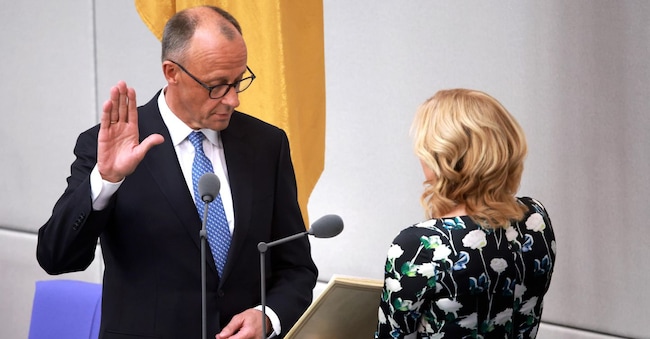
Friedrich Merz did it, at the second attempt, but he did it: he will be the next German chancellor. At the first attempt he failed to gain confidence in the Bundestag by six votes, stopping at 310 out of the 316 needed. Hours of negotiations and on the afternoon of 6 May a new attempt: absolute majority passed with 325 votes for his coalition government between the Union of Conservatives Cdu-Csu and the Social Democrats. Still an unthinkable situation on the eve of the election. For the first time since the Second World War, a candidate for chancellor failed in his first attempt.
The twist
.In the morning session, the call to vote proceeds quickly and closes at 9:35. The result, some thirty minutes later, is greeted by a silence full of disbelief. On paper, the red-black coalition could count on a reduced majority: 328 seats (208 for the Cdu-Csu and 120 for the Spd) compared to the required 316 votes. Merz only got 310 while 307 deputies said no. There were 621 votes out of 630, one was annulled and three MPs abstained.
There was an immediate hunt for snipers, covered by the secret ballot. In the Union almost everyone is looking in the camp of the social democrats. In the SPD almost everyone is convinced of the opposite and points the finger at the Cdu-Csu. Merz, however, keeps calm and with him his party leadership. They do not waste a second and dive to work to organise a second vote in the afternoon. To do so, a two-thirds majority in the House is needed: all groups agree. But theopposition of the ultra-right is not enough.
Shortly after 3.30 p.m., the second half of a match that no one in Germany thought they would see. The now former Spd Chancellor, Olaf Scholz, goes to shake hands with his rival. The bitter clash of the election campaign and the past legislature is behind him. Scholz is the first to congratulate when Merz overturns the result: it is 4.17 p.m., the result of the secret ballot is greeted by applause full of relief.
The Path
.And even before the old Bundestag was dissolved, at the end of March, Merz had already secured a historic result, the reform of the debt brake, the taboo set in the German Constitution. A breakthrough first and foremost with respect to his own positions and those of the Union, which had always sided with the defence of the constraint, and which handed the nascent government an enormous dowry to manage: 500 billion euros to invest in Germany's neglected infrastructure over 12 years and the green light for potentially unlimited defence spending.


